|
 |
|
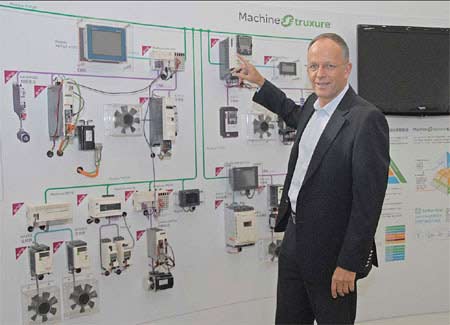
Patrick Gaonach, China senior vice-president of strategy and business development at Schneider Electric, says going green is a trend among Chinese cities. Geng Feifei / China Daily |
French electrical engineering giant is cashing in on the push for greater efficiency in China
Every working day exactly 15 minutes after staff at Schneider Electric's China headquarters in Beijing are supposed to knock off, lights in the building go out. Those who need to work late have to turn on the lights in their work area.
It is that kind of attention to energy-saving detail that has helped the French energy management company reduce power use in its Beijing building from 160 kW/h a square meter a year in 2009 to 105 kW/h a square meter a year in 2011, and it says it expects to have that down to 90 kW/h in 2014.
Increasing the energy efficiency of buildings is one of Schneider Electric's strong suits, but to strengthen its position in energy management it now has its eyes set on a bigger picture: it wants to provide smart solutions to make cities more sustainable, efficient and livable.
"It doesn't make sense to be leaders in energy management if we cannot address expectations and challenges cities are facing today," says Patrick Gaonach, China senior vice-president of strategy and business development at Schneider Electric.
"And China will represent a big proportion of this new market for us due to the number of its cities and the challenges they have."
Starting this year, Schneider Electric has been gearing up to carry on its Smart City Solutions, which is set to use different kinds of smart technologies to efficiently manage cities' resources - from energy to the environment, from water to space.
Gaonach says that while cities make up only about 2 percent of the Earth's surface, they account for half of the population, 75 percent of energy consumption and 80 percent of carbon emissions.
"As everyone wonders how to meet the growing demand for energy and resources, while drastically reducing global carbon emissions, one thing is clear: This challenge will be won or lost in the cities," says Gaonach, who has worked for Schneider Electric for about 25 years.
In keeping with that approach, Schneider Electric is working with about 230 cities and regions on projects to help them improve the efficiency and sustainability of all urban infrastructures, yield better and more integrated mobility management, meet ambitious environmental goals, and yet remain affordable to cities' stretched budgets.
Schneider Electric has many projects on its plate in Europe, and more in the United States, but of all countries, China probably has the strongest political will to make cities sustainable, Gaonach says. He also sees it as having the most potential in this new market.
The scale and pace of urban expansion in China is unprecedented. Last year, for the first time, more than half of its 1.3 billion people were classified as urban.
According to a McKinsey Global Institute report last year, "Mapping the Economic Power of Cities", by 2025 as many as 100 of the world's top 600 cities are expected to be in China.
"Going green is definitely a trend among Chinese cities, no matter big or small," Gaonach says. "With the rapid development, cities also want to be more cost effective not only in building those cost intensive infrastructures but also in operating and maintaining them.
"Last but not least, citizens in China are now becoming more and more demanding; they want the cities to be more convenient and livable."
Such demands are broad, he says, his company is providing solutions in various segments, be it in power grids, transport, water, public service or buildings and homes.
"For sure it is quite a significant move for Schneider Electric, which is moving from hardware and software provider to more and more integrated solutions. But this is a strategic direction we are taking to better meet the needs of our key stakeholders in China."
To achieve the goal, Schneider Electric, which reported sales of 22.4 billion euros ($29.2 billion) last year, aggressively acquired many leading IT solution providers in 2011, including Telvent of Spain. Schneider Electric says converging information and communications technologies and energy is now the big international trend.
By strategically applying information and communications technologies, cities can tackle challenges, such as implementing cycle and car rental schemes to get vehicles off the road, and building performance monitoring to drive down peak demand.
According to the report "Smart 2020", published by Accenture last year, deploying smart technologies in areas such as electricity grids, transport, logistics, buildings and industrial motors could save 15 percent of global emissions in 2020, and about $900 billion a year by then in energy savings to global industry.
Gaonach says the company has many opportunities in China. "What we are trying to do is to be more selective in partnerships and take a step-by-step approach."
The company has about 50 SmartCity projects in China, each focusing on one or two specific domains rather than the integrated solution Schneider Electric can offer, Gaonach says, and about 10 of those cities will become long-term strategic partners with Schneider Electric.
The partnership requires extensive collaboration between local government, private companies and investors in which people from different backgrounds need to jointly work out funding models and sustainable development models.
"It is one thing to do a specific project; it is another to become long-term partners, which is much more complicated. We are trying to develop our strategic partners from those cities we have solid, concrete projects with."
The clients are with a mixture of mega cities in China's well-developed coastal areas and emerging cities in the country's inland, he says.
He estimates that the complete makeover of a smart city can take 10 years or even more. "The top priority for us is to develop in China for China solutions. We have a very ambitious research and development plan with a new R&D center being established in China later this year."
Schneider Electric invests 5 percent of its annual revenue in R&D, he says, and a growing proportion of that funding is being put into programs in China.
mengjing@chinadaily.com.cn


Copyright 1995 - . All rights reserved. The content (including but not limited to text, photo, multimedia information, etc) published in this site belongs to China Daily Information Co (CDIC). Without written authorization from CDIC, such content shall not be republished or used in any form. Note: Browsers with 1024*768 or higher resolution are suggested for this site.
License for publishing multimedia online 0108263 Registration Number: 130349