Beijing has to make bigger efforts to maintain pace, says economist
Beijing will have to make a bigger effort in reform during 2013 to make China's GDP grow faster than this year's targeted 7.5 percent, acknowledged a senior government economist.
Economists are beginning to forecast the country's performance next year, now that its GDP growth was recently reported to be 7.4 percent year-on-year in the third quarter, and is expected to pick up somewhat in the fourth.
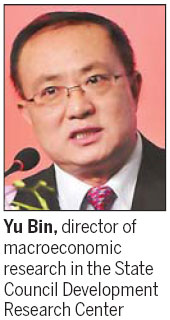 |
"China is entering a stage of economic re-balancing, which means the existing growth engines are weakening while the new driving forces are still taking shape," Yu said on Friday.
It wouldn't be a surprise if the country cannot repeat its record of annualized 10 percent growth as seen in the past decade, he explained.
In the meantime, the country is still in a transitional process before it reaches its "next breakthrough" in the reform in such industries as energy, transportation and agriculture.
The key of future reform, he said, is to encourage free competition, including more flexible prices and more active investment of private capital, so that the economy can become more efficient as a whole, the economist said prior to the 18th National Congress of the Communist Party of China.
The meeting is scheduled to begin on Nov 8 in Beijing. It is expected to be a milestone to mark the succession of the CPC top leadership team to lead the country's future reform initiatives.
As for the real estate market, the State Council economist said a more differentiated policy may come into practice in 2013 to take into account the various situations in different regions. But the current control of the commercial housing market should remain consistent to "prevent a comeback of asset bubbles", he said.
Yu also said China will have to strengthen its fiscal spending on infrastructure development to maintain the economy's overall level of investment in 2013.
As the world's second-largest economy, China saw an extension of the downside risk in the third quarter this year from the beginning of 2011. Fewer export orders, among other things, has led to a decline in GDP growth for 14 consecutive quarters.
The country's exports may see some recovery in the last quarter, as the recent monetary easing in the United States and Europe may help stabilize financial markets and boost consumption, Yu said.
But he added that "in our outlook for the next year, as the global recession still lingers on, it is unlikely that China's export volume will see a strong recovery".
In order to lift investor confidence, the European Central Bank released its new bond-buying program in September, and the US has started its third round of qualitative easing, which may give rise to new pressure on inflation and accelerate the flow of "hot money" into the emerging economies, he said.
Yu expected China's inflation for 2013 to be around 4 percent, based on a rise in commodity prices and the Producer Price Index, a measure of inflation in producer goods. Thus Beijing "should remain prudent" in managing its monetary policy, in order to prevent a surge in inflation.
On Friday, China's yuan appreciated to a 19-year high against the dollar, the second day to reach the upper limit of the People's Bank of China trading range, after the HSBC preliminary indicator of manufacturing activities rebounded in October and economists expected an exports recovery in the fourth quarter.
"We advise the government to keep a close eye on capital flows and keep the currency stable, for the steady growth of exports," Yu said.
The fast rise of the yuan can partly show that global investors still have strong confidence in China.
"The economic growth is slightly on the positive side. I think what is happening in China provides a little bit of comfort to global investors rather than scaring them," said Bruce Kasman, chief economist with JPMorgan.
"A recovery in investment demand, with the help of stronger policy support, should help bring up industrial production after de-stocking runs its course," Wang Tao, the Chinese chief economist from UBS AG, said on Friday.
China's benchmark stock index fell 1.7 percent at Friday's close, as many listed companies released their third-quarter financial results, many showing major losses or drops in profit.
Contact the writer at chenjia1@chinadaily.com.cn


Copyright 1995 - . All rights reserved. The content (including but not limited to text, photo, multimedia information, etc) published in this site belongs to China Daily Information Co (CDIC). Without written authorization from CDIC, such content shall not be republished or used in any form. Note: Browsers with 1024*768 or higher resolution are suggested for this site.
License for publishing multimedia online 0108263 Registration Number: 130349