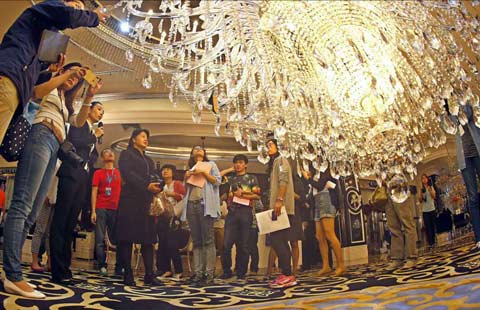
International experience
In modern society, pricing by cost is already old-fashioned, especially when it comes to the service industry, brand experts believe. Instead, "the total experience" is becoming another selling-point-and also money engine- for international gurus.
"You don't calculate the cost and then decide the price, that's really what we did 20 years ago," said Daniel Lutz, senior vice-president of Nestle Ltd, Greater China region. "Today we sell value to customers."
The pricing is actually dependent on consumer expectation, he claims.
"For example, if an ice cream is only for cooling down, you just need to make something from water and sugar, which will be very cheap. But if the customer expectation is to indulge, they would like to pay more for products with milky chocolate and almonds on the top, which can be more expensive than the ingredients cost."
Starbucks and Costa, two coffee chains in China, know how to sell more than just the product.
They focus on relaxation in their Chinese stores. Soft lighting, music and comfortable couches enhance the product they are selling.
China is a country with a tea culture but the atmosphere attracted youngsters.
However, it doesn't come cheap. While a bottled coffee costs only 6 yuan in any convenient store, customers soaking up the atmosphere have to pay 25 to 40 yuan for a cup of coffee in Starbucks or Costa.
Chinese customers love the places so much that they often indulge in the atmosphere all day, sipping coffee and limiting customer turnover.
In the US and Europe, Starbucks is not considered exclusive, said Mike Bastin, a researcher from the School of Contemporary Chinese Studies at Nottingham University.
"But in China, Starbucks means something different because it is a brand from America, and people will easily associate it with a positive American image.
"Urban people like to reward themselves with these slightly expensive products to make them feel different, and exclusive. If Starbucks lowered the price, it might cost the exclusivity of this brand, and it could lose its customers."
Gavin White, group general manager of glo London, a British restaurant and food chain, echoes those sentiments.
Although White was told to vary the offerings to cater to the Chinese customers, he soon found out that customers want authentic British fare.
When they opened their first restaurant in Shanghai last year, customers were roughly 70 percent expats. That situation has totally reversed.
While a regular Chinese restaurant cost 50 to 100 yuan per person for a decent dinner in Shanghai, the average bill for a meal in glo London is 150 to 200 yuan.
White said the pricing principle is "keeping it reasonable while making a decent margin", but he has his own complaints as to the price.
Although there are some importers in Shanghai selling British ingredients, the cost of these goods is very high.
"If you go to a city market where there is imported food, their prices are ridiculous. We have to charge slightly more than we want because of costs."
Indeed, it is not cheap to create international experiences - the rent in first-tier cities is soaring along with the property price, and staffing is getting more and more expensive.
"In terms of staffing, Shanghai is no longer cheaper than London, especially if you are looking for English-speaking staff," White said. "The staff turnover is probably the highest; rent is on par, and we pay more for electricity and gas than we pay in UK."
Gong, the director of Beijing Vogue Glamour Brand Marketing, said higher prices also create a sense of "exclusivity".
"If Starbucks lowers their price, the store will be packed with people using the free Wi-Fi and the same principle applies to Western restaurants. A low price will attract more customers, which will spoil the environment and staff need to work more for the same margin."
Moving down the pyramid
Not all the international brands are lucky enough to charge a premium.
To adapt to the changing market, brands are walking down the altar and shaking hands with the fast-growing middle class in China.
Levi's is such a brand. Ever since it entered China in 2001, its profile seemed to say that it only catered to wealthy people. In its home country, the US, a regular pair of Levi jeans is around $70, and during the sales, customers can easily get a pair for only $15 to $30. But in China a pair of Levi jeans costs typically around $100 to $150. Even during the sales, the Levi brand barely goes under 50 percent off.
In August 2010 it launched a new sister brand called Denizen. Although the company said it was not specially designed for the Chinese market, it chose Shanghai to launch this brand, its first launch of a new product in a foreign country.
A pair of these jeans is priced between 299 yuan to 399 yuan, much cheaper than its sister brand Levi's.
The target customers are younger people between 18 to 35 who are willing to buy international brands but are not yet affluent enough to squander $150 for a pair of jeans.
Terence Tsang, head of the Denizen brand, said the brand targets the middle stratum between the premium and the mass market. While they shop for the Denizen, they also have a chance to know more about the Levi's brand, which they might afford later .
As the clothing products are generally made in China, and they have quite a range of alternative products, it is hard for these brands to price premium in China, Preston from Nielsen said.
"Whether it can pitch the price high is decided by the brand strength. If the brand is strong enough to charge a premium, there is no problem. But if not, they have to adjust their strategy.
"Now it is getting a lot harder for brands to charge a premium unless you have genuine reason to do that."
Not only consumer products, but also service brands are moving down the consumer chain to approach those with a decent income but not yet super-rich. In short, the consuming power of second and third-tier cities has increased.
Philippe Garnier, vice-president of sales and regional marketing APAC, Hilton Worldwide, said they are dedicated to introducing more sister brands in China.
"It is fortunate that everyone knows Hilton, but not a lot of people realize that Hilton have 10 brands, covering a range of products from five-star Hilton to Scandic which targets the medium-income group."
Only recently has Hilton begun to bring those brands into China, Garnier said. "We are opening hotels on a regular basis, and by the end of 2014, we will have 100 hotels in China."
Hilton was among the first hotels to enter China in 1988.
"Our new hotels will be mainly in second-tier cities, because we have already got a very good presence in first-tier cities," Garnier said.
As the brand explores into the second and third-tier cities, the pricing will be adjusted accordingly, he indicates.
Pricing strategies will vary to reflect national conditions, , said Harry Tan, general manager of Days Inn China. While a three-star hotel room in Beijing can easily charge 500 to 600 yuan, a five-star hotel in Jiaozuo, Henan province only charges 300 to 400 yuan.
"Pricing is decided by a number of factors, but the location and the brand are key considerations," said Garnier. "It will be a very dynamic process."
wangchao@chinadaily.com.cn

Copyright 1995 - . All rights reserved. The content (including but not limited to text, photo, multimedia information, etc) published in this site belongs to China Daily Information Co (CDIC). Without written authorization from CDIC, such content shall not be republished or used in any form. Note: Browsers with 1024*768 or higher resolution are suggested for this site.
License for publishing multimedia online 0108263 Registration Number: 130349