Comments()
  Print
Print  Mail
Mail  Large Medium Small
Big advances see convergence across different industries as the world gets mobile
The increasing number of mobile subscriptions and growing penetration of smart devices is shaping the world to become a networked society, according to the chief technology officer of Ericsson.
By 2020, the world is expected to have more than 50 billion connected devices. Convergence is going to happen in different industries, such as telecommunications, data and media communications, said Ulf Ewaldsson, Ericsson's newly appointed CTO.
|
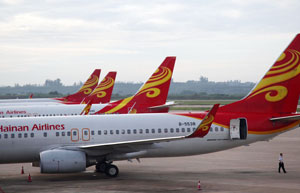
 Although it is a leading player in the world's FDD LTE market, Ericsson has lagged behind Chinese rivals, such as ZTE Corp in terms of TD-LTE network deployment. China's homegrown TD-LTE 4G technology is drawing more attention worldwide. [Photo/China Daily] |
"Take the car manufacturing industry as an example. If the car is not connected to networks, its existence is meaningless. For high-tech companies, no matter what they produce, they are all coming up with a mobile strategy now," said Ewaldsson, who took up his position in February.
In that networked society, the explosive growth of wireless data traffic would pressure telecom operators to deploy more efficient 3G and 4G mobile networks. Because of the scarcity of spectrum resources, China's homegrown TD-LTE 4G technology is going to draw more attention worldwide, he said.
"We have already seen the launch of Long Term Evolution networks in many countries. Most of them adopted FDD LTE technology, but now we see a strong drive for TD-LTE technology as well," Ewaldsson said.
Between the first quarter of 2011 and first quarter this year, the world's data traffic has doubled, according to Ericsson. The mobile data traffic across the globe is expected to grow 15 times in the coming five years, as video transmission becomes a prime driver.
However, there is a shortage of licensed spectrum for deploying more mobile networks. "It is very important (for carriers to choose technologies) adapted in any kind of spectrum situation and find the most efficient solution," he said. "In some cases the FDD solution is better; in some cases TD may be better."
According to a report by the Global Mobile Suppliers Association on Sept 11, a total of 96 operators had launched commercial LTE services in 46 countries. The figure includes 11 commercial TD-LTE systems that launched in nine countries including Australia, Brazil and Japan.
Although it is a leading player in the world's FDD LTE market, Ericsson has lagged behind Chinese rivals, such as ZTE Corp in terms of TD-LTE network deployments. Ewaldsson said his company showed a high interest in TD-LTE and is confident of doing well in the TD-LTE market.
"It (TD-LTE) is just a technology on the way up," he said, indicating Ericsson is going to show potential in that market. He said it is too early to define which company is a winner.
In July, China Mobile Hong Kong, a subsidiary of the world's largest mobile operator China Mobile Ltd, selected Ericsson to build a converged LTE FDD/TD network in Hong Kong.
According to its Traffic and Market Report issued by Ericsson in June, there would be close to 9 billion mobile phone subscriptions worldwide in 2017, up from 6.2 billion at present. In five years, half of the world's population will be covered by 4G LTE networks and up to 85 percent would have Internet coverage via 3G technology, the report predicted.
Smart devices, which are becoming more and more popular, will enjoy a rapid growth rate. The Ericsson report said Smartphone subscriptions would rise to 3 billion by 2017, compared with 700 million at the end of 2011.
During the first half of this year, between 35 and 40 percent of the new phones sold globally were smartphones, Ewaldsson said. "But there is still a long way to go," Ewaldsson added. Of the 6.2 billion mobile subscriptions that have been taken out in the world, only 10 to 15 percent are for smartphones.
The deployment of 3G and 4G wireless networks has allowed smartphone users to surf the Internet more quickly and smoothly using mobile devices. 3G networks are accessible to 45 percent of the world's total population, while 5 percent of the world's population has gained access to 4G networks.
shenjingting@chinadaily.com.cn
Copyright 1995 - 2010 . All rights reserved. The content (including but not limited to text, photo, multimedia information, etc) published in this site belongs to China Daily Information Co (CDIC). Without written authorization from CDIC, such content shall not be republished or used in any form. Note: Browsers with 1024*768 or higher resolution are suggested for this site.
License for publishing multimedia online 0108263 Registration Number: 20100000002731