The world is unlikely to see a repeat of the food crisis of 2007-08 despite the recent rally in grain prices, but potential risks lie ahead if countries fail to coordinate policy and increase long-term agricultural investments.
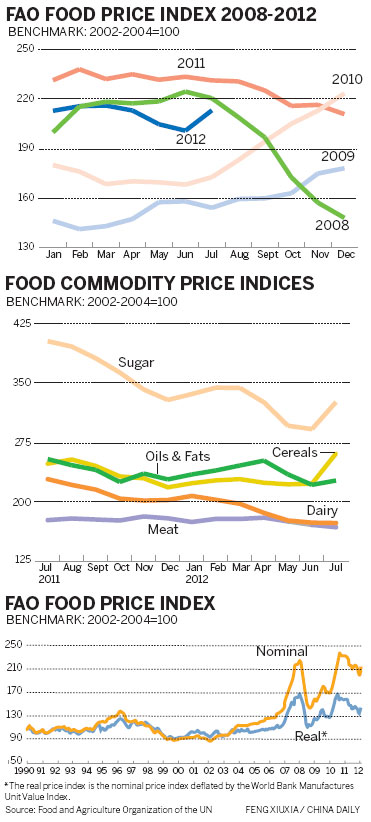
The worst drought in half a century in the United States and poor crops from the Black Sea bread basket have driven up prices of corn, wheat and soybeans, increasing fears of a crisis similar to that in 2007-08 that pushed millions into poverty.
 |
|
Drought-damaged corn is seen in a field near Nickerson, Nebraska, on Thursday. Dry conditions have worsened in the key farming states of Kansas and Nebraska as the worst US drought in decades continues, the latest US national report said. Nati Harnik / Associated Press |
"The overall grain production for 2012-13 is expected to increase by 2 percent, while consumption will increase by 1.8 percent, which means the supply can meet demand," said Zhang Zhongjun, assistant FAO representative in China.
Zhang ruled out the possibility of a food crisis similar to the one in 2007-08, before which grain production had reduced two years in a row.
"The increase of total grain production alone cannot guarantee a stable food price if there is no balanced global food market and well coordinated policy among world countries," Zhang said.
The drought in the US, which dominates the world corn trade, has destroyed one-sixth of the country's expected corn crop, according to the Financial Times.
|
 |
After the hottest July in US history irreparably damaged their crops, the US government estimated corn farmers had abandoned fields greater in area than Belgium and Luxembourg, the newspaper said.
"It's unavoidable to have crop failures as the agricultural industry is easily affected by natural disasters. But the problem is unbalanced production, which is especially vulnerable to risks once a certain region is affected severely by natural disasters with large scale crop failures," Zhang said.
"The world needs better policy coordination in the face of such a situation and a safety net to protect poor countries," Zhang said. "Food aid to poor and heavily affected countries is far from enough."
Countries with low incomes and a serious lack of food, including those in Africa, Bengal and Syria, will be among the worst affected by the increase in food prices, Zhang said.
Policy in grain consumption also needs to be improved, especially the use of corn in the US, Zhang said.
Under the five-year-old Renewable Fuels Standard, US fuel companies are required to ensure that 9 percent of their gasoline pools are made up of ethanol in 2012, which means converting some 40 percent of the corn crop into the bio-fuel, Reuters reported.
This week, 25 US Senators urged the Environmental Protection Agency to adjust the mandate, while the chief executive of grains giant Cargill said the free market should dictate bio-fuel use, it reported.
"It's all right to develop bio-technology, but it needs a reasonable plan. It cannot be developed at the cost of food security," Zhang said.
FAO's Director-General Jose Graziano Da Silva wrote in the Financial Times on Aug 10 that competition for the US corn crop was only going to intensify.
"An immediate, temporary suspension of that mandate would give some respite to the market and allow more of the crop to be channeled toward food and feed uses," he said.
In terms of global trade on grain, Zhang called for all countries to take care of the stability of the whole market, instead of swarming to import and restrict exports once food prices go up.
In the long term, Zhang said the fundamental solution should be to increase investments in agriculture, which lags behind investment in other areas.
"It's predicted that the world population will grow to more than nine billion by 2050. We have enough land and water resources to feed the population as long as sufficient investment is directed to the development of agriculture, especially in poor areas in Africa and Latin America," Zhang said.
Since 2008, efforts to improve productivity and investment in agriculture have improved. The World Bank boosted its investment in agriculture to $9.5 billion a year from $2.5 billion annually in 2008, according to Reuters.
China's output grows
China's grain output has remained higher than 500 million tons annually since 2007, and it grew by 4.5 percent to reach 571 million tons last year, marking eight consecutive years of growth, National Bureau of Statistics figures show.
Despite frequent natural disasters, the output of summer grain in the country reached 129.95 million tons this year, up 3.56 million tons, or 2.8 percent, compared to last year's output, official figures show. Summer harvests account for about 30 percent of the country's annual grain output.
"Due to the successive years of domestic grain harvest, China will not be easily affected by international markets both on grain supply and prices," said Wang Jimin, deputy director of the Chinese Academy of Agricultural Sciences' agricultural economics and development institute.
"Except for a small number of local farmlands that suffered total crop failures because of flood disasters, most parts of the country's arable land benefited from rich rainfall this summer as drought had tortured those areas for a long time," said Li Maosong, a researcher on disaster reduction at the Chinese Academy of Agricultural Sciences.
Noting that China has a large population to feed but limited arable land and fresh water to grow food, Zhang said, "it's not practical to expect China to export large amounts of grain".
The global trade on grain is no more than 300 million tons a year, while China's grain consumption is more than 500 million tons a year, according to Zhang.
"It will be the biggest contribution that China makes to the world if China can feed its own large population without importing large amounts of food when food prices have already been rising on the global market," Zhang said.
Contact the writers at chengguangjin@chinadaily.com.cn and jinzhu@chinadaily.com.cn

Copyright 1995 - . All rights reserved. The content (including but not limited to text, photo, multimedia information, etc) published in this site belongs to China Daily Information Co (CDIC). Without written authorization from CDIC, such content shall not be republished or used in any form. Note: Browsers with 1024*768 or higher resolution are suggested for this site.
License for publishing multimedia online 0108263 Registration Number: 130349