|
 |
|
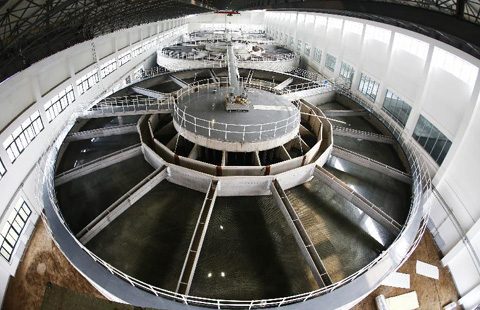
Taierzhuang, famous for its historic sites, has attracted millions of tourists. The local government rebuilt the ancient town by restoring these sites in 2009. The admission price has now more than tripled from its opening of 50 yuan two years ago. [Photo/ China Daily] |
Sector relying too much on expensive tickets, Jiang Xueqing and Li Jing report in Beijing.
Holiday time, and thoughts turn to visiting places of interest and scenic areas to enjoy, at leisure, nature's bounty. But rising admission prices may cast a shadow over such plans. During the Tomb Sweeping holiday in April, the ancient town of Taierzhuang in Zaozhuang, Shandong province, quietly raised holiday ticket prices, for tourists, from 100 yuan ($15.90) to 160 yuan. Taierzhuang is not alone.
From May 8, ticket prices for the Jinggangshan Scenic Area in the southwest of Jiangxi province will go up from 226 yuan per person to 260 yuan.
According to a report in the Beijing News, nearly half of the 130 top-level scenic areas nationally excluding those in Hong Kong, Macao and Taiwan have ticket prices which are now in excess of 100 yuan. About 90 percent of more than 1,000 Internet users said in an online poll that they think a price below 100 yuan is more acceptable.
Tourism experts said the price hike is reasonable, to a certain extent. Commodity and service costs are rising generally. However, government investment in tourist sites is lagging, and this puts the onus on operators to boost income. But the system is not uniform and prices vary.
The public is in the dark.
 |
| [Song Chen / China Daily] |
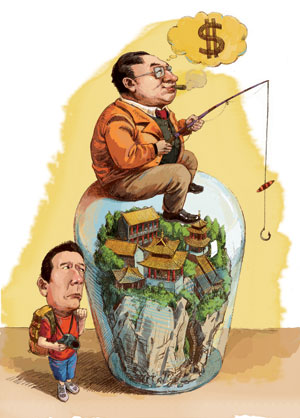
"In theory, scenic areas are public property, but this is a naive viewpoint," said Zhang Lingyun, vice-dean of the tourism institute of Beijing Union University. "In reality, the local government usually treats these natural resources as cash cows to revitalize the local economy."
Taierzhuang was a provincial business center during the Ming (1368-1644) and Qing (1644-1911) dynasties after the route of the Beijing-Hangzhou Grand Canal was changed. It later became a battlefield where the Chinese won a major victory over the Japanese in April 1938 during the War of Resistance against Japanese Aggression (1937-45).
Seeing its tourist potential, the Zaozhuang municipal government launched a project in 2009 to rebuild the ancient town by restoring the docks and renovating its courtyard houses and other historical sites.
The town had a "tourist test run" during the 2010 May Day holiday and received more than 2.4 million visitors by the end of last year.
When the town first opened to tourists the admission price was 50 yuan. This rose later to 70 yuan and more than tripled within two years.
"Zaozhuang used to rely on its rich coal reserves until they fell below 600 million tons in 2006," said Wang Zhan, the publicity officer for the ancient town's administrative committee.
"The city government realized its resources would be exhausted in less than 20 years and turned to tourism."
Billions of yuan were invested and since 2008 nearly 2 billion yuan in tourist cash has arrived.
Wang noted that Zaozhuang had no tour bus and no local tour guides when it decided to become a tourist center but it now has 105 tour buses and 400 local tour guides. Until recently, the city had only 4,700 hotel beds with an occupancy rate lower than 40 percent. During the last three years, the city has seen the arrival of 78 more hotels and 14,000 more hotel beds. Ten five-star hotels have been built or are under construction but they still cannot meet demand.
Publicity
The tourist industry, directly and indirectly, created 100,000 new jobs for the city. Farmers sold more than 200 million salted duck eggs in 2011, for 400 million yuan, Wang said.
To promote tourism in Zaozhuang, the municipal government formed a special office to generate publicity efforts across the country. The government also set a tourist number target for each department, district and site to bring to the city and made evaluations based on their performances.
Every week, the office generates a report on how many advertisements or promotional stories were placed on TV and newspapers, how many publicity posts were made on which Web forums, and how many brochures were distributed to which companies and organizations.
Among more than 20,000 tourism spots in China, income from ticket sales accounts for 30 percent of the total income of the spots on average, said Zhang of the tourism institute of Beijing Union University. For smaller tourism spots, the percentage is even higher.
"The finance of some local government relies heavily on tourism tickets, and therefore the government gives the nod for prices to rise, ignoring the long-term development of tourism spots," said Zhan Dongmei, an expert with the China Tourism Academy.
"Although scenic areas are owned by the central government, they are actually run by the local government. It is not clear who owns the rights or has overall responsibility for these tourism spots, so nobody is held responsible for increasing costs," she continued.
But rising ticket prices are tolerated by a majority of tourists.
Zhang noted that tickets only account for a small part of traveling expenses and therefore people rarely give up their plans simply because a ticket may cost more.
Even if they have to pay 100 percent more for a ticket that previously cost 100 yuan, the increase is, more often than not, accepted.
Besides, the growing demand for people to travel and have a break, especially on weekends and holidays, also helps push up the price. After Taierzhuang raised its prices it still received more than 22,800 visitors on Saturday, April 21.
Lao Yibo, a tourism-planning consultant based in Guangdong province, said most domestic tourism destinations rely too much on admission tickets as a main channel for income.
"And it seems that the ticket price does not have too much of an impact on the number of tourists as there are more people traveling nowadays. As a result, for managers of these tourism destinations, raising ticket prices is the least risky and easiest way to make money.
"However, this is still a beginner's way of developing tourism," he said.
|
 |
|
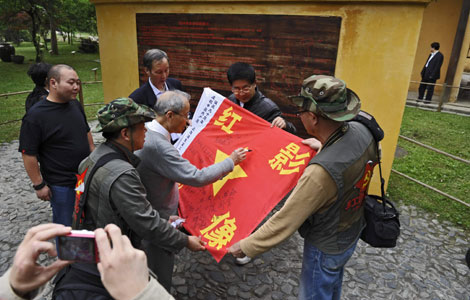
Visitors sign their names on a symbolic Red Army flag in Jinggangshan in the southwest of Jiangxi province. The admission price to the scenic spot will go up from 226 yuan per person to 260 yuan in May. [Photo / China Daily]? |
Discount
In contrast, according to Lao, many tourism sites in other countries are ticket-free, or only a small entrance fee is charged.
For instance, in Japan, the entrance fees for tourist sites are kept deliberately low. People do not need to pay to climb Mount Fuji.
And a majority of museums are also free. But people do need to buy expensive tickets at theme parks, such as Disneyland, as well as commercial shows and exhibitions.
In France, the average ticket price at tourism attractions is about 10 euros ($13.2). The government also has discounts to attract tourists. For instance, the admission for adults to the Louvre Museum is 9.5 euros and free of charge the first Sunday of each month. The museum also has a year pass for 15 euros for youths between 18 and 25.
Government subsidies play a role as do souvenir sales.
"I don't buy souvenirs normally but I bought one very expensive piece in Japan. It was of very high quality, so I didn't hesitate to pay for that," said Lao.
Contact the reporters at jiangxueqing@chinadaily.com.cn or lij@chinadaily.com.cn

Copyright 1995 - . All rights reserved. The content (including but not limited to text, photo, multimedia information, etc) published in this site belongs to China Daily Information Co (CDIC). Without written authorization from CDIC, such content shall not be republished or used in any form. Note: Browsers with 1024*768 or higher resolution are suggested for this site.
License for publishing multimedia online 0108263 Registration Number: 20100000002731