|
|
|
 |
|
|
|||||||||
|
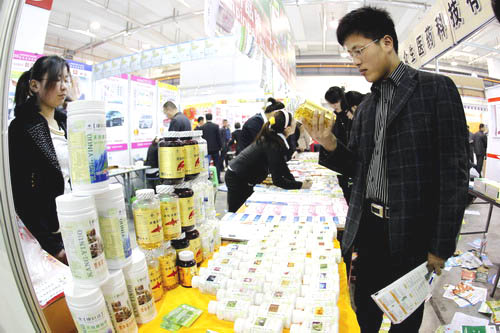 Visitors examine health products at the Jinan Drugs and Health Products Fair in Shandong province on May 17, 2011. China's health products market is projected to be the largest globally in 2015. [Photo/China Daily] |
Middle class quest for better life helps fuel sector's growth
China will use more health products than the United States in 2015, making it the largest market for such products in the world.
|
 Meng Dongping, vice-president of the China Chamber of Commerce for Import & Export of Medicines & Health Products |
In the meantime, the industry will remain one of the most active in China in foreign trade, measured by both imports and exports, she said.
Various Chinese and overseas corporations have moved to meet the demand arising from the country's young middle class, which is becoming increasingly aware of the importance of good health.
The value of the health products and services sector in China is expected to reach 450 billion yuan (more than $70 billion) in 2015. Last year, more than 260 billion yuan in health foods alone were sold in the country, according to the National Development and Reform Commission's Public Nutrition and Development Center.
Meng's forecast, no matter how optimistic it may be, looks modest when it is compared with one made by the China Investment Consulting Co Ltd, which said China won't have to wait until 2015 to use more health products than the US. It will become the largest market for those products this year, the company said.
Why the difference in forecasts?
One reason is that various means of measuring the country's use of health products are in use, each of which looks at different data. Most of them come with no clear definitions of what products and services they take account of and what they don't. But every one of them results in measures that are in the billions in yuan.
One common definition places health products into three groups: products that are made from medicinal herbs and produced according to the principles of traditional Chinese medicine, nutritional supplements made from natural resources and biological extracts made in accordance with the tenets of biology.
In addition, the sale of health improvement devices and services also generates billions of yuan a year; the market research company China Investment Consulting Co Ltd puts the figure at 300 billion yuan a year.
Of the health products in the three groups, those that fall into the first are the most popular, Meng said. They are both natural and, because of their long history, familiar to most customers, she explained.
|
 |
|
 |
Meng said China's large market is attractive to many overseas companies, a fact reflected in the recent rapid increase in the country's imports.
In 2011, China imported health products worth $145 million, up 62.28 percent from a year earlier. "Although the amount is still far from being large enough to match the size of the population, the speed of the increase has been impressive," she said.
She said the most popular health products in China are calcium supplements, fish oil, lecithin, spirulina and compound vitamins.
As international suppliers are swarming into the China market, Chinese companies are also exploring opportunities to expand overseas.
And as more people have become worried about the possible side effects that might come from using chemical compound supplements, they have begun to look with favor on herbal and traditional Chinese therapies, Meng said. She said she expects to see more of those products exported in coming years.
Last year, $206 million in Chinese health products and services were exported, a number that was up by 114.96 percent from 2010. The majority of them went to North America, the European Union, Japan and South Korea.
The accelerating pace in the export of those products stands in marked contrast to what has happened to other Chinese goods, many of which are being affected by a weakening demand from overseas.
Still, Meng expects to see more exports of natural food and herbs, healthcare supplements and traditional Chinese medical equipment, as well as services such as massages and acupuncture.
Guo Fanli, an analyst with China Investment Consulting, said a flood of overseas health products into the Chinese market, especially into large cities, is bound to elicit a reaction from domestic companies.
A group of Chinese pharmaceutical companies, makers of traditional Chinese medicines in particular, have been quick to respond.
Guo said the industry will maintain a double-digit percentage compound growth rate every year over the next five years. Meanwhile, the sale of "products made in accordance with traditional Chinese principles of medical care" will increase at an even faster pace, possibly by up to 30 percent a year, he said.
The Beijing-based Tongrentang, a traditional Chinese medicine producer with more than 300 years of history, has seen its healthcare branch's sales revenue go from 180 million yuan in 2003, when it was first opened, to 5.6 billion yuan in 2011.
During the five years from 2011 to 2015, the company's "development strategy" calls for further developing that healthcare branch, said Mei Qun, company general manager. Meanwhile, the Beijing-based Besunyen Holdings Co Ltd, a health food producer with 11 years of history, has a specialty in producing detox tea and narrow tea bags, which it says have therapeutic functions.
Besunyen was listed on the Hong Kong Stock Exchange in October 2010. In 2011, citing rising costs, it reported a sales decline of 3.9 percent year-on-year to 840 million yuan from 874 million yuan in 2010. It had a net loss of 40.88 million yuan in 2011, compared with a net profit of 59.66 million yuan in 2010.
Among international companies, Amway, a direct seller, has staked out a lead position in the market for healthcare products. Of its 21 billion yuan in sales in 2010, as much as 60 percent came from products such as its Nutrilite health supplements and the international drugmaker Pfizer Inc's Centrum vitamin supplements.
With China's per capita GDP now exceeding $4,000, the country is ready for a new wave of wealth accrual, Gan Chee Eng, CEO for Amway greater China, said recently.
Gan said only 25 percent of Chinese have used health products, and that the country's market for health products contains huge opportunities.
liujie@chinadaily.com.cn