|
|
|
 |
|
|
|||||||||
|
 |
|
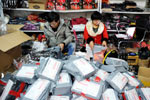
A medical equipment and device exhibition in Jinan, Shandong province. The booming household medical device market has led to fierce competition in major Chinese cities as well as rural areas as international and domestic manufacturers seek to update technologies and offer better services to grab more market share. [Photo / China Daily] |
Multinational companies are not alone in their enthusiasm for China's grassroots market. There is increasingly intense competition in key cities, where domestic players are becoming more competitive with new technologies and products, said Hu of Huatai Securities.
In January, China issued its 12th Five-Year Development Plan for the Medical Equipment Industry, which calls for the government to fund large research and development projects conducted by domestic companies and to support industry consolidation.
So far, the government has provided nearly 1 billion yuan to dozens of R&D projects. It will support the development of 10 to 15 large Chinese medical device companies by providing preferential land and taxation, as well as streamlined product registration and approval procedures and public tender rights. The goal is to build eight to 10 medical device giants, each with an annual output worth more than 5 billion yuan.
Shenzhen-based Mindray Medical International Ltd, set up in 1991, has become one of the top 10 Chinese medical equipment producers by sales. Its annual sales are expected to exceed 10 billion yuan by 2015, according to CEO Liu Jie.
Today, the company's products are found in 95 percent of China's major hospitals; its patient monitoring equipment has ranked first in sales for 11 consecutive years. Its latest product - an iPad-like patient monitor - is selling well, both in China and overseas.
Ten years ago, a patient monitoring device was priced at more than 100,000 yuan. Today it costs no more than 50,000 yuan.
"Foreign giants, which dominated China's high-end (medical device) market, did not want to reduce prices. However, they were forced to do so, because our products have the same quality and are priced lower. If they maintain their high prices, they will lose the market," said Liu.
So far, three top international companies, GE Healthcare, Philips Healthcare, and Siemens Healthcare, occupy about 70 percent of China's high-end medical device market.
Mindray, which does business in more than 100 nations and regions, expects its business to grow faster domestically than overseas.
Better care?
Such advances in technology do not always translate directly into savings or better care for patients, however.
Luo Jiansheng, 56, suffers from cardiovascular disease and usually visits the China-Japan Friendship Hospital in Beijing.
"For a general examination, such as a blood test or an electrocardiogram, the prices have remained relatively stable, compared with the overall inflation of recent years. However, for some complicated tests, such as nuclear magnetic resonance and ultrasonic examinations, the prices have jumped as much as 300 to 400 percent over the last five years," he said.
Luo considered seeing doctors in community clinics or other medium-sized hospitals, but was told that all his tests would need to be done again at the new facility.
"I don't know why I should pay to have the same tests done again and again if I change hospitals," he said.
Li Hongshan, executive vice-president of the Chinese Hospital Association, admitted duplication of services is a problem.
"That's mainly due to the lack of a unified database among medical institutions in China," he said. "On the other hand, we cannot deny that some hospitals are making money (from duplicate examinations)."
In addition to improved medical technologies and devices, many other new products have been developed to make diagnosis more accurate and treatment more targeted. These may help tailor therapies, reducing both the cost and discomfort experienced by patients, Li added.
Profit margins
While technological advances may improve patient care, their profitability remains to be seen.
"Sales at grassroots medical institutions are expected to be about equal to those at major hospitals, since the majority of products sold to rural and community institutions are low cost," said Hu.
Guo predicted the growth in sales to the grassroots market will be higher because of the size of the market and strong government support. However, the government is expected to try to reduce medical care costs, which in turn "forces hospitals to decrease examination charges and purchase equipment... at affordable prices", Guo said.
Rachel Duan of GE Healthcare China said that expansion into the grassroots market will not affect her company's performance, since quality and high cost-efficiency will help guarantee better profits.
"The profit margin of these products will not be lower than that of high-end equipment due to the cost savings brought about by technological development and integration of products and solutions," she said.
Thirty percent of components used by GE Healthcare are purchased from domestic suppliers. The company has three R&D facilities: in Beijing, Wuxi and Chengdu.
Advances in technology will lead to new products and help reduce the cost of traditional equipment, added Bernd Montag of Siemens Healthcare.
Japan-based Toshiba is another of the pioneers to tap China's rural areas. Sales of equipment from Toshiba Medical System (China) Co Ltd in China have been growing at 35 to 40 percent annually since 2007, contributing about 10 percent of Toshiba's global business last year.
"I believe the greatest headaches for multinational companies are distribution, relationships with grassroots government, qualified sales staff and cost reduction," said Li.
liujie@chinadaily.com.cn