|
|
|
 |
|
|
|||||||||
The pilot program that encourages small and medium-sized enterprises to issue bonds in Wenzhou, Zhejiang province, would help ease a credit crunch for many companies. But a lack of regulations and qualified traders, if not properly dealt with, could cause turmoil in a fledgling bond market, according to experts.
A series of financial reforms were announced on Wednesday by the central government that include the rolling out of a high-yield bond market in the city to help smaller businesses find money.
The move "will open funding channels to companies that may have little access to bank loans," said Zhou Dewen, chairman of Wenzhou SME Development Association.
Zhou, whose association oversees more than 800 small and medium-sized enterprises, believes the debt market is instrumental for such enterprises to get direct funding.
"In Western countries, 80 percent of firms obtain funds through issuing bonds, whereas the proportion is just 20 percent in China," Zhou said.
Data from regulators show China's total bond balance at the end of 2011 was 22.1 trillion yuan ($3.5 trillion), compared with $36 trillion in the United States.
According to Sun Lijian, a professor of private economy studies at Fudan University in Shanghai, 80 percent of bonds issued in China are based on State credit and most of the rest are from AAA or AA-rated large companies, which are also effectively risk-free.
In 2011, new issues of enterprise bonds by State-owned enterprises and government agencies totaled 247.3 billion yuan, according to the central bank.
In comparison, SMEs only issued bonds worth 5.2 billion yuan. Sun said the pilot program would lay the ground for the introduction of junk bonds - high-risk but high-yield bonds with low credit ratings - nationwide.
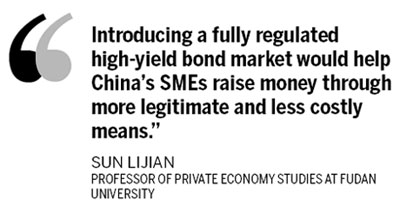
"Introducing a fully regulated high-yield bond market would help China's SMEs raise money through more legitimate and less costly means," Sun said.
Since last year, credit curbs imposed by the government to fight inflation forced smaller companies to turn to unregulated lenders that usually charge higher interest rates.
Small and medium-sized enterprises' borrowing costs exceeded 12 percent and loan rates were 30 to 50 percent higher than the benchmark level set by the central bank, said Zhang Xiaoqiang, vice-chairman of the National Development and Reform Commission.
The green light given to bond issues will provide a level playing field for small and medium-sized enterprises, which are generally not ready, or willing, to reveal confidential information as a prerequisite to listing on the stock market, Sun said.
The bond market will also give investors another means of arranging their portfolios, Sun added.
He said that as the market broadens and more investors are involved, that will eventually improve the sector's cost efficiency.
However, it remains to be seen how much of an appetite the market has for high-yield issues.
The real challenge is to rebuild market confidence in the high-yield sector, and this will require further structural reforms at the issuer level, said Zhang Zhiming, HSBC's head of China research. A functioning bond market needs skilled bond traders able to determine which enterprises have high growth potential, Sun said, but, at the moment, China is short of such talents.
Besides, an SME bond market requires over-the-counter transactions, which have a less standard structure to trade non-standardized products, Sun said.
But the prospects for a sound OTC market seem remote, given the notoriety of the nation's stock market.
And more challenges lie ahead on the regulatory front. Zhou said it still remains to be decided whether the Zhejiang provincial government or the city of Wenzhou holds the right to approve bond issues.
And who will compensate for the losses, should a default occur, also remains open to question.
hewei@chinadaily.com.cn