|
|
|
 |
|
|
|||||||||
|
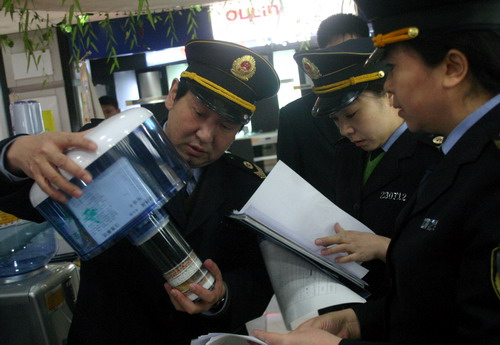 Uniformed officials from the health and epidemic prevention station of Harbin municipal government examining a water purifier at a department store in the capital city of Heilongjiang province. Chinese people's increased awareness of the quality of the water they drink daily is stimulating demand for water purifying products. [Photo / China Daily] |
Water purification is a mammoth business in the country as the population of more than 1.3 billion is more than ever concerned about the quality of what they drink.
China sold 30 million residential water purification systems last year, of which 20 million were purchased by Chinese families. It created a sales revenue of 30 billion yuan ($4.76 billion), according to data from the China Water Purification Association.
"The country's water purification business is promising because people are more conscious of the quality of drinking water. Along with their increasing incomes, an increasing number of Chinese families now intend to buy high-quality water purifiers," said Gu Jiuchuan, secretary-general of the association.
"During 2010 and 2011, sales of our products increased 100 percent," said Wendy Yu, marketing manager of Shanghai Ozner Environmental & Science Co. Yu's company is manufacturing the Ozner-branded water purification system in China and is considering listing in the United States in the next few years.
"People are paying more attention to water safety, especially after several serious water pollution incidents in China," said Yu.
The most recent serious water pollution incident happened in early February in Zhenjiang, Jiangsu province, when phenol leaked into local water sources. The outbreak of blue-green algae in Taihu Lake in 2007 also concerned many Chinese families.
Yu said most people who bought purifiers come from large cities such as Beijing and Shanghai. They have better knowledge and information about water quality.
Many households were likely to install a water purification system after buying a new home and embarking on decorating it, according to a report from Minnesota Mining and Manufacturing Co (3M).
Eyeing the booming market demand in China, makers of water purifiers rushed into the Chinese market to explore business opportunities. According to the China Water Purification Association, there are more than 3,000 companies engaged in the sector, including some foreign brands such as 3M and Philips.
"The majority of water purifier manufacturers are small companies in terms of their production," said Gu of the association.
"The low entry barrier prompted many small companies to rush into the market over the past few years. Acquisitions and mergers are expected in the industry in next three to five years and some small businesses will be squeezed out," said Gu.
Because the government is aware of the need for a nationally recognized standard for water purifiers to assist consumers in making purchasing decisions, some below-standard purifier manufacturers have to make a "life and death" choice to upgrade or quit the market, he said.
During the just-concluded Chinese People's Political Consultative Conference (CPPCC) session, Chinese painter and sculptor Yuan Xikun, who is also a CPPCC National Committee member, called for national standards for drinking water, including tap water, purified water, mineral water and soda water.
"Quite a few Chinese consumers believe the more expensive the drinking water product is, the more safe and purified it should be. But unfortunately, that's not true," Yuan said.
"There are many standards in China, but most are set by local authorities and are not widely recognized in the industry. Lack of national standards will have a negative effect over the industry" said Gu of the association .
Rachel Lou, brand manager with 3M Purification's residential water business, said: "Consumers will find it hard to make a decision when there is no national standard to guide them."
For many consumers, the increasing number of new products and lack of national standards cause difficulties when purchasing water purification products. Some said they lack the confidence to buy water purifiers.
"There are so many choices in the market and all companies claim they are the best. It is really hard to tell which one will be better," said Zhao Yue, a Shanghai resident.
It was stressed by industry experts that the development of the water purification businesses is still in its early stages and companies need to invest more to educate consumers and increase their brand awareness.
Lou told China Daily that the development of the Chinese water purification market can be divided into three phases. China is in the second phase when consumers should be educated on how to make a choice. Lou said the feature of the first phase is that misleading concepts spread widely in the market and consumers may find it hard to know what is right.
"In the second phase, branded and small companies compete with each other and consumers cannot tell precisely why one brand is better than another," said Lou. "Consumers should be educated about how to choose water purification products and which brand is better."
Experts said it is not essential for every householder in China to install a purification system at home. Householders should be educated to know what water is qualified to be considered "good" water.
"Some companies said their products can remove all impure substances in tap water, but customers should be aware that "good" or "healthy" water must have some minerals," said a professor surnamed Gao from Tongji University in Shanghai, who declined to have his full name revealed.
tangzhihao@chinadaily.com.cn