|
|
|
 |
|
|
|||||||||
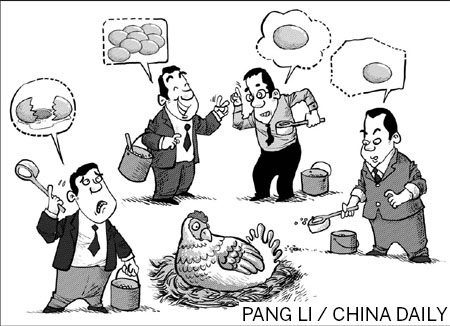
The news that China's pension fund may be invested in the stock market has led to heated debates in recent months. Surveys before the annual sessions of the National People's Congress and the Chinese People's Political Consultative Conference have shown that it is a major concern of ordinary people.
Many have questioned the wisdom of investing in China's stock market considering its poor performance in the past. By the end of 2011, the Shanghai Composite Index had fallen to less than its value 10 years ago. The well-known economic commentator Ye Tan even said investing the pension fund in the stock market would be akin to "falling into water".
The stock market's enthusiastic welcome to the initiative has only increased the public's anxiety about the move. Guo Shuqing, the head of the China Securities Regulatory Commission, has publicly stated that investing the funds would be "beneficial to the country, the capital markets and every citizen".
It is reasonable for the public to be concerned, because the pension fund is "lifesaving money" for the elderly and fund security must be the top priority. But what the public doesn't realize is that a huge loss has existed for years and this loss is growing larger every day.
Currently the majority of the pension fund is deposited in the banks, and the interest earned is comparatively low. Zheng Bingwen, head of the Global Pension Fund Research Center of the Chinese Academy of Social Sciences, has calculated that the average rate of return for China's pension fund has been less than 2 percent in the past dozen years, even lower than the average CPI over the same period, meaning that China's pension fund has devalued day by day. According to Zheng's calculations, the total loss from 1997 to 2010 was more than 600 billion yuan ($95.4 billion). Thus reforming the pension fund's investment channel is urgently needed in order to maintain the value of fund.
On Dec 15, Guo suggested at the 9th Caijing Annual Conference that China's investment banks design products that would help the funds invest in the securities market. His proposal received the support of Dai Xianglong, the chairman of the National Council for the Social Security Fund. Dai said at a forum on China's pension fund development report of 2011 that part of the pension funds managed by local governments should be allocated to buy stocks as this will "help preserve and increase the value of pension funds".
But he warned that equity investments should be long-term and value-oriented, as short-term speculation was too risky.
In fact, investing in the stock market, bond market and advantageous industries in order to maintain and increase value is common practice in many countries. The public's concern about the risks of such investments can be effectively reduced through long-term investment.
In 2001, Warren Buffet published an article in Fortune magazine in which, studying the statistics of almost 100 years, he came to the conclusion that the US stock market's long-term rate of return is 6-7 percent a year. The pension fund is a long-term fund, which can thus overcome the stock market's short-term volatility. Domestic practice also supports investing in the stock market for a desirable rate of return. In the past 11 years, China's social security fund has attained an annual rate of return as high as 9.17 percent, mainly attributable to its successful operation in the stock market.
However, the department in charge of the pension fund, the Ministry of Human Resources and Social Security recently declared there's no timetable for pension funds to enter the capital market, which is undoubtedly true because we still have a rather long way to go. In fact even if the public accepts the idea, the operation of the pension fund still has many obstacles to overcome.
There are five parties involved in the management of the pension fund, namely the Ministry of Finance, the Ministry of Human Resources and Social Security, the National Council for Social Security Fund, the China Securities Regulatory Commission and local governments, and without an all-round management regulation agreed by all five parties, the pension fund will not be invested in the stock market. Different standpoints, concerns and interest demands make the policymaking procedure rather complicated. The State Council's nationwide local pension inspection that began mid-February is regarded as the beginning of reform.
But no matter what the final conclusions are, the current situation must be changed as soon as possible. The authorities should bear in mind that it's the government's obligation to operate the pension fund well to secure citizens' well-being in later life.
The author is a reporter with China Daily.
wangyiqing@chinadaily.com.cn