Tarnished beauty of luxury goods
Updated: 2012-01-03 10:00
By Wang Wen (China Daily)
|
|||||||||


In their rush to separate Chinese consumers from their money, some of the world's best-known names in luxury goods have permitted poor quality control and inadequate customer service to mar their once unassailable image.
BEIJING - When the locks broke on her luxury luggage, Ricky Zhang was furious. Having spent 20,000 yuan ($3,158) on the item only a month ago, Zhang wanted her purchase replaced.
|
 |
|
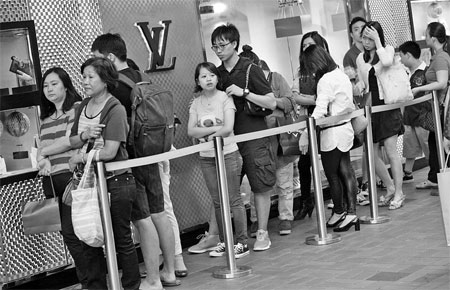
People line up outside a Louis Vuitton store in Hong Kong. China is now the world's second largest market for luxury goods, but some brands have left loopholes in their management due to quick expansion in the country. [Photo/Bloomberg] |
But the road to settlement turned out to be a long and difficult one.
Zhang, in her 30s, took the item back to the franchised store in Beijing, but the shopkeepers, who sold her the luggage, appeared much less enthusiastic than they were on the day Zhang made her purchase.
Snapping a photo of Zhang's item, the shopkeepers told her the shop was only responsible for sales and she would have to wait until the photo was reviewed by maintenance.
Zhang then waited a month before being informed the item could be repaired and she would be able to reclaim it in three months.
"If you insist on a replacement, our representatives will accompany you to the quality supervision authorities in China for an official review," the shopkeepers told her.
Knowing the difficulty of such review procedures, Zhang was convinced that the shop was deliberately making things complicated. With her patience running out, she reported her case to the media, but even the media coverage did not help her. The brand defended its procedures and claimed it was providing a standardized service.
"There was no reason for the brand to be so arrogant toward my claim," said Zhang.
Zhang's ups and downs are typical of how Chinese consumers are given the cold shoulder when it comes to complaints about luxury goods purchased in China. In recent years, questions regarding the quality of highly sought-after goods and the customer service provided by some well-known brands have marred the image of some of the world's biggest names in luxury goods.
Luxury brands are lured by the buying capacity of Chinese consumers. The mainland is now the world's second largest market for luxury goods. However, the region is still relatively new to high-end products and lacks the rich soil for a healthy development of the luxury industry, according to industry insiders.
Driven by the hunger for quick money from China's materialized social elite, the world's leading luxury brands have opened new franchised stores like supermarkets in China at a rate much quicker than their previous operations in their traditional European and North American regions. The deterioration in the product quality and services of these elite brands has come after years of rapid expansion on the Chinese mainland.
France's luxury manufacturer Louis Vuitton had a presence in 10 Chinese cities in 2005, today that has grown to 29 after the purchasing power of second and third-tier cities lured the brand to invest. The Italian luxury brand Gucci, which is now owned by French group PPR, has opened more than 40 stores during the past seven years in China. In 2011 alone, Gucci opened 12 new franchised stores.
The rapid expansion has resulted in profits, Gucci alone saw its revenues from the Chinese market reach 3.2 billion yuan during the first half of 2011, nearly one quarter of its global sales. But the rapid expansion has also brought problems.
While luxury brands usually open one new store in a year in the European region, these companies have had little time to adjust their operations and services to the Chinese market, leaving loopholes in their management, business insiders said.
"New stores and revenues are all the top managers have in mind," a former regional manager of a luxury brand in China told China Daily.
The former employee, who quit her job earlier due to the differences in management ideas for China, claimed the management has for years ignored poor product quality and customer services in China.
The former employee acknowledged it is a routine practice for the franchised stores in China to put repaired goods back on the shelves.
"The shopkeepers were told to deliberately change the serial code of a returned item and make it look like new," said the former employee.
It is also believed that while most of the luxury goods sold in China are labeled as being made overseas, they are actually produced by Chinese workers in factories in provinces including Guangdong and Zhejiang before taken to an overseas destination for final tuning and packaging.
"Wearing foreign made labels, Chinese consumers are not able to find out the real quality of the product," said Ouyang Kun, chief executive officer of the World Luxury Association's China office.
Market regulators in China have previously reported numerous quality problems with high-end clothes of luxury brands including Burberry, Armani, Chanel and Dior. Authorities in Zhejiang destroyed hundreds of pairs of expensive shoes made by brands including Louis Vuitton and D&G in 2006 because of quality problems.
"For these leading brands, fulfilling the rights of Chinese consumers comes long after emptying their wallets," said Tang Jiansheng, an official with the local consumers' association in Shanghai.
The problem-ridden industry has also encountered challenges from within.
In September, a group of former employees of a franchised Gucci store in the city of Shenzhen complained of "harsh and inappropriate" working conditions.
Often penalized for minor infringements such as failing to report when using the washroom or taking a rest at work, the employees claimed they have become victims of the military-style rules of the company. The incident came to an end after the Gucci management in China reached a non-disclosure settlement with the employees who resigned.
For Zhou Ting, an expert studying the Chinese luxury market, these incidents underpin the twisted mindset of a revenue-driven industry while adjusting into the lucrative Chinese market.
"Because China's market is proving to be too big for the brands to conquer, revenues have become almost their sole purpose and they are neglecting the risk control of quality and services," said Zhou, who is the executive director of the Research Center for Luxury Goods and Services at the University of International Business and Economics.
The expenditure by Chinese consumers on high-end clothes, handbags, watches and other luxury items is expected to exceed 100 billion yuan by the end of 2011, about one-fourth of global sales, according to initial calculations by the consulting firm Bain & Company.
The company predicts China will overtake Japan as the world's top consumer of luxury goods next year.
Zhou said the authorities need to take more responsibility in protecting the rights of Chinese consumers of luxury goods, although the size of the group remains relatively small compared to China's population and said the brands need to change their way of doing business in China.
"If the luxury brands fail to change ways from wild growth to nurturing the local consumers, they will eventually lose the loyalty of the Chinese consumers," Zhou warned.
Luxury brands including Louis Vuitton and Gucci did not reply to China's Daily's requests for a response.