Growing demand spurs greater horseplay
Updated: 2011-12-13 17:03
By Shi Jing and He Na (China Daily)
|
|||||||||||


Equestrian sector riding wave of popularity but hurdles remain, Shi Jing reports in Shenzhen and He Na in Beijing.
|
 |
|
Female rangers train regularly at a horse club in Dongguan, Guangdong province. They have been responsible for patrolling the city's high-tech zone since it was established in February. [Chen Fan / for China Daily] |
Ahandstand on horseback, with one hand grasping the saddle, is always well received by the audience at Splendid China, a theme park in South China's Guangdong province.
The park aims to display folk culture in an entertaining way, and the horseshow has been running in Shenzhen for 12 years. The performers, with their breathtaking moves, and their mounts are part of the attraction. Park visitors also have a chance to saddle up and experience the pleasure of horse riding.
Horses - for sport, pleasure or business - are becoming increasingly popular and people are willing to spend both time and money to be with them.
There's much talk of a burgeoning "horse industry", but that might be an overstatement. True industry status would mean an identifiable group of profit-making enterprises, some coordination among its various segments and concrete information on growth and development.
Some envision a solid horse industry developing in China but the route to that destination is far from clear.
|
 |
|
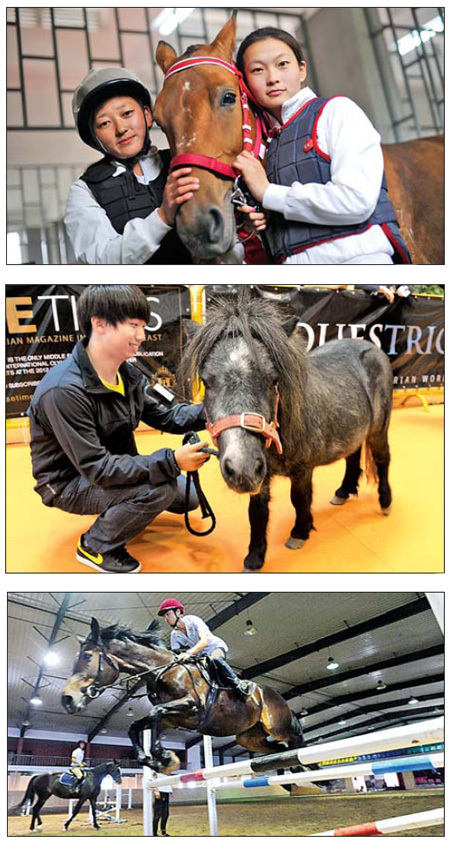
From the top: Sun Ziyan (left) and Dong Min, student jockeys at a Wuhan commercial service school, pose with their horse. The school is one of a few training such professionals in the country. Li Fangrui / for China Daily The China Horse Fair in Shanghai in October attracted 82 exhibitors from 18 countries and regions - and this man and his small horse. Gao Erqiang / China Daily A young equestrian from a pasture area of Inner Mongolia is training now for China's 12th National Games, which will be held in Shenyang, Liaoning province, in 2013. [Photo/China Daily] |
Few statistics are available, but a handful of numbers indicate the status of what Yue Gaofeng, deputy secretary-general of the China Horse Industry Association, calls a "sunrise industry . . . with tremendous market potential".
The association counts 280 registered horse clubs nationwide, more than double the number three years ago. And it estimates that horse racing, equestrian competition and horse-related leisure activities are worth at least 10 billion yuan ($1.58 billion) each year. It did not have data to support that estimate.
The 2011 China Horse Fair in Shanghai in October attracted 82 exhibitors from 18 countries and regions worldwide. The exhibitors, double the number in 2010, showed off horses and equine goods, and a forum on the world horse industry was part of the program.
"China has more than 6 million horses, but unfortunately we do not have a single well-known world brand" in breeding or training, said Yao Xinkui, a professor at Xinjiang Agricultural University who has studied horses for more than 30 years.
"In recent years," Yue said, "China began to import more and more purebred foreign horses to join the international events, which is a good attempt for China's horse industry." Data from the Horse Fair committee show that China brought in 4,000 horses this year, a tenfold increase from 2006.
Too few professionals
"Although the number of imported horses keeps increasing, China's horse industry is still far behind international levels," Yao said. "China has a great shortage of high-level professionals.
"The majority of China's animal husbandry-related universities and colleges do not have horse specialties. And schools that offer veterinary specialties seldom have horses as a subject. There is a big shortage of professional horse veterinarians and trainers."
Wang Jiyu, general manager of Daoxianghu horse club in Beijing, has worked in the horse business for more than 30 years. This is how he described its status:
"On one hand, government and horse club owners spend huge amounts of money to import foreign purebred luxury horses for international equestrian events, some of them costing 1 to 2 million yuan each ($157,000 to $314,000). On the other hand, from veterinary care to feeding, from ranch designs to horse stable management, we all lack systematic professional knowledge.
"No matter how purebred the horse was born, without scientific training, feeding and treating, the horse will lose its high quality soon," Wang said.
Yao noted that some of China's ethnic groups have long histories of horse culture. Instead of learning everything from abroad, he said, we should accept and develop our own heritage to build a complete horse industry that can change current breeding practices that produce only horses of little added value.
"More important, China needs to establish an entire set of modern horse raising and education mechanisms as soon as possible to cultivate more talented professionals in the field. They are vital to the industry's development," he said.
Who's in charge?
"So far, the government has not assigned a single department to specially guide and supervise the horse industry," said Han Guocai, director of the horse research center at China Agricultural University. "On the contrary, departments of agriculture, tourism, culture, sports and even technology all launched their own regulations, which has hindered the pace of development of this emerging industry.
"Take the regulation or operation of horse clubs for instance," Wang said. "Now it is a total mess. Without a clear and binding regulation, China's horse industry cannot develop in a smooth way, let alone form a strong horse industry mechanism to meet the international demand.
"I do hope China's horse industry can be better and be a leader of the industry in the world one day."
Contributions
From ancient times until about a half-century ago, horses played an important role in the daily lives of Chinese people. But as motor vehicles and other machines moved in, horses were generally moved aside. Yao, the agricultural professor, suspects that both ordinary people and the authorities are still thinking in old-time ways.
They "need to transform their concept of horse function first, from the roles of horses in agriculture, the military and transportation to new fields like racing, leisure sports and entertainment," he said.
"At present, more than 600,000 horses are working at tourist attractions," Yao said by way of example. A horse whose "job" is to be rented out for people to ride "can achieve an annual income around 4,000 to 15,000 yuan, which is considered the most effective and efficient way to increase local people's, especially herdsmen's, income."
A strong horse industry also can make a difference to a country. In Australia, for example, a study 10 years ago found that the industry contributed as much as $8 billion in value to the national economy. About half of that came from horse racing. In Hong Kong, taxes on horse racing bets account for more than 10 percent of the city's tax revenue.
"What I can see now," Han said, "is to learn from developed countries such as Germany, where the industry is clearly separated into two categories, breeding and racing. Unfortunately, a horse racing system, which has hundreds of years' history in other countries and regions, has not seen its embryo officially and legislatively set up in China nationwide."
China has experimented with horse racing, but does not allow wagering. Wu Gangfang, commissioner of public promotion for the Chinese Equestrian Association, told China Daily last summer that China has neither a legal framework for it nor systems to prevent cheating.
"Horse racing . . . would definitely bring high income to the horse industry, and it is the road that must be followed if a country wants to develop its horse industry," Yao said. "But the central government has imposed too many restrictions. I do hope the government speeds up the investigation pace and opens China's horse racing soon."
Meanwhile, the government is paying attention to other sports involving horses. China hosted six competitions of the International Federation for Equestrian Sports last year. Equestrian events also were held at the 16th Asian Games in Guangzhou.
"It is important to have the public involved and raise people's enthusiasm toward the horse industry," Yao said.
Write to the reporters at hena@chinadaily.com.cn and shijing@chinadaily.com.cn.
Related Stories
Indulging in plenty of horseplay 2011-04-18 08:00
- MOC scraps duties on abrasion-resistant paper
- Haitong delays its $1.7b offering in HK
- Fishermen sue ConocoPhilips for compensation
- MOC conditionally OKs Seagate-Samsung deal
- Industries to remain world's most competitive
- Watsons to open 2,000 stores in five years
- Fears from offshore yuan use overblown
- China's slice of export pie may shrink