When small businesses become big business
Updated: 2011-08-31 09:10
By Li Xiang (China Daily)
|
|||||||||||


|
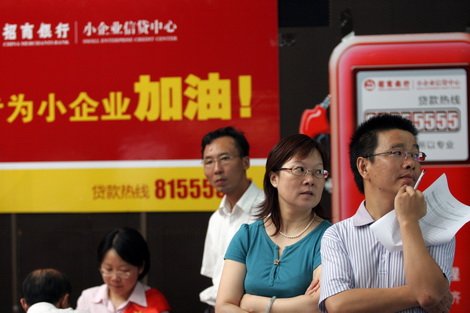 A small- and medium-sized enterprise (SME) financial industry fair in Nantong, Jiangsu province. Demand for sophisticated financial services among SMEs grew after many were hit hard by a capital crunch caused by the central bank's efforts to rein in inflation.[Photo/China Daily]
|
Top lenders are competing for a new growth engine. Li Xiang reports from Hebei province.
With large State-owned enterprises becoming more reliant on direct financing in the capital market, Chinese banks are increasingly turning their attention to the country's cash-strapped small- and medium-sized enterprises (SMEs) as a new profit driver.
Instead of passively implementing the regulator's policies to help SMEs obtain loans, the banks are actively seeking clients that have small operations but promising business models.
"It is strategically important for banks to explore the SME market, which will become a crucial part of their growth engine in the future," said Wei Zengran, the general manager of the SME division at the branch of China Construction Bank Corp (CCB) in Shijiazhuang, the capital of Hebei province.
Wei said that the branch aims to increase the amount of loans to SMEs to one-third of its total corporate lending during the next three to five years.
China's large State-owned lenders, which have traditionally catered to the financing requirements of State-owned enterprises, are gradually losing their premium pricing power over large clients, as many of those clients are seeking funds directly from the capital market at a much lower cost.
Meanwhile, demand for sophisticated financial services is rising rapidly among SMEs after many of them were hit hard by a capital crunch caused by a succession of interest rate rises and tighter credit controls as the central bank seeks to rein in inflation.
"Competition among banks for small-business clients, especially those of high quality, has become more intense than ever since last year," Wei said.
CCB extended 1.4 trillion yuan ($218 billion) in loans to more than 160,000 small businesses between 2007 and 2010. The bank's loans to SMEs in the first six months of this year accounted for 68 percent of its total new-yuan corporate lending. That figure has grown by 40 percent on average during the past three years, according to Yu Jiang, the head of the SME division at CCB.
Domestic lenders are also enjoying a raft of favorable policies provided by the regulator to encourage loans to SMEs, including a lower risk weighting when calculating capital-adequacy ratios and the exclusion of loans of less than 5 million yuan to SMEs in calculations of lenders' loan-to-deposit ratios.
Lending to SMEs has not only become a requirement for the top-tier banks to support the country's private economy - which contributed 65 percent of GDP in 2010 - but has also become a key driver in the transformation of the banks' profitability models and the restructuring of their assets, industry analysts said.
In a recent report on China's banking industry, the global accounting company Ernst & Young LLP (E&Y) noted that the provision of financial services to small-scale companies will become a new driver of profit for commercial banks this year.
The total net profit of China's 17 listed banks was 687.3 billion yuan in 2010, a 33 percent increase from 2009, according to the E&Y report.
Chinese banks' lending to SMEs had reached 9.45 trillion yuan by the end of April 2011, an increase of 7.1 percent year-on-year. The loans accounted for 28.8 percent of their total corporate lending, according to the China Banking Regulatory Commission.
However, the high costs of assessing, approving and monitoring loan requests from SMEs, in addition to their greater risk of default when compared with large clients, have long been major factors that have made large banks reluctant to lend to small businesses.
The credit assessment of a small business often involves visits to the company by loan officers to check its utility and tax bills. Given the difficulty of performing due diligence on small businesses, the banks have to allocate greater human and material resources to obtain an accurate and integral picture of the credit-worthiness of SMEs.
However, the banks are now seeking to solve the problem through innovations in business methods and products. CCB and Bank of China Ltd have introduced a "credit factory" business model which has standardized and streamlined the process of credit assessment.
"Instead of assessing small borrowers on a company-by-company basis, the 'credit factory' model enables us to process their lending requests in batches," said Dai Zhongxing, deputy general manager of the SME division at the Suzhou branch of CCB.
"It has successfully increased the banks' lending efficiency and helped reduce the high costs involved in the process," he said.
Dai also said that the bank is cooperating with credit guarantee companies to cover the potential default risks and maintain a low non-performing loan ratio.
Although the relaxation of the rules on lending and innovative financing models have made it easier for small businesses to obtain loans, traditional bank credit, which is strictly controlled by the central bank, is still unable to meet the capital demand of the country's SMEs.
"Adjusting the banks' lending structure is not going to solve the fundamental problem of the financing difficulties facing the SMEs. They must seek to expand their capital-raising channels beyond the banking system," said Dong Xian'an, chief economist at Peking First Advisory Co Ltd.
In order to alleviate the financing difficulties faced by small businesses, Chinese commercial banks are also bolstering their investment banking businesses to help SMEs raise funds directly from the capital markets.
"We are cooperating, for example, with private-equity funds to help broaden the capital-raising channels for small businesses," said Xu Ting, deputy president of CCB's Suzhou branch.
By the end of 2010, CCB had helped SMEs raise 2 billion yuan through industrial and venture-capital funds.
The bank has also provided debt financing of 2.2 billion yuan to SMEs through the issuance of wealth management products, according to data from CCB.
Related Stories
Tighter policies putting SMEs under pressure 2011-08-09 11:47
Dell looks to SMEs for growth 2011-08-08 17:19
Supportive policies for SMEs under draft 2011-07-29 17:24
SMEs scramble for funds from private lenders 2011-07-29 11:06
- China to give more thought to struggling SMEs
- Wuliangye jacks up prices by 30%
- 60m free from personal income tax
- China's listed firms' profits growth slows in H1
- eBay eyes up to 40% jump in China sales
- One-off gain boosts port operator's H1 profit
- Rothschild acquires 5.1% of China CYTS Tours
- Macao's economy expands by 24% in Q2