The dilemma of holding US govt debt
Updated: 2011-08-30 11:13
By Michael N.T. Tan (China Daily)
|
|||||||||||


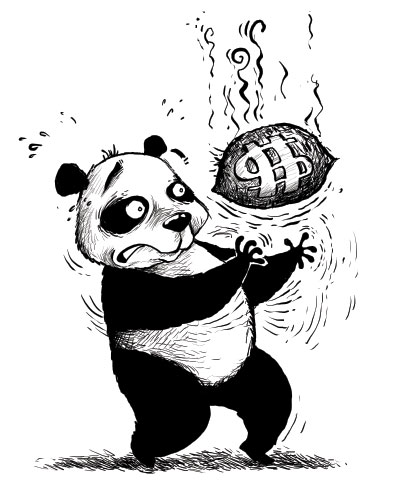
China has foreign currency reserves of more than $3.2 trillion, about 70 percent of which is believed to be in US dollar assets, especially in Treasury bills and bonds. Given the continuous increase in US government debts and downgrading of its credit rating by Standard & Poor's, the most obvious step for China would be to stop accumulating US Treasuries or start reducing its dollar assets.
But apart from the difficulty of switching from dollar assets to other currencies immediately, such a move could also cause a drastic drop in the dollar's value, which in turn could lead to a collapse of the international financial system. The value of China's dollar holdings will plummet, too. Besides, there are no other assets (gold, silver or other commodities) that could accommodate the huge influx of US Treasuries that China holds.
It has no desire to jeopardize the international financial system, but as a debtor nation the United States should also understand the needs and core interests of its largest creditor.
Under such circumstances, what exactly can China do?
China could start by reducing the use of dollar in international transactions and use its own currency, the yuan. In fact, it has already started doing so. The People's Bank of China, or the central bank, has signed currency exchange agreements with a number of countries, including Brazil, South Korea, Singapore, Malaysia, Indonesia, Belarus, Argentina and Iceland. And at a meeting in April 2011, the leaders of BRICS (Brazil, Russia, India, China and South Africa) agreed to promote the use of their own currencies to settle trade deals among them.
The setting up of offshore yuan markets is another step that will help internationalize the yuan. Such markets are already running in Hong Kong and Singapore, and more could be set up in countries and regions that have substantial trade with the Chinese mainland.
Offshore yuan centers will grow as more companies, both Chinese and foreign, trade in the yuan and their need to buy and sell their own currencies in exchange for the yuan becomes frequent. It is possible that even London, New York and Sydney, as well as more Asian cities could become offshore yuan centers.
But should the yuan become a reserve currency? Or more appropriately, is the yuan ready to become a reserve currency? The answer is a simple "no", because the Chinese currency still does not have many of the attributes of a reserve currency.
The first and most important attribute is that it must be fully convertible. The yuan now is only convertible in current or trading account, not investment or capital account. The reason for this is partly historical, because China suffered from dearth of capital in the early years of economic reform and capital controls had to be put in place, even though that is no longer the case.
Second, the yuan must be allowed to freely float in the market. The central bank still maintains the yuan's value within fixed bands, although the yuan has revaluated almost 30 percent since it was de-pegged from the dollar six years ago.
Third, China's debt, securities and capital markets are not sufficiently deep and sophisticated enough to cope with the role of the yuan as a reserve currency.
If the yuan is not ready to be a reserve currency now, will it be sometime in the future? The question, whether the yuan should or should not become a reserve currency, has already sparked a debate both within and outside the country.
One distinct advantage of having a reserve currency is that it allows the host nation to print as much currency notes as other nations are prepared to hold as their foreign exchange reserves. In other words, the host country can technically print huge amounts of its currency and use them to acquire foreign assets and can do so without worrying about pushing up inflation in its domestic market.
The disadvantage of having a reserve currency is that the host country must be prepared to run large trading and/or budget deficits so that other countries can accumulate sufficient amounts for use as reserve exchange. Since China now has trading surpluses with many countries, it will have to completely change its currency alignments to run trade deficits. This will deal a blow to small- and medium-sized enterprises, which cannot cope with skyrocketing values of the yuan.
Whether the yuan becomes an international currency or a reserve currency depends not only on the actions of the Chinese government, but more importantly on outside forces of trade, finance and investment that determine its pace and direction.
The yuan has been revaluating, and this process must continue. At some point, it will find its equilibrium vis-a-vis other currencies, and only then the People's Bank of China can stop fretting about its fluctuations.
The author is a research scholar in China studies at the University of New South Wales, Sydney.