Chinese market sets scorching pace for Asian automakers
Updated: 2011-07-08 10:10
By Richard Macauley (China Daily)
|
|||||||||||


|
 |
|
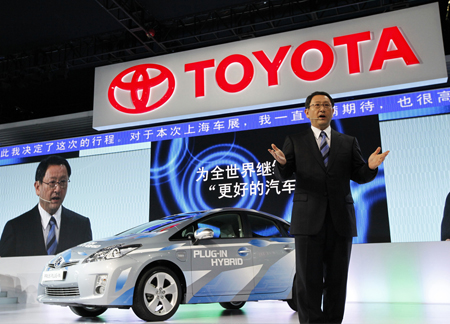
Toyota Motor Corp's President Akio Toyoda speaks at the Shanghai International Auto Show in April. Toyoda revealed that it's not just market share, his company wants to win China's mind-share, too.?[Photo / China Daily] |
CHONGQING - Akio Toyoda, president of Toyota Motor Corp, stands before a crowd at this year's Shanghai Auto Show speaking about the reasons his company loves working in China. "Bringing smiles to the faces of customers in China is key," Toyoda says.
His words are not merely a reflection of a healthy business bond but also a statement of conviction on how the Middle Kingdom has come to dominate the scheme of things relating to automakers across the world.
The Chinese auto industry is revving up for fast-paced action as global players make a beeline to get a slice of the world's second-largest economy.
What's more, the boss of the famed automaker also lets it be known why his company chose to build a research and development center along with one of the world's largest test tracks in China last year.
Toyoda reveals that it's not just market share, his company wants to win China's mind-share, too. "By greatly developing education here, we will be able to produce (the kind of) cars that will exceed the expectations of Chinese consumers," he adds.
That's a polite way to express his gratitude for the opportunity his company has been granted to do business in a country where, global research firm Nomura predicts, car sales will hit 20 million by the end of the year.
China's market offers a further sweetener - most buyers are still purchasing their first car. That means in China, sales are more likely to represent money in the bank for automakers
than in other mature markets such as the US.
Fueled by 28 percent in 2010 and 48 percent growth in 2009, China has come to be seen as a market of limitless opportunities and possibilities.
In February alone, about 1 million cars were produced in China, according to the China Association of Automobile Manufacturers. The makers include some leading Asian brands.
A 50-50 partnership with a Chinese company is the salient factor in doing business in a market that has overtaken the US in terms of sales.
Joint venture is the guiding principle in China, where the government is keen to see domestic brands grow stronger and sharper through knowledge gained through collaboration with top-notch international firms such as Hyundai, Daewoo, Honda and Suzuki from South Korea and Japan.
However, for the Asian car giants, particularly those who needed to move their factories only a few hundred kilometers westward and into China, the dilemma of sharing intellectual property is acute.
No organization worth its salt likes to see its business partner gain intellectual property, and later pose a big threat as a competitor.
But Eric Thun, professor of Chinese Business Studies at the University of Oxford, explained why this is not a big issue.
First, the joint-venture format is too profitable for a domestic partner to want to mess with it. "Local (partners) have no interest in taking risks and making investments to go it alone since the market traction is so great," he says. "(Domestic partners) sell really well and they make good money as the situation stands."
Another reason is that they lack the confidence needed to launch world-beating cars independently. Chinese automakers, Thun says, are well aware that in terms of novelty car design, they still lag far behind established Japanese or Korean brands.
This is not to say, however, that Asian car manufacturers do not consider their partners a threat. In fact, auto giants from other Asian countries devote considerable time and energy to fighting domestic companies for a slice of the market share.
Honda and Nissan have already launched entirely new car brands to take on Chinese automakers in their backyard. Far from living in fear of competition from their domestic partners, they have adopted new strategies to adapt to the business realities in China. They seem unflustered by the warnings of skeptics that such partnerships could prove to be a Faustian pact in the long run.
Venucia, a whole new brand produced by Nissan and its partner Dongfeng Motor, is a shining example of the automakers' great adaptability.
"Venucia ... compact cars look likely to be priced ... with the aim of harnessing new demand in regional cities through products that deliver both high quality and low prices," says Nomura in its winter 2010 report.
The report suggests that the unique selling point of the cars, born out of a marriage between reputable global companies and their Chinese counterparts, could be that they combine international experience with domestic sourcing opportunities to fill the gap in quality standards.
"If Nissan is able to launch low-priced cars that are highly reliable under the Venucia brand, we think it will win share from local makers," Nomura adds.
Honda, too, along with Guangzhou Automobile, has rolled out Everus, a wholly new entity designed jointly by these two companies. Everus is a model that is likely to aim at the middle ground - between reliable design and competitively priced components.
For those who know the industry well, the emergence of such brands is a natural progression.
It's the market, not just a cheap production hub for exports, that drives Asian automakers to China, says Beijing-based independent analyst Jia Xinguang. "(They) have had a good reward. You could even say that the main source of profit (from the Chinese joint ventures) is from sales in the Chinese market," he says.
The sales figures indicate that Japanese brands are clear market leaders. In 2010, they recorded 25.6 percent of sales, compared with 31.2 percent by all domestic brands put together. Brands from the European Union scored 21.3 percent.
Interestingly, Asian manufacturers arrived in China relatively late compared with such European behemoths as Volkswagen AG (VW). European manufacturers quietly made inroads into China when Japanese and Korean automakers were busy expanding their bases across the US.
"Some observers (say) this is a major fault of the Japanese (brands). To some extent it is unfair criticism because in the 1980s, when VW or others were entering China, Japanese producers ... had no resources to develop a Chinese plan," Thun says.
But when the time came - in the late 1990s to be precise - the likes of Hyundai, Nissan and Toyota were equipped to take on the European and American brands in China.
Thun in fact notices something special about the way Asian companies operate, especially when it comes to maintaining quality. He says that instead of sourcing parts locally in China, "Japanese and Koreans retain their supply chain and production structure - the way they do things".
However, he adds that with 60 percent to 70 percent of a car's value coming from its component parts, such an approach involves a fair number of risks that mainly include "higher costs of production, and the difficulty in lowering costs if necessary".
Hyundai brought with it all of its original suppliers despite moving its factories to a new country. This is a great example, Thun says.
Another great example is Guangzhou - which is also a glorious exception to the 50-50 ownership rule that typically dictates joint ventures in China.
"Japanese car producers are successful in Guangzhou because they have found a very receptive and flexible local government. It has allowed them to maintain their ways," says Thun.
It is in this capital city of Guangdong province in South China that Honda has built a manufacturing plant that it wholly owns. It is quite a feat indeed, but that's due largely to the fact that Honda only makes export-only cars in the city.
Such profound trust displayed by the local authorities serves to illustrate an important thing: The local government is fully aware that such arrangements create jobs and boost GDP.
But how long will Guangdong remain an automaking hub is a question already on the lips of analysts. To produce cheaper cars for the domestic market, supplies must also be domestically sourced, perhaps from inland provinces instead of the relatively expensive coastal cities.
The municipality of Chongqing in western China, for instance, has a long history of auto production. For brands such as Everus and Venucia, which are not destined for the high seas and onward to Europe and the US, it is less important to have a factory on the coast.
"Investment targets are now edging towards central regions such as Zhengzhou, Hefei, and Wuhan," says Jia. "Even the west, locations such as Chengdu and Liuzhou (are favorable destinations). But manufacturers will not give up the eastern market."
With such high consumption, Jia adds, it is the relatively prosperous coastal cities that will dominate the attention of car manufacturers in Asia, and indeed the rest of the world, at least for some time.
?