Economy
Tolls on road take a rising toll on drivers
By Gao Changxin (China Daily)
Updated: 2011-06-15 14:51
 |
Large Medium Small |
'Abnormal' tally
Already high, the road fees are made higher by the numerous illegal toll stations on the nation's roads.
Chen Lin, a 16-year truck driver in Shanghai who travels the country, said toll stations that are "apparently illegal" are widespread around the nation, especially in rural areas. He said some stations charge differently for the same distance on different occasions, and on some roads toll stations have been set up virtually "right next to each other".
"I have heard that in some small cities, if you speak the local dialect to the toll station staff, you get a lower rate," Chen said. "Typically drivers don't want to argue with them, because we are on the roads and don't want trouble."
In 2008, the National Audit Office said in a report that illegal tolls and provincial tolls out of line with national permits and regulations amounted to $3.1 billion a year. That comprises $2 billion from 158 illegal toll points and $1.1 billion from amounts that exceeded toll regulations.
The audit office criticized the management of toll roads as loose, including exempting officials and government departments or cutting their fees, transferring operating rights to private enterprises without approval and using toll revenues for purposes other than repayment of road construction loans.
The Ministry of Transport announced on Tuesday that starting Monday, various government agencies will go after unauthorized highway checkpoints and illegal tolls. A joint notice by five agencies promised harsh punishment to violators of toll road laws and regulations.
Zhu Jian, a professor in the School of Transportation Engineers at Tongji University, said it is "abnormal" for drivers in China to pay this much for the roads they travel. Roads are public goods, he said, and the government should provide them freely.
"At the root of the problem is the financing pattern behind the nation's road construction, where the regional governments disproportionately shoulder the financing burden," Zhu said.
Profitable business
Massive construction of China's road networks started in 1984, when the central government approved a policy to allow financing road construction by debt, which would be repaid through tolls collected over a specified period.
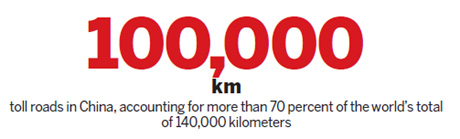
Road-building boomed as the policy brought in capital. By the end of 2010, China had 74,100 kilometers of expressway network, the second largest in the world, compared with a mere 147 kilometers in 1989, according to the Ministry of Transport.
|
||||


The provincial governments finance about 66 to 90 percent of the capital needed to construct and maintain the expressways through their own budgets and debt, according to a report published in April 2010 by the World Bank.
"With little financing from the central government, the provincial governments are left to find their own ways to get financed to meet the central government target," Zhu said.
To reduce their fiscal burden, the provincial governments enlist social capital by creating expressway companies, which allows for joint venture, securitized ownership, direct private sector investment, and different forms of leasing and concessions.
After completing the construction of a toll expressway, the governments will list the company on the stock exchanges and then invest the money paid by shareholders in construction of new toll roads.
Nineteen expressway companies are listed in Shanghai Stock Exchange's A-share market.
According to central government policies, every debt-financed toll road is given a specific concession period to recover its construction cost, with a ceiling of 30 years. But in many cases, the period runs longer, and some roads keep charging long after all the costs have been recovered.
"Running toll roads is so profitable that the provincial governments don't want to stop," Li said. "In fact, toll roads have become an important source of income in some regions."
According to a survey published by Securities Daily in 2009, the toll roads industry is ranked the most profitable in China. In 2010, the 19 listed expressway companies raked in about 12 billion yuan in profit, up 16 percent year-on-year.
Long time to repay
"The supervision by the central government is insufficient, mostly because the central government is not much financially involved. Many toll roads have concession periods much longer than 30 years," Li said.
"In fact, regional governments to some extent enjoy autonomy in how they deal with their roads."
An investigation report published by Guangdong provincial government in 2005 found that six toll roads in the province had concession periods of 100 years. One had a period of 756 years.
The 19-kilometer Beijing Airport Expressway, which started service in 1993, has a total investment of 1.165 billion yuan, with 765 million yuan in loans. After taking tolls for three years, the road was approved for another 30-year concession period by the Beijing government after being listed in Hong Kong, according to the National Audit Office.
By the end of 2005, the road had already taken in 3.2 billion yuan in tolls and a further 9 billion yuan is expected to be charged in the concession period, the audit office said. More recent numbers are unavailable.
He Jianzhong, spokesman for the Ministry of Transport, conceded that there are problems in the nation's toll roads.
"We don't evade the issues in the country's toll roads, including the opacity of information and irregular implementation of the central government rules," He said at a news conference in March. "The ministry has done research repeatedly and is taking measures to tighten supervision."
He also said 96 percent of the nation's roads will be toll-free in the future, but gave no timetable.
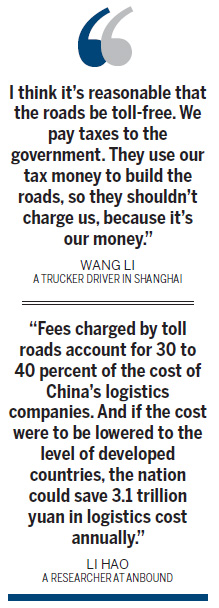
"I think it's reasonable that the roads be toll-free," Wang Li, the trucker driver, said. "We pay taxes to the government. They use our tax money to build the roads, so they shouldn't charge us, because it's our money."


| 分享按鈕 |