Companies
Promoting standards and managing risk 'a growing industry'
By Liu Jie (China Daily)
Updated: 2011-06-13 14:45
 |
Large Medium Small |
|
 |
|
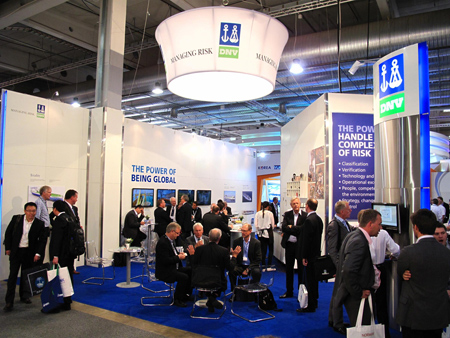
The booth of Det Norske Veritas (DNV) at 2011 Nor-shipping, a global event for the maritime industry, held between May 24 and 27 in Oslo, Norway. [Photo / China Daily] |
OSLO - Explaining what his company, Det Norske Veritas (DNV), does is a routine part of Tore Hoifodt's work.
That doesn't mean to say it's easy. The Norway-based multinational's business covers a wide range of sectors and is continuously adding more.
As senior vice-president and communications director of DNV's Asia-Pacific and Middle East division, Hoifodt has his hands full. He says risk management summarizes DNV's role and categorizes the company's businesses into traditional and emerging segments.
More specifically, the company establishes and applies technical standards for industries, offers technology, management, environmental and competency-related services for customers, and provides certifications and classifications to them - all designed to reduce business risk.
Although traditional sectors such as shipping, maritime and oil and gas are the pillars of the business, emerging sectors in emerging markets are expected to be the new engine for the international company, which has been around for 147 years.
Emerging industries
The company, established in 1864 as a classifier of ships, has more recently tapped into carbon capture and storage, emission trading, clean energy and corporate social responsibility. DNV says it will maintain an interest in new industries.
So far, 32 percent of all Clean Development Mechanism (CDM) projects are validated by DNV, 75 percent of the world's offshore wind projects are certified and verified by the company and it is the first to release the world's first standard for carbon capture and storage technologies.
Svensen says China is "very promising" for DNV. The company has involved itself in new energy, corporate social responsibility (CSR) and healthcare safety management sectors in the nation. It brought experience from developed markets, such as the United States and the Europe, into China.
Currently, 30 percent of CDM projects in China are validated or verified by DNV. It was one of the pioneers in launching CSR verification and the first to promote healthcare safety standards here.
"Although it is still at an early stage, we see the future," said Bjorn Kj. Haugland, DNV's executive vice-president, who is in charge of the company's sustainability and innovation businesses.
He explained that China is working hard to balance its economic, social and environmental development, which requires businesses to be socially responsible or develop in a way that keeps a balance among the need for economic development, social harmony and environmentally friendly operations.
In July 2009, DNV launched its Beijing sustainability center, which is now undertaking a risk management project in association with the State Council's Assets Supervision and Administration Commission (SASAC). The first phase of the project was completed in March.
The project is primarily geared to developing an optimized decision-making process for project risk analysis. It adopts a scientific approach to ensure that major investments are properly vetted through a formal risk assessment procedure before being implemented.
The latest business of DNV in China is healthcare safety management at the nation's public hospitals, which it is undertaking in cooperation with the Ministry of Health. The first project was signed in May with Zhengzhou Orthopedics Hospital in Henan province.
"China's medical reform, aimed at enabling medical care to cover a population of 1.3 billion, will need and promote the improvement of management in hospitals," said Haugland.
|
 |
|
TOR E. SVENSEN DNV President and Deputy Chief executive officer |
According to the Ministry of Finance, China invested 1.13 trillion yuan ($174 billion) in improving the medical care system between 2009 and 2011, 284.2 billion yuan more than the original budget. It also raised the ratio of the medical care spending in fiscal expenditure to 5.35 percent in 2011, up from 4.57 percent in 2008.
The company admitted that projects in the emerging sectors are still at an early stage so they have to be run in collaboration with government departments.
Traditional sectors
"We have been growing fast in China for many years. The average annual growth rate has been 20 to 30 percent," said Svensen. DNV is now the largest Norwegian company in China by sales.
Although its business in emerging sectors is rising here, traditional industry, such as maritime and energy activities, still account for the greater part of DNV's portfolio.
So far, 20 percent of all Chinese ship construction and 50 percent of offshore units built in China are classified by the company. Half of the offshore oil and gas fields in China are certified by DNV. "Last year, 92 ships and offshore units constructed in China were delivered with DNV classifications. That's twice the number of the previous year, so it was a big increase and we expect even more this year," said Svensen.
DNV now supports all the ship segments in China including container ships, liquefied natural gas (LNG) vessels and offshore units. The president said LNG production is in its infancy in China but it is developing very fast because of demand from both the domestic and international markets.
"The challenge is that Chinese yards are developing at different levels and there is a lack of design skills and expertise," Svensen said, adding that DNV's contribution to the market in China is bringing in design, competency and technology.
He admitted that the ship-building sector is slowing down globally. "We cannot expect the same growth (in China), but we expect similar growth in offshore work," he said, adding that he is nonetheless optimistic about the future of China's shipping industry.
China became the world's largest ship builder last year. The nation completed shipping capacity of 65.6 million TEUs (20-foot equivalent units, the standard for container ships), making up 43 percent of the global market. Meanwhile, new orders and orders in hand reached 75.23 million TEUs and 195.9 million TEUs respectively, accounting for 54 percent and 41 percent of the global market, according to the Ministry of Transport.
Liang Zhiyong, an analyst at the China Shipping Economic Research Center, said that China's shipping production capacity is leading the international market.
"What we need in the next stage is more specialized and value-added products," said Liang, adding that ownership diversity in the industry, which used to be dominated by State-owned enterprises, will help increase competency.
| ||||

China Rongsheng Heavy Industries Group Holdings Ltd was founded in 2004. The private company now owns two manufacturing bases for shipbuilding and offshore engineering in Nantong, Jiangsu province, and one for making diesel engines in Hefei, Anhui province.
The Hong Kong-listed shipbuilder generated revenue of 12.67 billion yuan last year, up 33.7 percent from 2009, with the net profit surging 32 percent to 1.72 billion yuan.
David Luan, executive director and chief operating officer of the group, said that a large portion of their projects are classified or certificated by DNV. The Norwegian company helped Rongsheng introduce international standards at the primary stage and maintain good oversight during construction and maintenance.
| 分享按鈕 |