Opinion
China's capital market opening up
By Andrew Moody (China Daily)
Updated: 2011-06-10 16:40
 |
Large Medium Small |

There is a growing sense of anticipation in Hong Kong's Central Business District that China's capital markets are beginning to open up. China may have become the second-largest economy in the world from nowhere in 30 years but the ability of outsiders to buy shares in the companies that have been the engine of that growth has so far been severely restricted.
Shanghai might be the world's fifth-largest stock exchange but foreigners are denied open access to it and its sister exchange in Shenzhen.
China equity funds run by the major European and foreign investment houses typically can only get a piece of the China success story by investing in Chinese companies like China Mobile and PetroChina that also have a listing on the Hong Kong stock exchange.
A measure of the restricted access is that while the mainland equities make up around 10 percent of the global equity market by value (or market capitalization) they make up just 3 percent of the global benchmark indices.
Things are happening, however, that suggest a mood of liberalization. The Chinese authorities have signaled they may give the go ahead as early as later this month for foreign companies such as Coca-Cola and European corporations like Unilever and HSBC to list in the mainland.
Over the past year, there has also been an extraordinary build up in the amount of yuan deposits held by Hong Kong banks from 90 billion yuan (9.5 billion euros) last July to 510 billion yuan, some of which is looking for yuan-denominated investments such as China equities.
Aaron Boesky, chief executive officer of Marco Polo Pure Asset Management, based in The Centrium, a skyscraper situated on a high slope in Hong Kong's Central Business District, believes China's stock markets could be open to foreign investors in just over three years.
"The wall is coming down and by 2015 QFII (the qualified foreign institutional investor scheme which currently rations access to the China equity market) will likely be finished and the A-share (China yuan-denominated listed shares) market will generally be wide open," he says.
Boesky, still only 36, has already made a personal fortune out of the Chinese authorities' decision to partially open its equity markets through the QFII scheme launched in 2002.
He set up his Cayman Islands-registered hedge fund company with Chris Tang, a former PriceWaterhouseCoopers audit manager, to invest in China equities through the QFII scheme. Its China fund has produced annual returns of 30 percent and has $125 million (85 million euros) of assets under management.
|
 |
 |
|
David Chang, regional head for the Greater China region for Franklin Templeton Investments, says the QFII quota is relatively insufficient for foreign investors. [Photo / China Daily] |
Aaron Boesky, chief executive officer of Marco Polo Pure Asset Management, believes China's stock markets could be open to foreign investors in just over three years. [Photo / China Daily] |
Boesky believes between $500 million and $1 trillion would flood into the China markets in the two years after the withdrawal of the QFII, creating a bull market in which the Shanghai Composite Index would rise from its current level of about 2,700 to more than 10,000. This would shatter its previous peak of 6,124 in October 2007.
 |
|
Joseph Chang, vice-president of SCM Strategic Capital Management Asia. |
"This would not be out of place by Shanghai standards since we have seen four bull markets in the last 20 years each of which has averaged over 500 percent."
Such dramatic inflows are something the Chinese authorities are likely to be keen to avoid.
Since QFII was launched they have adopted a gradualist approach granting 109 licenses to foreign companies to buy shares in the China stock markets.
The total value of these quotas is around $20 billion, which still represents a tiny fraction of around 0.5 percent of the $4.5 trillion value of A-shares on the China bourses.
The capital market regulator, China Securities Regulatory Commission (CSRC) controls the scheme and also issues the QFII licenses.
|
 |
|
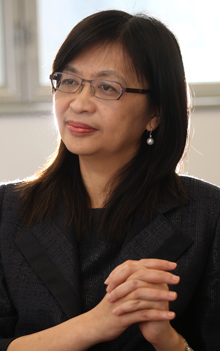
Julia Leung, under secretary for financial services and the treasury within the Hong Kong Special Administrative Region government. [Photo / China Daily] |
The actual quotas involve a foreign exchange transaction and are controlled by the State Administration of Foreign Exchange (SAFE), which makes available the yuan, the local currency.
David Chang, regional head for the Greater China region for Franklin Templeton Investments, which received its QFII allocation in 2004, did not want to speculate about any gold rush that might follow after the current quota barriers are removed.
"That is a hypothetical question. It is not going to happen tomorrow, that is for sure," he says from his office in Chater House on Connaught Road.
"I think, however, there is a lot of enthusiasm from foreign investors wanting to get in to the market."
Franklin Templeton's QFII quota of $200 million is only a fraction of the $15 billion it has invested in China stocks. Its main access to China is still investing in those companies that have a Hong Kong listing.
| ||||


"I think the consensus from foreign investors is that the QFII quota is relatively insufficient at the moment. From our point of view we are hoping they will open the quota a bit more and a bit faster," he says.
David Weipers, head of China operations for Martin Currie Investment Management, based in Edinburgh, which was one of the first foreign companies to get a QFII license, cannot envisage any sudden opening up.
"It will remain very gradual and very controlled. I don't think anything big is going to happen in the short term, " he says.
| 分享按鈕 |