Economy
Development to find balance
By Li Jing (China Daily)
Updated: 2011-06-09 14:17
 |
Large Medium Small |
|
 |
|
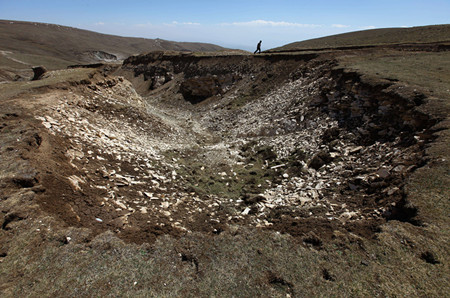
A big hole is dug out for a quarry earlier this month, damaging the grassland at Maxian Mountain, a water resource natural reserve in Northwest China's Gansu province. [Photo/for China Daily] |
BEIJING - China on Wednesday unveiled a nationwide development strategy based on regional environment and resource capacities, in a renewed bid to balance economic growth with natural conservation.
The appraisal criteria for local officials' performance will also be shifted from only focusing on economic achievement to fulfilling tasks based on each region's development priority, such as agricultural production or ecological protection, according to Xu Xianping, deputy director of the National Development and Reform Commission.
"China's rapid industrialization and urbanization have created a string of severe problems, such as diminishing farming land, overexploitation of natural resources, rampant pollution and degrading ecological systems," Xu said.
"Future development needs to be put in line with a certain area's resource and environmental capacity," said Xu.
| ||||


The aim is to foster new urban clusters in the inland areas, form major agricultural production bases and construct key ecological protective screens in the country, said Xu.
"Such a spatial arrangement is helpful in making more targeted and effective policies for different regions," said Yang Weimin, secretary-general of the commission.
For instance, the Yangtze and Pearl river deltas, as well as the Bohai Bay area, already suffer from the constraints of energy and resource scarcity, so that in the future their development should be focused on providing equal public services to urban and rural residents in the areas.
In major farming regions, the focus will be shifted away from economic growth and placed on the quantity and quality of agricultural production, said Xu, adding that such moves can better ensure food security.
It took four years for the national territory plan to be finished, which will be served as "a strategic and binding basis" for any future regional development and industrial plans, according to Xu.
Detailed steps and measures are yet to be finalized with related government bodies and local authorities, but policy tools on financing, investment, land management, agriculture, population and so on will be adopted to guarantee the full implementation of the plan, said Yang.
For those areas where large-scale urbanization and industrialization are limited or prohibited, the central government will compensate them with more subsidies to "purchase the ecological services and products".
Such financing policies have already been put into practice, and will be reinforced in the future.
"We understand that implementing the plan is likely to result in widening the gap of economic growth between different regions, but our ultimate goal is to narrow the disparity on basic public services, residents' income and infrastructure construction all over the country," said Yang.
Yang also said the country will re-define the scope and function of some nature reserves, natural and cultural heritage sites, national geological and forest parks during the next five years. Such places are under the category where development is prohibited.
"Once they are settled, no adjustment can be made on a single nature reserve," Yang said.
About 22 percent of the country's nature reserves have been damaged to different extents, Vice-Minister of Environmental Protection Li Ganjie said last week. Previous media reports said some national-level nature reserves have to make way for industrial and construction projects.
| 分享按鈕 |