Money
'Hot money' will keep pressure on economy
By Wang Xiaotian (China Daily)
Updated: 2011-04-27 09:20
 |
Large Medium Small |
|
 |
|
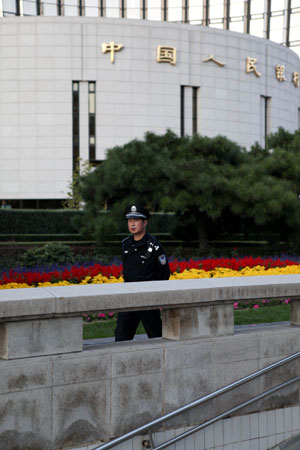
The headquarters of the People's Bank of China in Beijing. Chinese regulators have said the country is facing increasing pressure from "hot money" inflows. [Photo /?China Daily] |
Capital inflows create contradiction for policymakers and market players
BEIJING - China is facing continuously increasing pressure from capital inflows - so-called "hot money" - because of a contradiction between the nation's macroeconomic policies and the financial demands of market players, said a senior official at the State Administration of Foreign Exchange (SAFE) on Tuesday.
"This contradiction is restricting our steps in further opening up the capital account," said Li Chao, a deputy administrator of SAFE at the first China Trade Finance Annual Conference held in Beijing.
| ||||


Short-term capital inflows have accelerated since the third quarter of last year, arousing widespread concern about their negative effect on the world's second-largest economy.
In the first quarter of 2011, the nation's foreign exchange reserves increased by $197 billion to more than $3 trillion for the first time, a rise of 24 percent from the previous year. Meanwhile, the country's trade deficit was $1.02 billion over the same period, the first quarterly trade deficit in seven years.
Some analysts are concerned that surging capital inflows, partly accelerated by the loose monetary stance of the United States, will trigger greater speculation in the real estate sector and the already volatile stock market.
Liu Mingkang, China's top banking regulator and a member of the central bank's monetary policy committee, said earlier that rising speculative capital inflows will make it more difficult to curb inflation.
The consumer price index surged to 5.4 percent in March, a 32-month high, rising from 4.9 percent in February, according to data from the National Bureau of Statistics. The country has set an inflation target of 4 percent for 2011.
The government has announced that it will promote the convertibility of the currency under the capital account in the next five years, but the opening up of the account is expected to attract more speculative capital inflows.
Li said that at present more than 75 percent of China's capital account has varying degrees of convertibility, and that the actual amount is greater than official estimates, if informal channels such as overseas property purchases and emigration are added into the calculation.
"However, in terms of a totally converted scale, the situation in China still lags behind the demand of market players," he said, adding that no consensus has been reached among researchers as to how to promote a substantial opening-up.
Reducing government intervention in the capital account is a must if China wants to float the yuan in the global market and make it an international reserve currency, said Yu Yongding, a former adviser to the Chinese central bank.
Li Bo, the director at the central bank's monetary policy department, said on Tuesday that China will encourage the use of the yuan under the capital account, by allowing overseas companies to use the currency to invest directly in China on a trial basis.
The nation will also help foreign central and commercial banks to use the currency to buy and sell in the domestic interbank bond market.
| 分享按鈕 |