Cars
Space race over parking fees
By Hu Yongqi and Li Jing in Beijing and Wu Yiyao in Shanghai (China Daily)
Updated: 2011-04-12 16:04
 |
Large Medium Small |
|
 |
|
A toll collector checks how long this car has been parked in a downtown Beijing business center. The sign lists the new rates, which took effect on April 1. [Photo / Xinhua] |
Increase in charges fuels a rethink, Hu Yongqi and Li Jing in Beijing and Wu Yiyao in Shanghai report.
You drive to work in Beijing and return to your car in the late afternoon to find a white piece of paper stuck on it. A note from a passing friend?
Not likely, not this month. It's probably a parking citation and it comes at a cost; 200 yuan ($30.60) to be precise.
Parking fines were increased in Beijing on April 1 but that was not all that changed at the beginning of the month.
Parking fees also shot up as part of the capital's continuing efforts to relieve chronic traffic congestion.
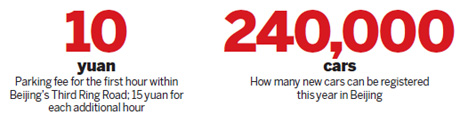
Roadside parking within the city's Third Ring Road now costs 10 yuan for the first hour and 15 yuan for each additional hour.
Drivers were previously charged only 2 yuan per hour in most areas of the city except for downtown business and shopping areas, where the cost was already 10 yuan per hour.
Between the Third and the Fifth Ring roads, parking fees rose from 2 yuan for the first hour to 6 yuan, and to 9 yuan for each following hour.
The new rule, announced in December, applies citywide from 7 am to 9 pm every day, according to the Municipal Commission of Development and Reform. Toll collectors are responsible for recording parking times and collecting fees.
In the past two years, Beijing has adopted a string of policies trying to curb the use of private cars. The capital is the first city in China to ban cars one day a week, based on plate numbers.
Beijing started a vehicle license lottery on Jan 1, limiting the number of new cars that could be registered this year to 240,000, one-third of the number registered last year. Bumper-to-bumper traffic persists.
The new parking fees have made a dent, according to some commuters who drive and toll collectors who watch where they park.
Li Ming, whose job is near the Ciqikou area in downtown Beijing, said he has quit driving to work altogether because he cannot afford at least 70 yuan in parking fees every day.
Hou Wenzhong, 55, has been working as a toll collector for six years at Huixindongjie area in Beijing's Chaoyang district. He said there is space for 20 cars in the roadside parking area he contracted from Huapu Road Parking Management Co, but only six or seven cars park there now.
The new regulation also raises fees for underground parking, which now stands at 6 yuan per hour, and for off-street parking spaces, 8 yuan. A man surnamed Quan, who manages underground space, reported a sharp decline at his site in Zhongguancun, a key area of traffic control in Beijing's Haidian district.
Illegal parking also has shrunk. A warden, surnamed Chen, said he fined about 15 cars for illegal parking at Huixindongjie in the first three days of April. Since then, he said, he has seen fewer cars parking outside the designated roadside spaces.
|
 |
|
Traffic like this, on Beijing's Second Ring Road, illustrates why the city is trying to ease congestion. The latest tactic is higher parking fees. [Photo / Xinhua] |
|
 |
|
A resident reads the ticket posted on a car window on Beiheyan Street in Beijing. [Photo / China Daily] |
Many tradeoffs
Like Li Ming, many drivers have switched to public transportation to commute between home and work five days a week. But Li, who used to drive about 45 minutes from home to work, now spends about 80 minutes on the subway and then a bus.
Qiu Linqi, a 35-year-old bus driver in Chaoyang district, said more people rushed to his bus on the morning of April 6, the first working day after the Qingming Festival. "People were lining in longer queues at bus stops. Many of them complained they had to wait half an hour during rush hours."
Du Zhenxing, 27, took a crowded bus to work for several days - a horrible experience, he said - so he organized a carpool with his neighbors to reduce the cost of parking but maintain the convenience of traveling by car. They take turns, with each neighbor driving one week.
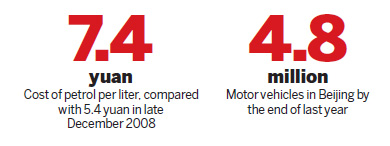
Du bought his car when the municipal government provided a tax break to people who bought smaller car. Now, he said, the cost of petrol has risen as well as parking fees. Fuel costs about 7.4 yuan per liter compared with 5.4 yuan in late December 2008.
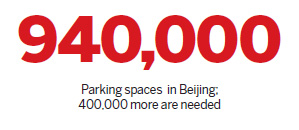
By the end of last year, Beijing had 4.8 million motor vehicles. Vice-Mayor Zhao Fengtong said earlier this year that the city has 940,000 parking spaces but needs 400,000 more.
The city announced a plan last year to build 26 large, free or low-cost parking lots near subways and bus stops to encourage drivers to take public transportation from the outskirts to downtown. None is available now.
Beijing's new five-year plan also set a goal to further expand the subway system, from 331 kilometers to 661, by 2015.
Work it out
| ||||


And people like Hou, the toll collector in Huixindongjie, notice.
"The new (pricing) regulation definitely reduces the number of cars on the road because fewer cars come to my parking lots now," Hou said. "But it also shrinks my income. Car owners would not park in my lots any more."
Hou is allowed to charge more, but said his income still would not return to pre-increase levels. He used to charge about 150 yuan a day; now he collects about 100. He pays 2,000 yuan a month to Huapu Road Parking Management Co; now, he said, the company is considering charging the toll collectors more.
Hou used to clear 2,500 yuan a month to cover his living expenses (home is in a basement). Now, he is not so sure.
| 分享按鈕 |