Economy
Imports help feed hunger for grain
By Jin Zhu (China Daily)
Updated: 2011-03-25 10:09
 |
Large Medium Small |
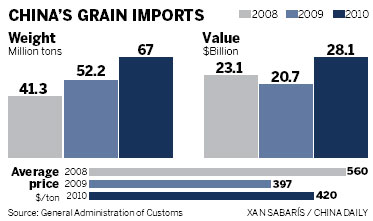
BEIJING - China ramped up its grain imports last year and its large reserves mean the country will not suffer from a severe shortage in 2011, according to a senior agricultural official.
China's net grain imports, including soybeans, reached more than 60 million tons in 2010.
Of that total, the country imported 54.8 million tons of soybeans last year, which accounted for 60 percent of the world's total, said Chen Xiwen, director of the office for the Communist Party of China Central Committee's Leading Group on Rural Work.
"The import volume (of soybeans) last year was more than any other previous year in the country," Chen said on Thursday at a press conference in Beijing.
The nation also imported 1.57 million tons of corn and 1.2 million tons of wheat last year, statistics from the Ministry of Agriculture showed.
Chen said China has impressively increased its grain imports - chiefly soybeans and corn - in recent years, partly because domestic supply fell away.
"Corn, for instance, experienced a great shortage last year because a severe drought hit Liaoning and Jilin provinces, the country's main corn-producing areas, in 2009 and caused a sharp decrease on output," he said.
"The situation will improve this year because the country had a better corn harvest."
Chen said there is no chance that China will experience a severe shortage of grain this year because of its ample reserves. He said that means prices too will remain stable.
"Some 200 million tons of grain are now in storage, which does not include grain that farmers have not yet placed on the market," he said.


The country will continue to be largely self-sufficient in grain production and will not rely heavily on foreign trade because the volume is quite limited at present, Agriculture Minister Han Changfu said earlier this month.
"For instance, the world's total trade volume in rice only accounts for 15 percent of (China's) domestic rice output. It would not be enough to feed us, even if we could purchase all the rice on the global market," he was quoted as saying by Hong Kong-based Phoenix TV.
In 2010, the country's grain output was 546 million tons, a 2.9 percent year-on-year increase. It was the seventh consecutive year that the grain harvest had grown.
China plans to boost annual grain output to 550 million tons by 2020 to ensure adequate supply for its growing population.
Total annual grain output will remain at 540 million tons during the next five years, Chen said.
The country will continue to raise minimum grain purchase prices this year to encourage farmers to grow grain, he added.
Lu Bu, a researcher at the Chinese Academy of Agricultural Sciences, told China Daily on Thursday that the country's continuous increase in grain imports show that the central government is paying more attention to foreign resources that can meet domestic needs.
"Limited available arable land, scarce water resources and rapid urbanization have made it very difficult for China to expand its grain harvest," he said.
"When the country began to obtain grain supplies from both domestic and international markets, more vegetables and fruit could be planted and bring more profits to farmers."
| 分享按鈕 |