Daryl Guppy
Investors move away from dollar
By Daryl Guppy (China Daily)
Updated: 2011-03-07 15:06
 |
Large Medium Small |
The Middle East remains unstable and this is driving up the price of oil as the prospects of prolonged disturbances continue. Permanent increases in the oil price have already been factored into airfares, freight contracts and other logistics services. The anticipated impact of oil-driven inflation is part of the increase in soft commodity prices. It is contributing to the rise of metals and commodities such as coal and iron ore.
This is a very rapid move toward economic and market instability and usually this triggers a flight to safety as investors and fund managers become risk-adverse. The increase in the price of gold and silver is an indication of investors hedging against inflationary pressures.
Gold burst through the triple top resistance near $1,440 and is heading towards the extended technical target near $1,460. Silver felt the same pressures, breaking above $31 and moving quickly to the technical upside target near $35.

However there is an interesting and significant anomaly in this current behavior. The flight to safety often includes a rise in the US dollar as funds are transferred out of other currencies and into the global reserve currency. The US dollar is seen as a haven in times of turmoil.
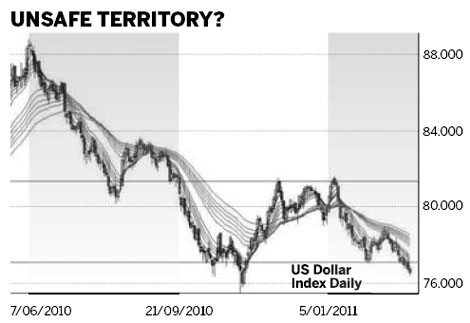
This has not happened. The US dollar Index has moved below critical support levels while other currencies have moved up. The flight to safety and low-risk environments have bypassed the US dollar and moved into the Japanese yen and the Swiss franc. The yen increased by 0.7 percent and the Swiss franc by 2 percent. Compare this with 2008 when the US dollar rose by around 24 percent as money sought a safe haven during the financial collapse.
The US Dollar Index chart confirms the story, and also gives some indication of the potential downside. In November 2010 the US dollar hit new long-term lows near $0.77 against a basket of other currencies. This was followed by a rapid rebound, and then retreat toward historical support levels near $0.77 in February 2011. These historical support levels were tested again in the final days of February. It appeared there was a high probability of a double-bottom rebound pattern developing. This double bottom is a classic pattern of trend-reversal and suggested a strengthening US dollar.
The support level at $0.77 has failed to hold and this calls for a revision of market analysis. The next support level is near $0.755. This is substantial weakness and shows a move out of the US dollar as a safe haven currency. A fall to these levels has the momentum to drop even further and potentially re-test the lows near $0.72.
| ||||


The quantitative easing policies continue to keep US interest rates low and this encourages capital to flow into other currencies. It contributes to the inflationary cycle, which in turn triggers an increase in interest rates.
The prospect of increasing levels of US debt and the apparent unwillingness to take the same medicine as prescribed for other debtor nations adds to the decline of the US dollar as a haven. The US dollar faces increased competition as a reserve currency. The soft internationalization of the yuan has received a boost from this reluctance to rush to the US dollar.
The failure of support near $0.77 and continued weakness in the US Dollar Index chart makes it more difficult for other economies. Trade wars start from currency weakness. These extremes of movement in the US dollar Index confirm continued currency volatility. Investors and commodity buyers need to include this volatility in their hedging strategies. They also now need to include a greater level of dollar weakness as many investors have comprehensively rejected the US dollar as a low-risk haven.
The author is a well-known international financial technical analysis expert.
| 分享按鈕 |