Opinion
The real economy, not the yuan, stupid
By Yao Yang (China Daily)
Updated: 2011-01-17 16:29
 |
Large Medium Small |
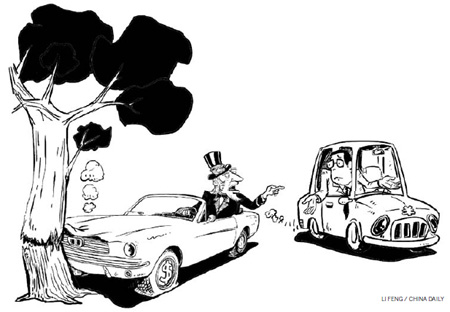
The year 2010 was bumpy for Sino-US relations. On the political front, the United States has been irritated by what it sees as an "overly confident" China. On the economic side, China's revaluation of the yuan cannot satisfy some Americans' appetite for a buoyant rise of the yuan in the range of 20 to 40 percent.
Against this background, some Americans, especially people on Capitol Hill, see President Hu Jintao's state visit to the US this week as an opportunity to increase pressure on China to make bolder progress on the yuan issue. On the Chinese side, however, no giant steps will be taken; the yuan is already on the revaluation track.
To a large extent, the Chinese leadership's cautious attitude toward the yuan is understandable. Many people in the US, including a number of China experts, have failed to realize that like its American counterpart, the Chinese leadership, too, puts employment at the top of its agenda. In the US, the motive is votes. In China, it is social stability.
The revaluation of the yuan, however, may not have a great effect on employment in China. Researchers at the China Center for Economic Research and the National School of Development in Peking University did a simulation study on the effects of the yuan's revaluation on the Chinese as well as the US economies.
They found that a 10 percent revaluation of the yuan would have minor effects on employment in China and the US. In China, employment will drop by 1.47 percent; in the US, it will increase by a negligible 0.06 percent. A 5 percent revaluation would have an even minor effect. The Americans, therefore, are barking up the wrong tree.
The debate on the dollar-yuan exchange rate, too, fails to appreciate the fact that the Chinese and US economies are so deeply interdependent that it has become hard to define their separate "interests". China's is one of the most open economies when it comes to attracting foreign direct investment (FDI). FDI companies contribute to half of China's exports. US companies operating in China contribute 44 percent of Beijing's trade surplus with Washington, with companies from other countries contributing another 20 percent. In 2009, iPhone alone contributed $1.9 billion to China's trade surplus with the US.
The Americans portray global trade imbalance as a destabilizing factor for the world economy. But a deeper analysis will reveal another perspective. China's "excessive" savings have been created by China's "double transition": migration of workers from the countryside to cities and the huge increase in the country's working-age population. In the last decade, more than 100 million rural residents entered cities. And today, China's working-age population comprises 71 percent of the total, the highest in the world.
China could have used its savings within the country. But the US has greater capability than China to invent new technologies, so using the savings in that country would generate higher income - if not now then in the future. Therefore, China and the US could engage in an inter-temporal trade in which China can store its savings (in bonds or other kinds of assets) in the US, which in turn can invest them in new technologies and generate higher income. That is to say, the Chinese and the US governments could have used the global imbalance to improve their peoples' welfare.
Unfortunately, the above scenario exists only in theory. In reality, the US is not investing the money from China to generate income. Instead, it is using it to buy products made in China. This entails losses for both countries in the future and has made the global imbalance a real problem today.
| ||||


But the defeat of the Democrats in the mid-term election has made that impossible to achieve politically. The Republicans do not like government spending and they have become more assertive on Capitol Hill after their mid-term election victory in November.
In contrast, China is moving decisively toward a more balanced growth. One of the goals of the 12th Five-Year Plan (2011-2015) is to reduce China's reliance on external demand. China is taking concrete steps consistent with this goal and in response to US Secretary of Treasury Tim Geithner's call to contain the current account surplus/deficit within a reasonable range.
President Hu is likely to send out more positive signals during his visit to the US. The year 2011 thus will see deeper cooperation between China and the US. Instead of being bogged down by the yuan's exchange rate, the two countries are likely to work on broader issues with the aim of rebalancing their economies. The ball is in now in the US court, and American policymakers have to realize that changes have to come from the real economy.
The author is a professor and director of China Center for Economic Research, Peking University.
| 分享按鈕 |