Specials |
 BUSINESS Economy
Companies
Money
World Business
Statistics
InfoGraphic
Newsmaker
Biz Unusual BUSINESS Economy
Companies
Money
World Business
Statistics
InfoGraphic
Newsmaker
Biz Unusual
|
|
Japan's lower-than-expected growth in the second quarter has definitely pointed to the imminent prospect of China overtaking Japan as the world's second-largest economy at the end of this year. But the international community should refrain from expecting too much from a developing economy that is still relatively poor per capita.
|
News |
China 'overtakes Japan in economic prowess'
Japan's nominal gross domestic product (GDP), which is not adjusted for price and seasonal variations, was worth $1.286 trillion in the April-to-June quarter compared with $1.335 trillion for China, according to data released by the Japanese government on August 16.
Japan's GDP grew at an annualized rate of just 0.4 percent, the government said, far below the annualized 4.4 percent expansion in the first quarter and adding to evidence the global recovery is facing strong head wind.
China's economy will almost certainly be bigger than Japan's at the end of 2010 because of the huge difference in each country's growth rates. China is growing at about 10 percent a year, while Japan's economy is forecast to grow between 2 to 3 percent this year. Full story

| Round Table | |||||||||||
|
As per per?capita?GDP criterion, one of the most important indicators in identifying whether a country is a developed or a developing one, China cannot be regarded as a middle-income country, let alone be placed on a par with Japan. |
China is now the second-largest economy. It becomes increasingly hard to defend all these protectionist policies,as the US and Europe complain that China keeps its trade gap high by manipulating its currency and shielding its own companies from competition, America could push for China to reduce its trade imbalance. " | ||||||||||
|
French economist Diana Hochraich: China is still a developing country with its per capita income ranking behind although the country has replaced Japan to become the world's "No 2 economy." The economic model of China "is still mainly based on subcontracting, providing labor-intensive segments for re-exportation.
|
?
 |
Li Qingyuan, scholar of international studies: The large proportion of China's rural and impoverished population means the country has not yet extricated itself from a developing nation status. Of the country's 1.3 billion population, 700 million, or about 58 percent, still live in rural areas, seven percentage points higher than the world's average level of 51 percent. | |||||||||
|
Yang Yi, professor at the School of International Relations and Diplomacy, Beijing Foreign Studies University: Despite the fast expanding GDP, China is still bothered by such domestic problems as poverty and a widening wealth gap, which thwarts its efforts to take on more international responsibilities. How much China could contribute to the international community depends on how well it could address domestic economic problems. |
Lei Yanhua, researcher with the Chinese Academy of International Trade and Economic Cooperation affiliated to the Ministry of Commerce: Responsibility on the international scene should result in a greater say in global bodies. When China takes more responsibilities internationally, it should have a greater voice in major international organizations on key global issues. | ||||||||||
|
Opinion |
China still behind Japan economically
Analysts who are against using GDP as the primary indicator of a country's overall strength prefer the concept of per capita GDP. According to the International Monetary Fund, China's GDP per capita in 2009 was only $3,566, significantly lower than that of Japan ($39,573). China only ranked 99th worldwide in terms of per capita GDP.
 GDP per capita is one of the most important indicators in identifying whether a country is a developed or a developing one. As per this criterion, China cannot be regarded as a middle-income country, let alone be placed on a par with Japan, whose economy has been the world's second largest for over four decades. Full story
China still a developing country: French economist
The economic model of China "is still mainly based on subcontracting, providing labor-intensive segments for re-exportation," French economist Diana Hochraich was quoted by French newspaper La Tribune.
"Actually, China continues to import 70 percent of what it exports and it is mainly the foreign companies that export sophisticated products from China," said Hochraich, an expert on the Asian economy who has worked with the Ministry of Economy for many years. Full story
China's ascent in economic power
On the one hand, China has already become a major driver of global growth. Accounting for about one-third the size of the US economy - the world largest - China has not only replaced the US as the world's largest auto market, it has also passed Germany to become the world's biggest exporter last year.
On the other hand, as the world most populous nation, China's per capita income is merely about one tenths those of the other biggest economies, ranking about 100th in the world. Full story
China isn't really taking over the world
A close look at the key economic metrics and the subtler shades of power, such as cultural influence and humanitarian aid, reveals that while China is indeed one of the great powers in the world now (late last month it officially overtook Japan as the world's second-largest economy), its influence is mixed, and often undercut by America's.
While China's trade with regions like Africa and Latin America is growing exponentially, it is still outpaced by America's, which tends to be more diverse. In Asia, China is now the dominant trading partner, yet the flows are mainly in low-end goods, while America dominates higher up the food chain. US aid and foreign direct investment in these regions still eclipses that of the Chinese, and its soft power still reigns, as does its military might, despite recent Chinese buildups in this area.Full story
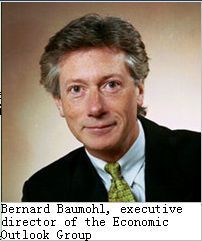
As the US and Europe complain that China keeps its trade gap high by manipulating its currency and shielding its own companies from competition, America could push for China to reduce its trade imbalance, said the article. "China is now the second-largest economy. It becomes increasingly hard to defend all these protectionist policies," Baumohl said.
Moreover, with China's rise to the No. 2 economy, said the article, politicians in the US may have additional firepower to seek retaliatory measures, which could be bad for both sides. "With the US trade deficit at its largest in more than two years, Sen. Charles Schumer of New York has been pushing for a bill that could hit Chinese companies with a new round of tariffs." Full story
With power comes responsibility
|
Background |
Experts urge fairer income distribution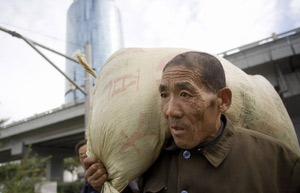
Despite the government's efforts to deepen reform of the income distribution system, there are still many challenges and obstacles, analysts said.
A total of 23 provinces, regions and municipalities in China raised their local minimum wages in the first half of this year, according to the Ministry of Human Resources and Social Security.
Some provinces, such as Hubei, Hunan, Shandong and Guangdong, have increased their rate more than 20 percent, and Shanghai has the highest monthly minimum wage in the country - 1,120 yuan ($165.40).
Developing country status
The large proportion of China's rural and impoverished population means the country has not yet extricated itself from a developing nation status. Of the country's 1.3 billion population, 700 million, or about 58 percent, still live in rural areas, seven percentage points higher than the world's average level of 51 percent.
According to the, "one dollar a person a day", poverty standard set by the United Nations, China still has 150 million people living below the poverty line, unevenly distributed in 512 poor counties. Even according to the low-income standard worked out by China in 2009 - which set an annual income of 1,067 yuan as the threshold dividing those who weren't living in poverty from those who were - the country still has about 43 million people living in poverty, a figure equivalent to the whole population of the People's Republic of Korea and five times Singapore's population. Full story
Protecting society's most vulnerable
How can we make sure that poor, sick, and marginalized people don't get left behind in the process of economic development? What needs to be done to protect these vulnerable groups in times of crisis?
In China, the rural communities have yet to reap many benefits from the country's rapid progress. There is now a big focus on helping the rural poor climb out of poverty. Full story