BIZCHINA> Top Biz News

|
BIZCHINA> Top Biz News
|
|
Warming of plateau is 'threatening all Asia'
By Miao Xiaojuan from Xinhua (China Daily)
Updated: 2009-08-18 07:51
The Qinghai-Tibet Plateau, one of the most susceptible areas on the planet to global warming, is heating up at such an alarming rate that experts fear it will suffer environmental deterioration and water shortages that may threaten the entire continent. "The Qinghai-Tibet Plateau is among the regions worst hit by global warming," said Qin Dahe, of the Chinese Academy of Sciences (CAS). "In turn, this will have a deleterious effect on the global climate and also the livelihood of Asian people." Qin, who is the former head of the China Meteorological Administration (CMA), was the first Chinese person to cross the South Pole. He pointed out that the temperature in the Tibet autonomous region rose by an average of 0.32 degrees Celsius every 10 years between 1961 and 2008. That rate of warming was much faster than the average across China, where temperatures rose by between 0.05 and 0.08 degrees. Tibet's average temperature in July was the highest since 1951, according to CMA data.
And, during the same month, there was between 30 and 80 percent less rain in western and southern Tibet than in the same month in previous years. "Due to global warming, glaciers on the Qinghai-Tibet Plateau are retreating extensively at a speed faster than in any other part of the world," Qin said. "In the short term, this will cause lakes to expand and bring floods and mudflows." He said the climate changes will cause widespread problems across the region. "In the long run, glaciers are vital lifelines for Asian rivers, including the Indus and the Ganges. Once they vanish, water supplies in those regions will be in peril." Yao Tandong, one of China's leading glacier experts and director of the Qinghai-Tibet Plateau Research Institute of CAS, echoed Qin's view, adding that glaciers were accurate archives of climate changes. "Glaciers on the plateau show warming has been abrupt and exceptional. It is warmer now than at any time during the past 2,000 years," Yao said. The plateau is the world's third-largest store of ice. So far, 82 percent of glacier surfaces on the plateau have retreated and the glacier area itself has decreased by 4.5 percent during the past 20 years. The Intergovernmental Panel on Climate Change (IPCC), a United Nations body studying global warming, predicted in May that Himalayan glaciers (including the Qinghai-Tibet Plateau) could vanish within three decades at the present rate of warming.
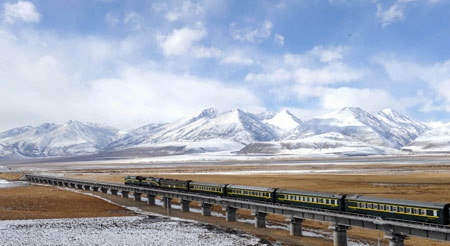
Another huge threat from warming is the degradation of the permafrost - the perennially frozen ground, Qin said. "Permafrost plays a vital role in protecting the ecological environment and hydrological cycles. But it has been breaking down during the past 50 years," Qin said. He pointed out that if vegetation on the plateau decreases, "consequent absorption of solar radiation will change the intensity of summer monsoons in Asia. This will bring drought to north India and intensify floods in southern China and droughts in the north". He said construction in the area will also suffer. "The Qinghai-Tibet railway and highway surfaces may possibly become deformed in the future," Qin warned. But Cheng Guodong, a CAS researcher and member of the Qinghai-Tibet railway project team, was more optimistic. "After we took measures to cool the permafrost under the railway, it hasn't melted during the past three years. I believe the railway will be safe over the next 50 years," he said.
"Warming is good for agriculture and tourism. It has increased the growing season of crops," Qin said. Scientists agree that the Himalayan region is one of the most sensitive and vulnerable to global climate change. It has seen consistent warming during the past 100 years. "The region is like an antenna and reacts quickly to global warming," said Andreas Schild, director general of the International Center for Integrated Mountain Development in Nepal, when speaking at the 5th International Symposium on the Qinghai-Tibet Plateau in Beijing last week. "Warming will also evaporate more water into the stratosphere and thus accelerate warming, which will influence or even alter global climate," said Schild. As the world's highest and most complex mountain range, the Himalayas stretch across six countries, including China, India and Nepal. Several major rivers in Asia, including the Yangtze, begin there, and their combined drainage basin is home to more than 2.7 billion people, Qin said. Schild said Asian nations should make systematic efforts and boost regional cooperation and look for ways to slow warming, as well as find ways to adapt to it. Warming has become "a cruel reality that many countries and regions in the world have to face, but it is not a problem that can be handled by one region or country alone", Qin said. (For more biz stories, please visit Industries)
|
主站蜘蛛池模板: 日韩大片在线永久免费观看网站| 理论片午午伦夜理片影院99| 国产成人精选在线观看不卡| 亚洲国产精品成人无码区| 亚洲欧洲中文日韩AV乱码| 日韩美女视频一区二区三区| 久久婷婷成人综合色综合| 狠狠躁日日躁夜夜躁欧美老妇| 欧美性XXXX极品HD欧美风情| 最新永久无码AV网址亚洲| 麻豆国产传媒精品视频| 久久热99这里只有精品| 亚洲第四色在线中文字幕| 精品人妻免费看一区二区三区| 国产精品亚洲欧美大片在线看| 图片区偷拍区小说区五月| 国产精品天堂蜜av在线播放| 午夜免费国产体验区免费的| 日本乱人伦AⅤ精品| 人妻系列无码专区69影院| 韩国一级永久免费观看网址| 人妻精品中文字幕av| 亚洲最大国产精品黄色| 亚洲区成人综合一区二区| 丁香花成人电影| 亚洲乱码国产乱码精品精| 2021国产在线视频| 免费激情网址| 色天天天综合网色天天| 18禁超污无遮挡无码网址| 激情五月开心婷婷深爱| 国产精品天天在线午夜更新| 国产成人亚洲日韩欧美| 国产一本一道久久香蕉| 日韩精品国产精品十八禁| 丰满熟女人妻大乳| 五月婷之久久综合丝袜美腿| 乱女乱妇熟女熟妇综合网| 亚洲熟妇色自偷自拍另类| 精品国产一区二区三区久久女人| 精品午夜福利在线视在亚洲|