BIZCHINA> Top Biz News

|
BIZCHINA> Top Biz News
|
|
Booming sales cheer home appliance makers
By Liu Jie (China Daily)
Updated: 2009-07-08 07:59
If you, like thousands of personal investors in China, are wondering what hot stocks to pick to cash in on the market bull run, take a walk down Shanghai's busy Huaihai Road and feel the heat. Indeed, the heat wave that baked nearly half the country for over a month and sent the mercury in many municipalities, provinces and autonomous regions to record highs is also setting off a rush by hundreds of thousands of consumers for air conditioners, refrigerators and other cooling aides. While in the shops, they were also picking up other consumer durables such as washing machines, flat panel television sets and cooking ranges. The buying spree has been further boosted by the government economic stimulus package that calls for, among other things, generous subsidies to consumers in the rural areas for the purchase of big-ticket electrical appliances. Not surprisingly, leading consumer electronics manufacturers like Gree, Midea and Haier and their foreign counterparts are laughing all the way to the bank. Sales of air conditioners, for instance, have been growing at double-digit rates since May. Suning, a leading consumer electronics retail chain, reported that sales of all white goods in its Beijing outlets in June jumped more than 200 percent from a year earlier. The sales bonanza is particularly welcomed at a time when the prospects for consumer electronics makers around the country is clouded by the global economic downturn, resulting in a fall in overseas demand. To be sure, not all household appliances are flying off the shelves. Retailers said the economic softening hasn't gone unnoticed by consumers, who have become increasingly concerned not only about the purchase price, but, more importantly, about cost of usage. For that reason, energy-saving products, especially those that contain new materials and technologies, are in demand, retailers said. The manufacturers best known for their energy-saving products "are most welcomed in the market", said Hu Yali, analyst, CITIC Securities. The central government has started providing subsidy to produce 10 kinds of high-efficiency and low-emission household appliances, including air conditioners, refrigerators, washing machines and televisions, since June 1. Subsidies to producers of energy-saving household appliances will directly help reduce producing costs and cut retailing prices, said Hu, citing the air conditioner sector as an example. In line with government provisions, manufacturing of conversion air conditioners, a type more efficient and greener than the traditional products, can get fiscal subsidy of 10 percent. So, if a set of conversion air conditioners was priced at 5,000 yuan ($731.5) in the store originally, about 1,500 yuan higher than the traditional type, its price should drop to 4,500-plus yuan after the subsidy. Electricity used by air conditioners makes up around 20 percent of China's household electric consumption. That percentage goes up every summer to 40 percent in key cities because of the wide use of air conditioners, according to Zhao Jiarong, director of the Environment and Resource Department under the National Development and Reform Commission. "Promotion of energy-saving air conditioners should be on agenda," he said. Wang Jingdong, spokesman of Zhuhai-based Gree Electric Appliances Inc, said that the air conditioner specialized company has stopped manufacturing traditional products and all its products from this season are energy saving ones. "In addition to government subsidy, our company provides more choices to consumers," said Wang. He said a particular type of air conditioner which was priced at 3,360 yuan originally, can now be purchased in Suning for 2,599 yuan. Midea, the Guangdong-based household appliances producer, is also taking more efforts to upgrade its technology and style. "We believe that if a consumer wants to buy an energy-saving product, he/she must have high environment awareness and be not much price sensitive, so niche technology and stylish designs are essential," said Yang Jun, general manager of Midea Guangzhou.
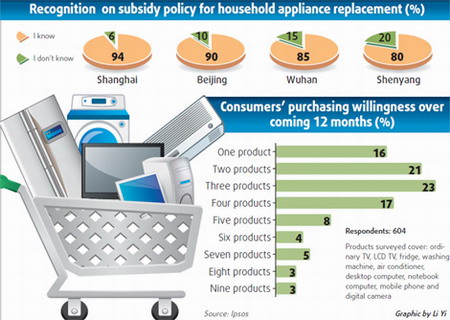
Air conditioner sales of Suning Beijing jumped 200 percent and 400 percent year-on-year on June 25 and June 28 respectively. "Products bought by consumers are mainly energy-saving air conditioners," said Fan Zhijun, vice-president of Suning Appliance. The consumer appliance chain, with nearly 1,000 stores across China, has collaborated with suppliers, such as Midea, Haier, Gree and Changhong, to carry out large-scale promotion campaigns, focusing on reduced prices and enhanced services. Chen Mingzhen, a 50-year old Beijinger, told China Daily that she would like to choose a Gree conversion air conditioner with a retail price of 3,886 yuan in a Suning chain. "Though it (conversion air conditioner) is somewhat expensive than the traditional one, its electric-saving function is attractive. In the long run, it is worth the price," she said. Meanwhile trials of the subsidy scheme for trading old household appliances for new ones has started in nine cities and provinces including Beijing and Shanghai. The preferential policy covers five types of commodities - TV, fridge, washing machine, air-conditioners and computers.
Analyst Zhu Lijun of Galaxy Securities pointed out that the policy would help accelerate consumers' enthusiasm for upgrading household appliances and, also create a channel for environmentally friendly recovery of old appliances. Sources from the National Bureau of Statistics (NBS) said Chinese families own 130 million refrigerators and 170 million sets of washing machines. Those appliances were mainly bought in late 1980s and 1990s. In line with industrial standards, most of them have expired and need to be replaced. According to NBS, home appliance consumption in China rose 12 percent year over year in May, compared with 0.6 percent year-on-year growth in April. "The increase is expected to be higher in June," said a report of the bureau. Though all the above seemed to be favorable news to home appliances manufacturers and retailers, some producers, analysts and consumers said more detailed provisions should be formulated and they are not too sure about the implementation of these subsidy policies. Pan Zhifeng, general manager of electric appliance company Skyworth Beijing, said the government has to clearly identify the terms of tradable old appliances. "If a product has been used for over 10 years, I don't think the owner should get the subsidy, as the ordinary life period of a home appliance is six to eight years," he said. How to set the subsidy cap is also a problem without detailed regulations, said Galaxy's Zhu. "If the cap is too low, the demand stimulus might be weak; if it is too high, high-end products may not be attractive to consumers," he said. "I am really concerned whether the price tagged is true," said Jiang Wen, 32, who planned to buy a refrigerator this year. "Some companies may label a higher original price and hence the preferential price is meaningless, so governmental or industrial supervision is needed to protect consumers' rights."
 (For more biz stories, please visit Industries)
|
|||||
主站蜘蛛池模板: 中文字幕成人精品久久不卡| 亚洲欧美综合人成在线| 免费三A级毛片视频| 五月国产综合视频在线观看| 亚洲国产精品久久久久秋霞| 色猫咪av在线网址| 欧美福利电影A在线播放| 国产蜜臀视频一区二区三区| 18禁成人免费无码网站| 亚洲毛片αv无线播放一区| 日韩淫片毛片视频免费看| 欧洲码亚洲码的区别入口 | 国产精品黄色精品黄色大片| 国产精品任我爽爆在线播放6080| 久久久久成人精品无码中文字幕| 国产精品自拍一二三四区| 成人3d动漫一区二区三区| 六月丁香婷婷色狠狠久久| 免费男人j桶进女人p无遮挡动态图| 国内不卡一区二区三区| 天天摸日日添狠狠添婷婷| 国语精品自产拍在线观看网站| 精品国产中文字幕在线| 日韩精品一区二区三区四| 欧美国产国产综合视频| 色综合色综合色综合久久| 久热这里只有精品12| 欧美videos粗暴| 亚洲一区二区三区四区三级视频 | 国产啪视频免费观看视频| 成在线人午夜剧场免费无码| 少妇真人直播免费视频| 亚洲AV日韩AV高清在线观看| 在线观看中文字幕国产码| 麻花传媒免费网站在线观看| 久久久综合九色合综| 精品午夜久久福利大片| 又色又无遮挡裸体美女网站黄| 亚洲 日本 欧洲 欧美 视频| 综合色亚洲| 在线 欧美 中文 亚洲 精品|



