BIZCHINA> Review & Analysis

|
BIZCHINA> Review & Analysis
|
|
New strategy needed in antidumping cases
By Jiang Diqing (China Daily)
Updated: 2009-05-18 08:03
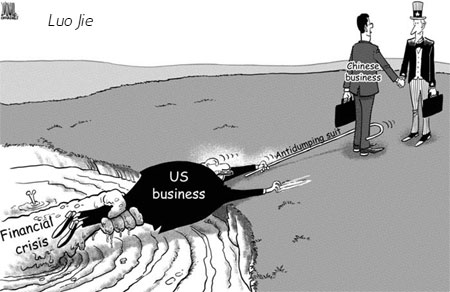 China may face more antidumping cases during the global economic slowdown. It is not rare for trade disputes to erupt between China and the US with more than 70 antidumping cases having been filed so far, but petitions have never been filed as frequently as they have this year. On April 23, the US International Trade Commission determined that circular welded carbon quality steel line pipes from China were sold at less than fair value in the US market, to the detriment of the domestic steel industry. The US Department of Commerce then issued an antidumping order on imports of such products from China.
The rapid buildup of antidumping cases is partly due to the economic crisis. In the name of pursuing fair trade, fanatic US businesses accuse China of exporting at prices below the cost of production. But the prices of Chinese export products has not changed much in recent years. If they are priced below production why were the petitions filed now rather than much earlier? US steelmakers were enjoying unprecedented profit growth and even planned to expand investment last April. But these businesses have lost competitiveness as globalization continues, since China and other developing countries boast unrivaled advantages in labor and raw material costs. Fading industries in the US, such as steelmaking, have survived or enjoyed temporary prosperity in recent years because of lasting wars abroad involving the US and a lower interest rate policy during the Bush administration, which artificially spurred the property market. These industries were among the first hit when the global economy began to slow last year. With the economic crisis deepening, it is likely more US companies in declining industries will file trade cases against China and abuse of the antidumping bill could threaten free trade between the two countries. China needs to consider its response to these antidumping actions.
Chinese companies have historically won few antidumping cases mainly because they are not familiar with the legislating and operational procedures of the US Antidumping Bill. Some Chinese scholars say the antidumping cases are part of a larger, undeclared Sino-US trade war and that the US government is playing a role in the cases behind the curtain. To some extent, such an opinion makes sense, but is still far from the entire picture. Daniel Ikenson, an associate director of the Center for Trade Policy Studies at the Cato Institute, said the antidumping cases are conflicts between companies, rather than part of a bigger economic dispute between nations. The Commerce Department seems to be playing a key role in the cases by taking responsibility for approving investigations, handing out surveys and deciding duties. But the organization at the core of the trials is the US International Trade Commission, a quasi-judicial federal agency with broad investigative responsibilities on matters of trade. The Commission consists of six commissioners with tenure of nine years, all of them nominated by the president. There are usually three Democrats and three Republicans. China should pay more attention to winning the cases by preparing persuasive information, rather than speculating on potential political motivations behind the results. The companies most likely to file antidumping suits are in fading US industries, which tend to have been operating in the red for at least four consecutive months and whose labor unions are strong. American attorneys and economists tend to select favorable data when assessing dumping rates. Chinese companies should collect the necessary data to fight back. Otherwise fairly-priced Chinese exports might be unjustly judged to be selling at a dumping price. China should nurture a host of trade experts in particular industries, such as attorneys and economists with solid theoretical knowledge and extensive experience in domestic businesses and international economics. Chinese companies should learn to deal with different governmental and non-governmental institutions in the US. They should understand that in an open society filled by various voices, such as the US, an influential interest group might not necessarily represent the greater American interest. In the US, there are think tanks representing labor unions, there are also those that advocate market economy and free trade. The latter know exactly how much the antidumping bill has been abused by certain interest groups and how much that ultimately hurts the American people. Chinese businesses should enhance cooperation and exchanges with such US institutions as well as with the US media, which could help to reduce trade disputes between the two countries. The author is the head of the China program at the Cato Institute. The article was reprinted from China Business News (For more biz stories, please visit Industries)
|
|||||
主站蜘蛛池模板: 日韩精品专区在线影观看| 成人av片在线观看免费| 自拍偷在线精品自拍偷免费| 国产午夜在线观看视频播放| 欧美成人精品手机在线| 国产精品妇女一二三区| 白嫩人妻精品一二三四区| 人妻偷拍一区二区三区| 久久99精品久久久大学生| 亚洲中文字幕无码专区| 国产微拍精品一区二区| 日本午夜精品一区二区三区电影| 91福利国产在线观一区二区| 亚洲午夜精品国产电影在线观看 | 人禽交 欧美 网站| 国产一区二区在线有码| 日韩精品一区二区av在线观看| 成人免费av色资源日日| 国产成人精品亚洲午夜| 给我播放片在线观看| 青草青草久热精品视频在线播放 | 久久精品免费自拍视频| 精品国产乱码久久久久APP下载| 久久国产乱子精品免费女| 亚洲色无码播放亚洲成av| 欧美大bbbb流白水| 国产成人综合欧美精品久久| 国产偷窥熟女高潮精品视频 | 性虎精品无码AV导航| 日韩午夜一区二区福利视频 | 高清国产一区二区无遮挡| 无码 人妻 在线 视频| 最新永久无码AV网址亚洲| 国产AV影片麻豆精品传媒| 热99精品视频| 国产精品高清视亚洲中文| 亚洲女同精品一区二区| 日韩黄色av一区二区三区| 中文字幕乱码中文乱码毛片 | 秋霞AV鲁丝片一区二区| 国产91精选在线观看|



