BIZCHINA> Top Biz News

|
BIZCHINA> Top Biz News
|
|
Mind reader points to the future
By Erik Nilsson (China Daily)
Updated: 2009-02-23 08:04
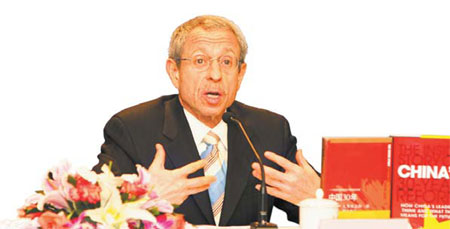
American Robert Lawrence Kuhn, already a bestselling author in China, has launched his latest book, How China's Leaders Think: The Inside Story of China's 30-Year Reform and What It Means for the Future of the World. The book is based on a 20-province tour and interviews with more than 100 ministerial leaders. Kuhn said it is designed to help Western readers understand the mindset of China's leadership, particularly Hu Jintao's political philosophy of the Scientific Outlook on Development, which appeals to Kuhn's background as a scientist. "It gives insight into how leaders think about these things, beginning with the top leaders, but emphasizing all other leaders right below them who are experts in these different sectors," Kuhn said. It also helps Chinese readers understand how a Westerner would present their country to the West, he said. The Chinese version was released in December 2008 and the English version will hit shelves around April. The book is the product of Kuhn's access to Chinese government officials and his role as a government advisor over the last two decades - uncommon for a Westerner. "I believe Chinese writers couldn't write such a book because it has to do with Mr Kuhn's unique experiences, the scope of his study and his understanding of China," said State Council Information Office Minister Wang Chen. Former Vice-President of the Party School of the CPC Central Committee, Xing Bensi - an integral figure in the "Truth Debate" of 1978 on the relativity of class truth - said Kuhn addressed the debate in an objective and accurate way that is "extremely rare for a foreigner".
"I believe this book will not only help foreigners understand China, but also it will be interesting for Chinese readers. It is very vivid, but it is from a foreigner's perspective, using a different language and logic," said senior Party literary official Leng Rong. Kuhn's 2005 book The Man Who Changed China: The Life and Legacy of Jiang Zemin was similarly based on his unique access to Chinese officials. It was the first biography of a living leader published on the mainland and was China's bestseller that year. Kuhn first came to China as a scientist and investment banker, attending a conference on science, technology and entrepreneurship reform in Beijing in 1989. His decision to come to the conference had nothing to do with its location, he said. "I had no interest, not only in China, but in any country," Kuhn said. "I loved science and studied a lot of philosophy and then became an investment banker." But the spirit of reform Kuhn saw in that first visit struck him. "People had the sense this was the beginning of a great resurgence of China, and people were saying, 'hey, we can do this'," he recalls. At the conference, Kuhn met Song Jian, then-chairman of the State Science and Technology Commission, and a State Council member. Song was then helming sweeping reforms in China's science and technology sectors. Later that year Song invited Kuhn to return as an advisor to his commission. For the next several years the New Yorker spent his holidays visiting China. Nearly 20 years later Kuhn has advised nine Chinese ministries in various sectors in addition to a slew of major institutions, such as CCTV, the Chinese Academy of Sciences and the Chinese Academy of Engineering. Kuhn never accepted money from the government on principle, he said. "It gives me a certain independence from the government that makes my advice stronger in one sense, and it makes me on a more parallel basis, as opposed to if there were funds changing hands," Kuhn said. "I enjoy the process, and I look upon it as a learning experience." A turning point in China came after a single-book synopsis of Kuhn's seven-volume Library of Investment Banking, the most comprehensive series of its kind, became the first on the topic translated into Chinese in 1996. The next year, the National People's Congress liberalized ownership, capital, and mergers and acquisitions (M&As). "I was very excited by this (but) every time I went back to the US, I became frustrated, because I saw tremendous misunderstandings of China." Americans had largely failed to recognize the transformations in China since the reform and opening up began, he said. So Kuhn filmed a series of eight half-hour TV programs on M&As for CCTV entitled Capital Wave and a 90-minute special for the US Public Broadcasting Service (PBS) aired in 2000 entitled Made in China: Voices From the New Revolution. The CCTV programs gave oomph to domestic interest in M&As. And the character-driven PBS special on "real China," which narrated the reform not only through business people but also through migrant laborers, laid-off workers and farmers, was named the Washington Post's pick of the week. "It whetted my appetite. I said, 'this is a wonderful area, I really want to do more '," Kuhn said. Mike Wallace interviewed then-President Jiang Zemin on 60 Minutes the same week the PBS special aired. "When I saw that interview, I realized that although I knew the contemporary China of that time, you know, the late '90s, 2000, very well in terms of reform, I realized I didn't know very much ... in terms of the history leading up to that," Kuhn said."I saw (Jiang as) someone who could be the vehicle to tell the story of China." Kuhn's book about Jiang followed a few years later. (For more biz stories, please visit Industries)
|
主站蜘蛛池模板: 久久精品中文无码资源站| 综合亚洲色图| 亚洲精品中文字幕尤物综合| 国产精品剧情亚洲二区| 日本55丰满熟妇厨房伦| 亚洲国产成人综合熟女| 久久久这里只有精品10| 精品无人区无码乱码毛片国产| 成人福利一区二区视频在线 | 福利一区二区在线播放| 欧美牲交a欧美牲交aⅴ图片 | 91精品国产高清久久久久久g| 老子影院午夜久久亚洲| 亚洲人成成无码网WWW| 国产一区男女男无遮挡| 国产一区二区内射最近更新| 亚洲综合一区二区三区| 人妻激情偷一区二区三区| 国产熟女精品一区二区三区| 亚洲国产精品一二三四区| 九九热在线免费视频观看| 国产线播放免费人成视频播放| 国产超高清麻豆精品传媒麻豆精品| 亚洲精品成人福利网站| 亚洲中文字幕无码久久精品1| 女主播扒开屁股给粉丝看尿口| 天堂网在线观看| 狠狠色噜噜狠狠狠狠色综合久| 亚洲人成亚洲人成在线观看| 国产V片在线播放免费无码 | 日韩精品中文字幕国产一| 亚洲国产美女精品久久久| 九九日本黄色精品视频| 亚洲高清免费在线观看| 国产精品污一区二区三区| 日本sm/羞辱/调教/捆绑 | 人妻丝袜AV中文系列先锋影音| 日本怡春院一区二区三区| 久操资源站| 国产精品亚洲А∨天堂免| 啦啦啦高清视频在线观看|