BIZCHINA> Top Biz News

|
BIZCHINA> Top Biz News
|
|
Let one billion customers bloom
By Diao Ying (China Daily)
Updated: 2009-02-23 08:04
A calligraphy painting and a statue of Lei Feng, the "model comrade" whom, in 1963, Chairman Mao Zedong said all Chinese should learn from, decorate James McGregor's office. McGregor, a tall, fast-speaking American in his early 50s is a journalist-turned businessman who started a Beijing research firm targeting US investors in 2007 after reporting on China's economy for the Wall Street Journal since 1990. McGregor said he is a fan of Chinese chengyu, idioms and slang, since they reflect the country's culture and psychology. He bought the Lei Feng statue near the Art Museum in Beijing in 1990 for 150 yuan, as a reminder to help others. Lei Feng was famous for helping others. McGregor's company, JL McGregor & Company, does independent research and compiles reports on Chinese companies listed overseas. Consultant firm Goldman Sachs invested $7 million in the firm last July. It has expanded quickly since, increasing its staff from 30 to over 90. Business has slowed amid the financial crisis but is still relatively steady since China is the only major economy that still has solid growth, said McGregor. Move descent to China The American of Scottish descendent said he is similar to the Chinese in many ways. He grew up in a family of nine kids and learned early how important it is to earn money and save. He does not take out loans and would only buy a house if he had saved enough money, like traditional Chinese used to do. He first came to China in the late 1980s and traveled around the country. He saw things were changing fast and that people were ambitious and eager to learn. The changes in China would likely be the most important in his lifetime, he thought, and he wanted to experience them firsthand. He persuaded his wife to come, telling her that their first stop in China, Taiwan, was an island just like Hawaii. They sold all their belongings in the US. The couple landed with two suitcases in Taiwan and started to learn the language. McGregor took Chinese lessons during the day and taught English at night. He had previously been a political journalist in Washington DC and was hired by the Wall Street Journal after a few months. Several years later the Wall Street Journal sent him to Beijing to work as their bureau chief on the Chinese mainland. His office was in Jianguomenwai, a diplomatic compound on Chang'an Avenue. He wanted to know what was happening with ordinary Chinese people but foreigners dominated his neighborhood. So he went out bike riding every night to find stories. He would try to talk with people pedaling beside him. But Chinese were reluctant to talk with foreigners in the early 1990s. "Sometimes I would use my daughter as a bait," he said. McGregor would take his one-and-a-half-year-old daughter to the front gate of department stores. Chinese, who rarely saw any foreigners at all, loved the blonde little girl with long curly hair. He did his interviews as they watched her. Beijing had few skyscrapers and people still mostly wore Mao suits but big changes in China's economy were already happening and there were many stories for a Western journalist. His first front-page story was about Yang Baiwan, or Millions Yang, as he called the 40-year-old steel factory worker in the story. Yang had a ninth-grade education but made over $100,000 a year by buying government bonds for pennies from workers in remote towns who thought they were worthless paper and selling them for huge profits in Shanghai's bond market. Writing about China's transforming economy taught McGregor about business practices in the half-reformed system. The job also brought him to rural areas of China and into contact with a variety of people. He talked to farmers before the Three Gorges Dam was completed, for example. Sitting at his office in Beijing's CBD, he said he misses the freedom and the traveling of reporting. Career change
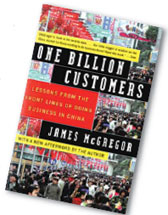
But he realized journalism was not a lifelong career for him. "You cannot grow old being a reporter anymore. It is really a young person's game," he said. "You either get promoted or you have to move on." If he had been promoted, he would have had to return to New York. He wanted to stay in China so he started to work with Dow Jones, the Wall Street Journal's parent company. He quickly applied what he learned about the country to the corporate world and started selling the idea of more than 1 billion customers to salivating Western companies, he said. At one point he went as far as to put on a Peking Opera outfit in an executive meeting as Dow Jones' newly-appointed chief business representative in China, including a chandelier-like hat, a knee-length fake beard and a billowing silk robe. He was adept at keeping Western companies up to speed on the changes happening here and the opportunities these changes brought. "My scheme worked," he said. He started Dow Jones in China from scratch and turned it into a company with several hundred employees. But as the company grew big and bureaucratic, he got itchy feet and started looking for a new challenge. He decided to write a book. Book on China It took him three years to write. He spent half of the time researching and interviewing people and the second half secluded in the snow-covered woods in Minnesota, with temperatures often below 40 degrees centigrade. He got up at 3:30 in the morning and wrote from 5 o'clock until the afternoon. Then he would do some physical work and edit and plan the next day's writing at night. He cut his Internet connection and his family was two hours' drive away. The most difficult part, he says, was to write his little red book of doing business in China after each chapter. In China, the little red book of Mao quotes was treated like the Bible in the 1960s and 1970s. McGregor wrote his book, One Billion Customers, to explain that China is not as mysterious as some people might think. "The Chinese are more like us than different from us," he said. In 2006 he traveled around the world on a book tour, answering questions about China from investors. He saw demand for more information about doing business in China, so he started his research firm with several old friends from China in 2006. (For more biz stories, please visit Industries)
|
主站蜘蛛池模板: 日本欧美大码a在线观看| 久久国产精品亚洲精品99| 国产一区二区三区精品综合| 久热这里只有精品视频3| 国产成人AV国语在线观看| 亚洲精品国产精品国自产小说| 国产免费一区二区不卡| 91亚洲精品一区二区三区| 久热这里只有精品蜜臀av| 视频一区二区三区中文字幕狠狠| 少妇被多人c夜夜爽爽av| 精品亚洲国产成人av制服| 狠狠人妻久久久久久综合蜜桃| 欧美人与禽2o2o性论交| 中文字幕欧美成人免费| 九九热在线视频只有精品| 亚洲韩欧美第25集完整版| 日本韩无专砖码高清观看| xxxxbbbb欧美残疾人| 精品无码久久久久国产电影| 亚洲乱熟女一区二区三区| 国产婷婷精品av在线| 九九久久精品国产免费看小说| 好吊色欧美一区二区三区四区| 亚洲日韩性欧美中文字幕| 国产精品成人精品久久久| 巨爆乳中文字幕爆乳区| 99精品国产一区二区三区| 最新国产精品亚洲| 久久国产精品久久精| 精品人妻二区中文字幕| 99久久免费只有精品国产| 国产精品自产拍在线播放| 亚洲av无码专区亚洲av伊甸园| 日本一区二区中文字幕久久| 色综合天天综合天天综| 久久成人成狠狠爱综合网| 久久精品国产亚洲AⅤ无码| 久久精品熟女亚洲av麻| 精品久久久久久无码不卡| 亚洲精品久久无码av片软件|