BIZCHINA> Top Biz News

|
BIZCHINA> Top Biz News
|
|
Shenhua shows the way to make gas from coal
By Si Tingting (China Daily)
Updated: 2009-01-22 07:58
 In the middle of the Ordos Desert that borders North China's Inner Mongolia autonomous region and Shaanxi province, a huge factory was recently built to perform the kind of tricks that most people believe only magicians are capable of doing - turning black solid coal into clean liquid fuels.
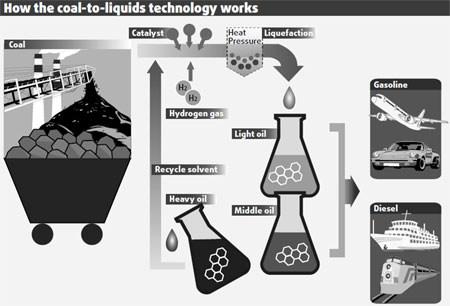
Although relatively unfamiliar in most people's vocabulary, the technology dates back to World War II when German scientists developed a technology to convert coal into liquid fuels like gasoline and diesel. With oil prices falling since 1985, the interest in coal liquefaction also slowly declined across the globe. China, a net oil importer with rich coal reserves, however decided to pursue the efforts and teamed up with the US, Japan and Germany for feasibility studies in Inner Mongolia autonomous region, Heilongjiang province and Yunnan province, respectively. Shenhua's proposal of building a direct coal liquefaction plant in Ordos in Inner Mongolia was granted State approval in 2002, and after seven years of efforts, this world's largest direct coal liquefaction facility rose from paper, adopting a cutting-edge technology tested only on some small demonstration programs before. The first trial operation of this 10-billion-yuan facility was launched on Dec 30, 2008 and the quality end products, namely diesel, naphtha and liquefied natural gas, came out on the second day. The trial was stopped after it ran successfully for more than 300 hours. "We are happy to see the trials going on for over 24 hours. So far the results have far exceeded our expectations," said Zhang Jiming, manager, Shenhua direct coal-to-liquids (CTL) project in Ordos. "With the success of the trials, China officially becomes the first country in the world to have the core competence to build and run a direct coal-to-liquids project capable of producing 1 million tons of fuels annually," he said. "If the second trial operation, to be launched in summer, turns out to be a success, its production will be normalized and we will begin to expand this project to three times its current size," Zhang said. By then, the entire coal liquefaction facility would be able to contribute 3 million tons of clean fuels annually. China imported 178 million tons of crude last year, and its oil import dependency was around 50 percent. "Coal liquefaction could greatly reduce the country's dependence on foreign oil when it is widely adopted, but mastering the technology is our priority for now," he added. Zhang Xiwu, chairman, Shenhua Group, equates the importance of Shenhua's direct coal liquefaction technology to the satellite monitor technology demonstrated in the successful mission of China's third manned spacecraft Shenzhou VII last September. The end products are composed of 70 percent clean diesel, and the rest are liquefied natural gas and naphtha, which could be used as chemical feedstocks. "This technology certainly produces clean fuels with low sulfur, nitrogen and metal content. We minimize the pollutants and could achieve almost zero-emission during the production process," Zhang said, adding that the diesel produced with his CTL process is even cleaner than fuels of Euro V emission standards. However, debates over the economic viability to put the coal liquefaction technology into full-scale commercialization never abate, but only grow louder after international crude prices dropped significantly from a record $147.27 a barrel in July 2008 to as low as $33.87 in December.
Coal can be used to produce liquid fuel suitable for transportation applications by removal of carbon or addition of hydrogen, either directly or indirectly. Direct liquefaction is one of the most efficient technologies currently available for this. However, the cost of converting coal into liquid fuel is higher than the cost of refining crude. What still makes the technology attractive to pursue is the relative price of coal and oil. Shenhua Group completed the feasibility study of the direct CTL project in 2001 when international oil prices were about $23 a barrel. But experts believe that a CTL plant in China needs an oil price of $40 or more to be free from financial risks. "If this line's operation could be normalized, we can definitely make ends meet. However, to make this operation more economically sound, we have to expand its scale," said Zhang. "Anyway, the price of coal here is very cheap. Actually, our project is sitting right on top of a large coalfield that could feed this project for over 100 years," he said. With a proven coal reserve of 223.6 billion tons, Ordos is listed as the eighth biggest coal mine in the world. "Despite all the talks about economics, I feel it a must for China to master the technology, as the country needs more and more liquid fuels, most of which are imported. The pirates along the oil transportation routes and the political changes in the Middle East are affecting our imports," he said. "The fuel we produce out of coal could be an important source of strategic oil reserves to ensure energy security." The National Development and Reform Commission issued a notice in September to suspend all other CTL projects except for the two run by Shenhua, one in Inner Mongolia and the other in Ningxia Hui autonomous region, saying there are still risks involved in this technology and capital-intensive business. Since then, Shenhua is the only official player in this mega-buck game. According to Zhang, the CTL project needs an investment of 10 billion yuan to increase capacity by 1 million tons and it could make better profit when it is run on a large scale. The project, however, had its share of critics too, who termed it an environmental hazard. Many people believed that the CTL project is water-consuming and hence the decision to build the facility in the middle of a desert could be definitely unwise, said Kenneth G. Tasker, director and technical advisor, Axens, a US company which provides engineering design and technical services for the Ordos project. "However, they didn't know that the CTL project has installed a facility to achieve complete recycling of the water used," he said. To provide enough water for the Ordos CTL project, groundwater is piped in from 100 kilometers away. Statistics show that the project needs about 6.5 tons of water to produce one ton of liquid fuel. The water consumption per unit of industrial value-added is only about 7 percent of the nation's average level. "In addition, with this piped-in water, the trees we grow in the middle of this desert could be watered everyday. These trees could keep the sand down, so that it does not blow towards Beijing," he said. The process of converting coal into liquid fuels releases CO2, just as the extraction and refinement of liquid fuel production from petroleum would do. Therefore, the Ordos project has proposed to adopt carbon dioxide sequestration measures to avoid releasing it into the atmosphere, said Zhang. "Though sequestration will add to the cost, we will carry on with the feasibility study and apply it when the expansion project gets started," he said.
 (For more biz stories, please visit Industries)
|
|||||
主站蜘蛛池模板: 亚洲熟妇色xxxxx亚洲| 亚洲精品日韩久久精品| 国产欧美久久一区二区三区| 男人一天堂精品国产乱码| 老司机aⅴ在线精品导航| 亚洲日韩一区二区| 正在播放国产剧情亂倫| 92自拍偷拍精品视频| 日韩有码中文字幕av| 激情中文丁香激情综合| 亚洲国产精品一区二区久| 国产欧美综合在线观看第十页| 中文字幕无码av不卡一区| 国产对白老熟女正在播放| 中文字幕亚洲精品人妻| 四虎成人精品在永久免费| 亚洲一线二线三线品牌精华液久久久| 精品人妻伦一二三区久久aaa片| 国产午夜精品久久精品电影| 亚洲人成在线观看网站不卡| 国产91特黄特色A级毛片| 亚洲乳大丰满中文字幕| 亚洲伊人久久成人综合网| 成人免费A级毛片无码片2022| 国产h视频免费观看| 欧美成人精品三级在线观看| 久久精品第九区免费观看| 在线高清免费不卡全码| 亚洲免费自拍偷拍视频| 日韩精品亚洲精品第一页| 国产精品无套高潮久久| 亚洲综合伊人五月天中文| 亚洲韩欧美第25集完整版| 麻豆一区二区三区精品蜜桃| 亚洲伊人久久综合成人| 色综合色综合色综合频道| 中文字幕在线视频不卡一区二区| 少妇人妻av毛片在线看| 亚洲成aⅴ人在线观看| 亚洲中文久久久久久精品国产| 国产精品乱码高清在线观看|



