BIZCHINA> Top Biz News

|
BIZCHINA> Top Biz News
|
|
New ideas for an old village take rural roots
By Fu Jing (China Daily)
Updated: 2009-01-12 07:57
At first glance, Wuxiongsi Village in suburban Shunyi district of Beijing is still a typical rural community in northern China. About 400 one-floor households live in walled-yards arranged door-by-door in a concentrated open area. Roughly one-hour-drive from downtown Beijing, the residential blocks are linked by narrow pavements. But some households have locked their doors for years after the owners moved to other towns or downtown Beijing. A villager Liu Yayin, in her 50s, says the exit has had a plus side, however. "Put simply, the village is cleaner, much more pleasing and comfortable than before," said Liu with pride. "But several years ago, it stunk to high heaven." Liu's earlier complaints came because there was no sewage drainage system in the village and several blocks of households shared a public toilet and cattle were kept next to the residence of every family before 2006. But now, every family is equipped with septic tanks and trash bins. A complete drainage system has been installed and all the pollutants and waste water are channeled to an artificial wetland, where degradable plants treat the sewage. Behind the environmental and residential progress are two architects. One is Zhang Yue, associate professor with Tsinghua University, who has been long interested in village renewal and rural architectural culture. And the other is Ni Feng, officer of Beijing Municipal Commission of Urban Planning who has been sent to Shifang, Sichuan province to join in the post-quake recovery efforts. "Through public participation the villagers and we have been taught by each other to seek what is comfortable and sustainable in the village step-by-step," says Zhang. "We have finished the infrastructure and it works well." Even though only a small part of Zhang and Ni's blueprint has turned into reality, the Wuxiongsi village stood out in November in a competition conducted by the Swiss-based Holcim Foundation for Sustainable Construction to promote sustainable responses from the building and construction industry to technological, environmental, socioeconomic and cultural issues. Zhang and Ni's planning for the village won the $100,000 Gold Award in Asia Pacific area and they will know by the first half of this year if they will win the global award competing against 5,000 projects from 90 countries. The jury also said that Zhang and Ni's comprehensive urban planning strategy improved logistics, public utilities and services while meeting stringent ecological and energy-saving targets for new buildings. Jury head and acclaimed Indian architect Ashok B Lall praised the detailed approach to challenges of pollution, urban sprawl, loss of agricultural land and limited resources. "The project has a high potential to become a role model for the sustainable development of rural communities and urban districts in emerging economies experiencing rapid change," he said. Zhang, however, isn't basking in the praise and said, "More tough tasks are still ahead to renew the whole village and fulfill the whole plan." Zhang and Ni also have another project in mind. "We are planning to use part of the award income to support a sustainable village design in Sichuan," Zhang said, adding he will be spending the Spring Festival break on a feasibility study in Shifang, where Ni works as deputy mayor in charge of urban and rural construction. Pressing task
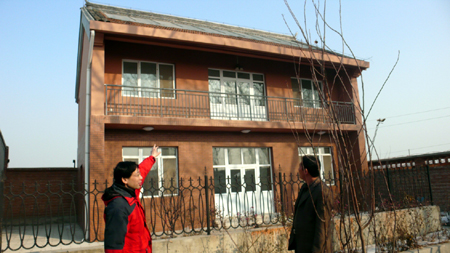
For Zhang, the improved infrastructure, sewage treatment and drainage system was only a tiny part of a sustainable village. "Many elements can enrich the ideas of an eco-village," said Zhang. First of all, land space and use is vital. Currently, all of the households are living in one-floor yards. "If they rise to two-floor buildings, at least half of the potential construction land can be saved for other commercial purposes," said Zhang. "The wallets of the villagers will be fattened if this comes true." For individual household design, Zhang plans to implement an eco-strategy. The local agricultural straw waste is enormous and it will be processed to become biodegradable exterior insulation material, instead of being burned and causing air pollution. In his plan, solar panels and methane pools will be equipped for every household. In addition, a rainwater collection facility is also on the design blueprint. To demonstrate the plan's feasibility, Zhang, with the help of the Ni's urban planning commission, has constructed a two-story house with solar panels, insulation element, water collection pools and even a garage. It costs about 200,000 yuan. The villagers say the demonstration eco-house is a brilliant experiment. Liu Yayin, now living with her husband in a spacious seven-room house after their son moved to urban Beijing said: "If I have the chance to build my house again, I will definitely follow the professor's idea to make the building more compact." It's hard though to persuade the whole village to rebuild their homes as eco-homes. "If the eco-ideas came earlier, the village would have become greener," said village head Zhou Lianbao. That doesn't disappoint Zhang, who has offered a menu of demonstration houses for families of various sizes. In his mind, a micro-spreading renewal plan is becoming mature. "We can do that block-by-block but the moves and changes will be strictly at the residents' will and will be encouraged by government's subsidies," he says. "In this way, the social fabric is basically maintained in its original physical pattern," said Zhang. "Eco-strategy will not conflict with neighborhood relationships."
(For more biz stories, please visit Industries)
|
主站蜘蛛池模板: 香蕉EEWW99国产精选免费| 国产精品中文字幕久久| 欧美最大胆的西西人体44| 又大又紧又粉嫩18p少妇 | 久久综合国产色美利坚| 日韩久久久久久中文人妻| 97人妻碰碰碰久久久久禁片| 日韩成人高精品一区二区| 久久人人97超碰人人澡爱香蕉 | 中文字幕亚洲区第一页| 色综合激情丁香七月色综合| 国产乱子伦一区二区三区视频播放 | 亚洲国产综合亚洲综合国产| 亚洲综合成人一区二区三区| 欧洲熟妇色xxxxx| 伊人久久大香线蕉av色婷婷色| 97精品伊人久久大香线蕉APP| 狠狠狠狠888| 午夜成年男人免费网站| 香港特级三A毛片免费观看| 人人人澡人人肉久久精品| 男同精品视频免费观看网站| 91在线无码精品秘 入口九色十| 日韩精品亚洲不卡一区二区| 国产成年码av片在线观看| 婷婷五月综合激情| www欧美在线观看| 天天澡夜夜澡狠狠久久| 777午夜福利理论电影网| 国产综合精品91老熟女| 人妻精品动漫H无码中字| 欧美在线天堂| 亚洲春色在线视频| 日韩成人大屁股内射喷水| 色吊丝二区三区中文写幕| 国产精品自线在线播放| 国产一级老熟女自拍视频| 欧美成人看片一区二区| 人妻av中文字幕无码专区| 精品国际久久久久999波多野| 在线观看欧美精品二区|