BIZCHINA> Top Biz News

|
BIZCHINA> Top Biz News
|
|
Hire more now for greater benefits later
By Tuo Yannan (China Daily)
Updated: 2008-12-29 07:48
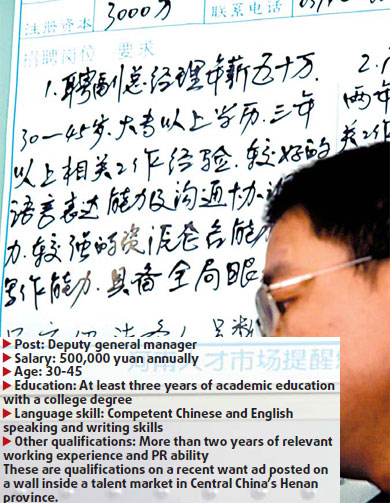 Chinese enterprises that found themselves falling behind the talent rush in the past should take heart from the global economic slowdown as it presents a golden opportunity for them to recruit qualified and experienced executives and professionals from around the world. Of course, talent doesn't come cheap, human resources experts say. But it is at least available as more and more US and European multinational companies are going into the retrenchment mode to cut costs.
But before the economic pendulum swings to the other side, there exists a window of opportunity for Chinese enterprises, long constrained by their relatively more rigid pay scales and rudimentary incentive programs, to get the professionals they need to expand their businesses on the mainland and overseas . In an exclusive interview with China Business Weekly, Goodwin, CEO of Antal International, a global recruitment company that charges corporate clients thousands of dollars as consultancy fees, says "hiring people now can bring greater long-term benefit than firing". Goodwin advocates different strategies for local companies, multinational firms already present and for those companies who want to enter China. He stresses that the ultimate objective for all three categories would be "a long-term HR policy". US companies tend to react a little more aggressively to the perceived effects of the global economic downturn and reduce their workforce quickly. On the other hand domestic enterprises and European multinationals have shown greater restraint in their response to the crisis, says Goodwin. In these uncertain times when the developed economies, especially the US, are sliding into a recession, corporate executives need to be careful while formulating the human resources strategies, he says.
"Companies that are now firing people would experience problems next year when the economy improves," Goodwin says. "These companies will have no choice but to start rehiring then at higher costs," he predicted. During the 1998 economic downturn, a US company swiftly laid off 3,500 people to cut costs, he recalls. When the economy began to recover a few years later, it took that same company 18 months to re-hire the people it needed and at much higher costs than before. Because of the difference in corporate cultures, European and Chinese companies tend to follow a much more conservative approach in cost control than their US counterparts. They do not offer big-time salaries to compete for talents, but at the same time they also do not resort to massive layoffs when they encounter bumps, says Goodwin. His advice to foreign companies in China is to save costs by speeding up the process of localization. Companies should hire more Chinese managers and professionals rather than bring people from their own countries. The quality of the Chinese management talent, especially those who have worked in foreign companies has improved rapidly in the past three years, he adds. With the knowledge and cultural gap narrowing, localization is only a simple matter of economics, he says. "Foreign experts may cost the company 300 to 400 dollars every month apart from costs related to accommodation, car, driver and children's education. In contrast, hiring Chinese staff will not cost companies the extra expenditure, says Goodwin. CapitaLand, the Singapore-based investment and real-estate firm is one of the companies that has followed the localization route. "In 2009, we will be hiring even more local talent," says Liew Mun Leong, CEO of CapitaLand. The company's target is to eventually have a 100 percent Chinese management team. "It is very difficult for a foreigner to understand Chinese culture. So the best way is to hire executives locally," says Liew. Opportunity beckons Goodwin says the small- to medium-sized Chinese firms should now take the opportunity to grab whatever talents they can get. Antal has over 600 clients in China and of these 35 percent are local companies. Chinese companies that acquire foreign companies could also encounter talent challenges like when Lenovo took over the PC business of IBM. But Goodwin says, such problems can be solved more easily. "In the next six months, when Chinese companies enter overseas markets, they will see a veritable talent pool of directors, managers and even CEOs from western companies to choose from due to the recession. The Chinese firms can hire them for overseas development as they have better chances to take over struggling US companies," he says. "If the financial crisis had not happened, the smaller companies would never have been able to compete with big corporations for top managers," Goodwin says. "Now is the best time for them to tap the market for talent." The moot question, however, is how to retain the hired talent when the economy starts growing again. Goodwin feels this is not a major deterrent as the small companies can also grow. "Small firms would become mid-sized and they in turn will become big. The talent hired by small and mid-sized companies would also scale up the ladder in tandem with the firms and hence remain loyal to their employers. "As long as the talent feels satisfied with their job and get paid well there is no reason for them to leave for bigger companies," says Goodwin. He adds that it would be prudent for companies that are planning to enter the Chinese market to hire talent locally. "With US companies laying off people, it would be the right time for other foreign firms to hire people from the Chinese talent market," says Goodwin. He cites the example of myweather.com, a meteorologic solution company that is planning to hire local talent for its business expansion. (For more biz stories, please visit Industries)
|
|||||
主站蜘蛛池模板: 久久香蕉欧美精品| 亚洲精选av一区二区| 成人国产精品日本在线观看| 中文人成影院| 国产精品日韩av一区二区| 伊人成人在线视频免费| 手机看片日韩国产毛片 | www免费视频com| 亚洲日韩精品制服丝袜AV| 精品国产精品国产偷麻豆| 欧美老少配性行为| 农村妇女高清毛片一级| 亚洲免费成人av一区| 国产精品成人免费视频网站| av在线播放无码线| 狠狠色丁香婷婷亚洲综合| 久久中精品中文字幕入口| 国产午夜精品福利视频| 国产亚洲欧美另类一区二区三区| 人妻中文字幕亚洲一区| 热久在线免费观看视频| 久久久精品94久久精品| 色 亚洲 日韩 国产 综合| 日韩激情无码av一区二区| 亚洲精品综合网中文字幕| AV教师一区高清| 麻豆精品久久精品色综合| 欧美日本在线一区二区三区| 亚洲男女羞羞无遮挡久久丫| 成人无码特黄特黄AV片在线| 国产亚洲一区二区手机在线观看| 国产精品自在拍首页视频8| 日韩精品成人无码专区免费| 亚洲精品日韩久久精品| 亚洲av午夜精品无码专区| 日本欧美大码a在线观看| 国产精品午夜福利免费看| 亚洲情色av一区二区| 日韩秘 无码一区二区三区| 亚洲一区二区在线av| 久久这里都是精品二|



