BIZCHINA> Review & Analysis

|
BIZCHINA> Review & Analysis
|
|
Related
Crisis won't deter fight against climate change
By Fu Jing (China Daily)
Updated: 2008-10-30 10:44 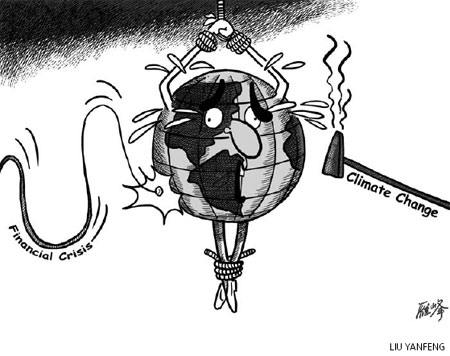 As the US financial tsunami unfolds and an extended period of recession in developed countries looms, China made a strong gesture yesterday on battling climate change. The Chinese government yesterday published its white paper on climate change, signaling that the severest economic crisis since the Great Depression will not weaken China's determination of bringing economic growth on sustainable track. The white paper signals its determination to bring a global deal on climate change to replace Kyoto Protocol as the world is now in the middle of the two-year journey from Bali, where negotiation were launched, to Copenhagen which hosts the crucial meeting of the United Nations Framework Convention on Climate Change (UNFCCC) at the end of next year when the world must craft and clinch the deal. It also repeatedly stresses that the Chinese government has been poised to fulfill its promises on sustainable development though the worsening global economic situation makes it difficult for China to predict its growth for next year.
In some way, it was relatively easy for China to make the policy shift to increase investment in sustainable development as the central government's determination in this regard was shown even when there was no financial crisis. And now the financial crisis will propel the government to expand spending and help strengthen its determination to promote growth that can be sustained. Still it is uncertain how fast China's economy will grow next year, Liu He, deputy director of the Office of the Central Leading Group on Finance and Economy Work, pointed out last Friday that economic slowdown can work as an opportunity to restructure its economy, which has relied heavily on government investment, foreign trade and low-cost technology over the past years. When the economy is experiencing fast growth, companies are unwilling to upgrade their technologies but the slowdown gives such firms the opportunity to enhance their competitive edge through better technologies. For him, this is an opportunity for China to embark on low-carbon path, which means China will implement tougher measures to save energy, control pollutant emissions and promote responsible ways of investment. Nicholas Stern, former UK government advisor famous for his climate report, said a low-carbon infrastructure also represents huge investment opportunities. The International Energy Agency estimates that world energy infrastructure investments are likely to be around $1 trillion every year over the next two decades. "If the majority of this is low carbon, it will be an outstanding source of investment demand," said Stern. "That's an opportunity both for China and the rest of the world." How to turn the investment potential into reality? Chinese companies should set up "joint ventures" with technology groups in developed nations to pursue its aim of developing a "low-carbon" economy, Stern suggested, despite the fact that under the Kyoto Protocol and the United Nations Framework Convention on Climate Change, developed countries are obliged to provide financial support and transfer technology to developing countries on favorable terms. But the developed countries, which have held more than 90 percent of the advanced technology related to climate change, are reluctant to provide it to developing countries out of concern for losing their competitiveness. And many developed countries are blamed for failing to deliver on commitments made on funding and technology transfer to help developing countries combat global warming. Currently, many developing countries, including China, have reached the consensus to develop their economy by using low-carbon technologies but the developed countries have required high transfer fees. And the high technology transfer fees have blocked many countries from using the advanced technologies. Meanwhile, the weekly average oil prices of the Organization of Petroleum Exporting Countries (OPEC) dropped to $61.53 per barrel last week, the lowest price since the end of March 2007. This may decrease incentives for the oil users to take measures to save energy and dampen the industry's enthusiasm in investing in developing renewable energy, which may not become cost-competitive and economical. Facing the new changes, it will become a demanding negotiation between developing countries, including China, and rich countries, to set up an effective mechanism to facilitate technology transfer from industrialized countries. At the strategic level, the gesture China made yesterday is vital. But from the point view of its implementation, more efforts and negotiations are along the way. (For more biz stories, please visit Industries)
|
主站蜘蛛池模板: 日韩国产精品无码一区二区三区| 亚洲精品免费一二三区| 亚洲国产成人久久综合区| 毛片亚洲AV无码精品国产午夜| 国产成年码AV片在线观看| 国内a级毛片| 国产亚洲一二三区精品| 午夜国产小视频| 亚洲国产成人精品区综合| 国产精品国产三级国产a| 在线日韩一区二区| 人妻少妇邻居少妇好多水在线| 亚洲第一狼人区在线观看| 亚洲AV国产福利精品在现观看| 精品中文人妻中文字幕| 青草成人精品视频在线看| 1024国产基地永久免费| 精品久久综合日本久久网| 热久在线免费观看视频| 国产内射性高湖| 亚洲综合小说另类图片五月天| 黑人av无码一区| 久在线精品视频线观看| 国产成人久视频免费| 国产在线一区二区不卡| 丰满人妻被猛烈进入无码 | 人妻无码av中文系列久| 唐人社视频呦一区二区| 国产午夜美女福利短视频| 人人人澡人人肉久久精品| 性欧美在线| 国产成人亚洲日韩欧美| 亚洲欧美国产精品久久| 国产亚洲精品第一综合另类| 亚洲色精品VR一区二区三区 | 国产在线小视频| 91精品国产蜜臀在线观看| 成年午夜免费韩国做受视频| 色丁香一区二区黑人巨大| 午夜在线不卡| 视频一区视频二区在线视频|