BIZCHINA> Olympics Economy

|
BIZCHINA> Olympics Economy
|
|
Related
GE helps to deliver a cleaner, greener Olympics
(China Daily)
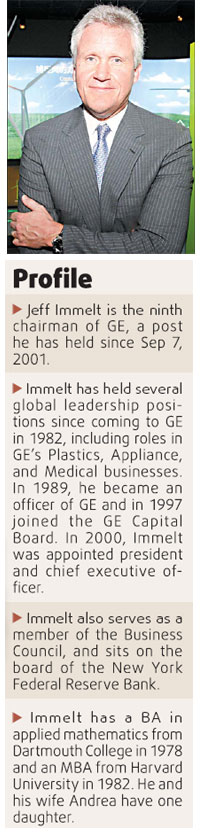
Updated: 2008-09-16 11:21 With more than 400 clean-tech infrastructure projects in and around Beijing, General Electric Co (GE), a global Olympic Sponsor, played a major role in ensuring that the Games were truly a "Green Olympics". These projects have already generated more than $700 million in revenue, $200 million more than the firm initially expected. In addition, during its coverage of the Beijing Games, NBC Universal, in which GE is the major shareholder, raised more than $1 billion in advertising revenue. Jeff Immelt, chairman and CEO of GE, spoke to China Daily reporter Bao Wanxian, about GE's environmental strategies and its marketing goals in the China market.
Q: Are you satisfied with GE's sponsorship of the Beijing Olympic Games, especially in terms of providing clean tech products to Beijing? Would you like to share with us the major challenges GE faces in its clean tech business in China? A: In 2006 we signed an MOU with the National Development and Reform Commission (NDRC) on "ecomagination" to focus on clean energy and clean water. And so I think we're in the process of what we call activation, where we're working with steel mills and municipalities to really drive these initiatives. For example, (these initiatives are) reducing energy consumption by 20 percent and reducing water consumption by 20 to 30 percent. I think so far we're seeing a very good customer response. So I think right now the biggest challenge for GE is just getting the resources in place and the customer support in place in order to really drive this activation process in China. I'm quite encouraged in terms of what we seen on this trip to China. We've got a number of initiatives going with Baosteel and Wuhan Iron and Steel Group and other local companies. So I actually think this is going to be a big growth driver for us in China. Q: Water treatment is one of GE's key businesses and GE has been promoting technology for the Beijing Olympics. Would you like to share your comments on China's water treatment market? A: We think water is a big need in China. It's been one of the real focus areas for the government in China. Our business today is still relatively small - $100 million - maybe a little bit more. I will be disappointed if the business isn't significantly bigger in the future. You know our focus in the short-term is all around industrial reuse, so we expect to make more initiatives with our industrial customers to reduce their waste and allow them to do more water recycling and things like that. So our focus is more on the industrial side than the consumer side. We're trying to partner with engineering and construction companies do big desalination projects. So we think China is going to be one of the largest and most important markets for our company as time goes on, possibly the second or third after the US. Q: Your financial business is highly profitable, but the financial market in China is still developing. Do you think your financial business has potential in China? How do you plan to explore this market? A: We'd like to be bigger in financial services in China. Today, we are relatively small - $3 or $4 million in assets. It's on aircraft leasing, a little bit of consumer credit, and a little bit of private equity investment. Again, the only way we can consider growing in China over time is working in partnership with either banks or finance companies. So we are actively exploring all of those opportunities. We like to be more of an operating partner with a company. So we continue to look for ways to grow in financial services, despite the fact that we are very small today. Q: How did GE benefit from the Beijing Olympic Games? After the Beijing Olympic Games, you will move the office to Shanghai for the 2010 World Expo to seek sustainable business growth in the Chinese market, so what is your long-term goal in China in the coming years? A: GE's unique (characteristic) is that we are a multi-business company. We are an infrastructure company, we are a media company, and we're a financial company. The Olympics is actually one of the few events in the world that brings two of those things together: infrastructure and media. So, in other words, if you think of Beijing for us that means $1 billion in advertising, $700 million in infrastructure building, and so we benefit greatly. The Olympics give us a platform that is very unique to GE. And all the things we learned around the Beijing Olympics, we can now move to the Shanghai Expo, move to Macao, move to London in 2012, move to Vancouver in 2010. So we are always looking for things we can do that are truly unique to our company, especially in China's market.
(For more biz stories, please visit Industries)
|
主站蜘蛛池模板: 亚洲日韩av无码| 欧美自拍另类欧美综合图区| 极品少妇小泬50pthepon| 亚洲无av中文字幕在线| 亚洲国产精品久久综合网| 国产精品福利在线观看无码卡一| 成人无码无遮挡很H在线播放| 成人免费乱码大片a毛片| 欧美日本免费一区二| 人妖系列在线精品视频| 国产精品论一区二区三区| 日韩精品一区二区三区视频| 国产女人18毛片水真多1| 久久天天躁夜夜躁狠狠85| 57pao国产成视频免费播放| 福利一区二区视频在线| 色综合久久久久久久久久| 国产一区二区三区粉嫩av| 中文字幕日韩国产精品| 妺妺窝人体色www聚色窝仙踪| 99re在线视频观看| 好吊妞| 狠狠噜天天噜日日噜| 处破痛哭a√18成年片免费| 欧洲精品色在线观看| 日韩精品国产一区二区| 最近中文字幕国产精选| 亚洲国产一区二区三区,| 国产精品中文字幕av| 老妇free性videosxx| 日本不卡片一区二区三区| 中文字幕日韩熟女av| 视频一区二区三区自拍偷拍| 国产成人AV男人的天堂| 四虎影视库国产精品一区| 大香伊蕉在人线国产免费| 国产精品偷伦在线观看| 暖暖 在线 日本 免费 中文| 成人午夜国产内射主播| 国厂精品114福利电影免费| 71pao成人国产永久免费视频|