BIZCHINA> Center

|
BIZCHINA> Center
|
|
Related
Environment exchanges waiting for trading
By Li Jing (China Daily)
Updated: 2008-09-15 11:30 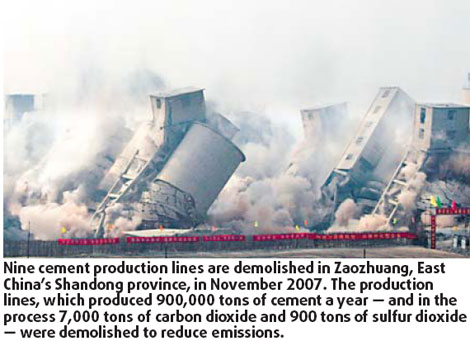 On August 5, two environment and energy exchanges opened almost simultaneously in Beijing and Shanghai, the first of their kind in China. Obviously no one wants to fall behind the starting line. Both of the exchanges want to secure a leading position in a nascent market in China: trading environmental equities. China's 11th Five-Year Plan (2006-10) calls for cutting energy consumption per unit of gross domestic product (GDP) up to 20 percent by 2010 while reducing major pollutants, such as sulfur dioxide by 10 percent. And the government is now encouraging market-based measures to achieve these goals. As a result, in addition to Beijing and Shanghai two other cities are also expected to try to grab a slice of the market. However, since a legal and structural framework for emissions trading has yet to be established in the country, neither the Shanghai or Beijing exchanges is actually carrying out any trades at the moment. Nonetheless, Tianjin is also mulling over an environment and energy exchange. Changsha, the capital city of Hunan province, is reported to have drawn up a plan to assign credits for dust, carbon dioxide and chemical oxygen demand (COD), a major measurement of water pollution, with a view to facilitating the trade of those credits as early as next year. Compared with Changsha's straightforward schedule, the working plan of two environmental exchanges in Beijing and Shanghai seems to be rather vague. The Shanghai Environment and Energy Exchange (SEEE) says it will collect, filter and publicize information for environment and energy-related equity and emission credit trading, and provide a platform for such deals between companies or institutions, according to a statement from the Shanghai United Assets and Equity Exchange (SUAEE), the sole owner of the environment and energy exchange. Its counterpart in Beijing, the China Beijing Environment Exchange (CBEE) will function to promote the exchange of technologies for environmental protection, energy conservation and emissions reduction, to provide a platform for trade of SO2 and COD discharge rights, and to act as an information service for greenhouse gas emission reduction. Cai Minyong, chairman of SEEE, says 55 projects are listed on the exchange, which involve the funding of environmental projects, transfer of technologies and patents in the field of wastewater treatment, urban domestic refuse disposal, and clean energies such as solar power. Cai estimates that by the end of 2008, the total volume of trade at SEEE will reach 10 billion yuan. CBEE, according to spokesperson Shuai Xiaoshan, is dedicated to setting up a nationwide platform for trading COD and SO2 emission credits, as well as technologies related to energy saving and emissions reduction. The exchange has prepared about 30 technology transactions. The emissions trading project provides economic incentives for reducing pollution emissions. It limits the amount of pollution produced by industrial sources, such as power plants and factories. When emissions fall below permitted levels, the source is allowed to store the excess quota for future use or to trade with other industrial units which cannot meet the pollution standards set by environmental protection authorities. China started pilot projects for SO2 emissions trading in seven provinces and cities including Jiangsu, Shandong and Shanghai in 2002. In June, the Ministry of Environmental Protection (MEP) planned to generalize this cap-and-trade system for SO2 emissions throughout China's whole electrical power industry, according to a 10-year cooperation plan signed between China and the United States. Yet it is still unknown when the emissions trading platform will be set up, says an official from MEP, because the process of determining the emission caps and allocating credits is complicated, adding that the country is still experimenting with pilot projects to find an effective solution. One pilot project that requires enterprises pay for their emission permits, in the highly polluted Taihu Lake area, on the border of Zhejiang and Jiangsu provinces, has pushed the efforts one step further. Taihu Lake has suffered from heavy algae infestations caused by excessive pollutants. Even if industrial plants near the lake adhered to the strict emission standards, the amount of waste was still more than the lake could handle. On August 14, when the project was jointly launched by MEP, the Ministry of Finance and the Zhejiang provincial government, five polluting enterprises signed agreements with local environmental protection bureaus to purchase the COD emission permits. The pilot project also aims to establish a primary market for emission permits and set up a trading platform by 2010. But experts have predicted that the emission-trading scheme is likely to meet opposition from polluting enterprises. For instance, strict emission reduction rules will add to the costs of industries, such as installing waste treatment facilities Besides, those enterprises that have extra quotas are reluctant to trade them; instead, they save them for future use, because emission permits means the opportunity to expand production capacity. This dilemma exemplifies the status quo of China's burgeoning environmental equity exchanges: the market is there; the question is how to mobilize it. (For more biz stories, please visit Industries)
|
主站蜘蛛池模板: 日韩AV高清在线看片| 亚洲中文精品一区二区| 国产va免费精品观看| 亚洲国产成人av在线观看| 久久精品国产福利一区二区| 亚洲国产成人无码网站大全| 亚洲av不卡电影在线网址最新| 亚洲AV无码乱码在线观看性色扶| 久久国产精品偷任你爽任你| 国产精品亚洲一区二区在| 久久久久综合中文字幕| 精品无套挺进少妇内谢| 另类图片亚洲人妻中文无码| 国语精品自产拍在线观看网站| 亚洲国产良家在线观看| 大地资源网高清在线观看| 日韩人妻少妇一区二区三区| 久久99精品中文字幕在| 精品人妻av中文字幕乱| 中国CHINA体内裑精亚洲日本| 成人精品视频一区二区三区| 亚洲不卡av不卡一区二区| 久久久久成人片免费观看蜜芽| 久久久久亚洲AV无码专| 精品人妻少妇嫩草av专区| 国产精品女同一区三区五区| 又硬又粗又长又爽免费看| 日韩精品国内国产一区二| 日本女优中文字幕在线一区| 国产怡春院无码一区二区| 亚洲午夜性猛春交XXXX| 成人无码视频| 男女性杂交内射女bbwxz| 无码av永久免费大全| 综合在线 亚洲 成人 欧美 | 四虎成人精品在永久免费| 成人免费A级毛片无码片2022| 中文国产日韩欧美二视频| 亚洲人成电影在线天堂色| 日韩少妇人妻vs中文字幕| 国产成人亚洲综合A∨在线播放|
