BIZCHINA> 30 Years of Reforms

|
BIZCHINA> 30 Years of Reforms
|
|
Related
Maximizing returns
By Diao Ying (China Daily)
Updated: 2008-08-18 11:02
The old US embassy in Beijing, located by the bustling Silk Market, was famous for long queues with impatient crowds waiting for over half a day to get their visas. But 53-year-old Wang Boming remembers that he was treated like an honored guest when he applied for his visa back in 1980. "At that time few people went to the US from the Chinese mainland," Wang, now chairman of the Stock Exchange Media Council (SEEC), and one of the designers of the Shanghai Stock Exchange, said in an interview with Southern People Weekly. "The consul led me to the embassy - as if they were asking me for a favor," he was quoted as saying. Wang is not exaggerating. While China and the US are major trading partners today, the two countries established a diplomatic relationship in 1979 - just one year before Wang landed in New York.
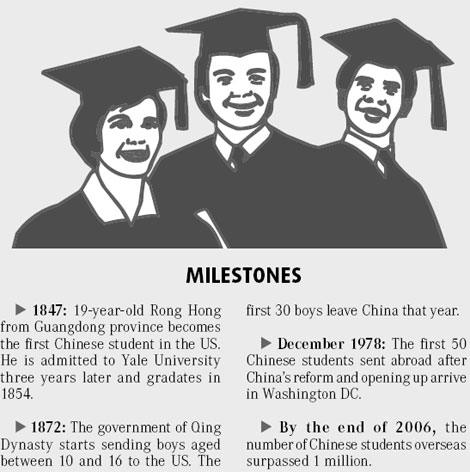
In 1978, China's Vice Premier Deng Xiaoping, who studied in France in the 1920s, said China needed to send more students abroad to study. That year, China and the US agreed to send students and visiting fellows to each other's universities. China almost stopped sending students overseas during the "cultural revolution (1966-1976)". And before this, the government only sent students to the former Soviet Union and other socialist countries in Eastern Europe. As a result, those who moved abroad from 1978 to the early 1980s and returned to China are known as the first generation of returnees after China's reform and opening up. Wang was admitted to the City University of New York in 1980, and he later received a master's degree from Columbia University majoring in international finance. Around the same time, Liu Erfei, a well-known investment banker and former chairman of Merrill Lynch in China, was attending Brandeis University studying economics. He later got an MBA degree from Harvard and Wan Gang, China's current minister for Science and Technology Ministry, won a World Bank fellowship and went to Clausthal University in Germany to pursue his PhD in engineering. Over the next 30 years a large group of Chinese students followed them. Figures from the Ministry of Education show that over 1 million Chinese students traveled overseas from 1978 to the end of 2006. But from 1847 - when Rong Hong, the first Chinese student studied in the US - to 1978, only 130,000 Chinese studied overseas. According to Wang Huiyao, vice-chairman of the Western Returned Scholars Association, the returnees have played and are playing an increasingly important role in China. "They connect China and the outside world. They are the best translators of both the Chinese and Western culture," says Wang, who was one of the earliest MBA students educated in Canada. He returned to China in the early 1990s. For Wang, his time in the US gave him the chance to also meet like-minded expatriates. After he graduated from Columbia University with a master's degree in international finance, he worked at the New York Stock Exchange and met Gao Xiqing, a Wall Street lawyer with a law degree from Duke University. At this time the stock exchange was on the Chinese agenda for reform, but little had actually been done. Expressions like "market makers" were considered as much as a taboo as "love makers" in China at the time, Wang claims. But Gao and Wang believed that stock exchanges would do well after China's economic reforms. In 1988, Wang and Gao returned to China and they talked to the then mayor of Shanghai, Zhu Rongji. Together with other Chinese scholars and young economists, in 1989, they built the first stock exchange in Shanghai, which is now an important part of China's capital market. Wang started a media group focusing on business and financial information, and his friend Gao now bears another important title as the general manager of China Investment Corporate Ltd, responsible for managing part of China's foreign exchange reserves with $200 billion of assets. Other returnees participated in China's economic reform in other ways. For instance, some today work as heads of multinational companies' China businesses. According to Wang from the Western Returned Scholars Association, returnees have participated in nearly all of the world's top 500 companies in their operations in China. For instance, when Levono, the largest computer manufacturer in China was acquiring PC businesses from IBM, it was Liu Erfei, the former chairman of Merrill Lynch China, who helped with this deal is a prime example. Liu was also a leading investor for the China Shenhua Energy Company Limited when it was first listed in Hong Kong. Last year, Wan Gang was appointed as the minister of the Ministry of Science and Technology. Fluent in German and English, the former senior engineer of Audi represents the newer generation of government officials who have been educated overseas. Before taking the minister position, Wan was president of prestigious Tongji University in Shanghai - it has been common for returnees to hold the leading positions in universities. According to the Ministry of Education, 78 percent of presidents in universities in China are returnees, and 63 percent of advisors for PhD students are returnees. Unlike today's Chinese students studying abroad, most of who are funded by their families and went abroad after graduating from college, the first generation of returnees experienced enormous changes in their personal lives. Most were teenagers during the "culture revolution(1966-1967)", and spent their youth doing farm work in China's rural areas. With a keen interest in seeking knowledge, some never stop learning despite their achievements. For instance, Liu Erfei from Merrill Lynch remembers he always wanted to memorize English vocabulary after coming back from farm work late at night. The persistence brought many of them back to universities in 1978, when China resumed the college entrance examinations. They were able to combine their experiences with western thinking as they seized opportunities to go abroad during the 1980s. Figures from the Ministry of Education show that the percentage of those who returned is still relatively small. In 2006, around a quarter of them came back. But the number of returnees is increasing, as more students are lured by China's increasing economic power as well as the good platform in China for the returnees to show their own expertise. And many believe that as China's reform and opening up policy continues, returnees will play an even more important role in China in the next several decades. Justin Yifu Lin, the newly appointed chief economist of the World Bank, who also got his PhD in economics in the University of Chicago in 1986, said at a meeting for returnees, that the next three decades will be an important period for returnees to showcase their capability and experiences.
"Returnees are the elites in China's society," said Lin, who added that returnees mostly have an international vision with their experiences overseas and life experience in China. But the opportunities also mean challenges. "China is in a transition period and we are different from many other countries, returnees will have to be innovative to push the development of China forward," Lin says.
(For more biz stories, please visit Industries)
|
主站蜘蛛池模板: 国产精品毛片av999999| 国产亚洲AV电影院之毛片| 五月天福利视频| 亚洲欧洲av一区二区久久| 一本久久a久久精品综合| 欧美和黑人xxxx猛交视频| 国产亚洲精品超碰| 亚洲第一区二区快射影院| 人妻少妇精品久久| 亚洲天堂男人天堂女人天堂| 国产高清一区二区不卡| 久久久久免费看成人影片| 四虎成人在线观看免费| 欧美伊人色综合久久天天| 国产一区二区不卡在线看| 奇米四色7777中文字幕| 国产乱老熟女乱老熟女视频| 精品一区二区三区女性色| 2022亚洲男人天堂| 一本加勒比hezyo无码人妻| 中文字幕在线看视频一区二区三区 | 亚洲国产精品综合久久20| 高清国产美女av一区二区| 国产亚洲精品成人av一区| 老司机精品一区在线视频| 我要看特黄特黄的亚洲黄片| 久久亚洲欧美日本精品| 日韩一区二区三区不卡片| 开心五月婷婷综合网站| 欧美日韩国产综合草草| 亚洲熟妇自偷自拍另欧美| av天堂午夜精品一区| 色就色中文字幕在线视频| 思思99热精品在线| 成人做爰www网站视频| 成人福利一区二区视频在线| 五月综合婷婷开心综合婷婷| 视频一区二区不中文字幕| 色噜噜久久综合伊人一本| 男人av无码天堂| 久久精品国产精品亚洲|