BIZCHINA> Center

|
BIZCHINA> Center
|
|
Related
Foreign investors drawn to real estate
By Hu Yuanyuan (China Daily)
Updated: 2008-07-10 10:07
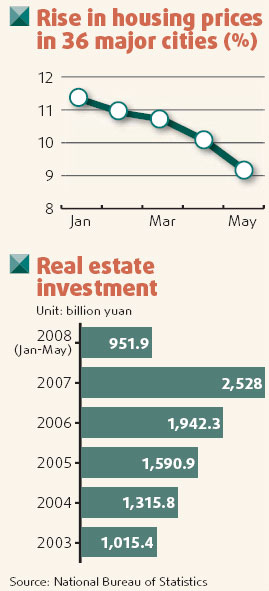
 Falling prices, dwindling transactions and property developers' discount offers may be frightening away individual buyers but seem to be attracting more international investors in the real estate sector. International real estate service provider Jones Lang LaSalle said in a recent report that some international groups have raised substantial capital for China property funds and are now deploying the money, while others are moving capital from less vibrant markets in North America and Europe. The squeeze on bank loans and falling property prices, in fact, provide foreign investors with a good opportunity to enter the market.
Blackstone, one of the largest US private equities, in June acquired a commercial project in Shanghai for 1.1 billion yuan ($160.24 million), the first time the company invested in China's property market. Other international funds, said industry insiders, are also looking for mature properties in key cities. "We have received lots of inquiries from investors in the United States and Europe interested in investing on the mainland following a downward adjustment in property prices," said Malcolm Tam Yuk-cheung, a financial advisory leader at Deloitte China Real Estate Industry. "They are looking both at opportunities to acquire a stake in a property company and to directly invest in projects," he said, adding these investors typically target an average 15 percent internal return rate before leverage. Due to the credit crunch, industry experts say, mergers and acquisitions in China's real estate market are expected to reach a five-year high this year. Tam Yuk-cheung expects mergers and acquisitions deal values to grow 5 to 10 percent this year. Dealogic, investment bank data provider, said the value of merger and acquisition deals involving mainland property last year was $21.01 billion, the highest since 2003. By June this year, 171 deals worth $15.29 billion had been announced, up 142 percent from the $6.31 billion spent on 123 deals over the same period last year.
"We will definitely strengthen our presence in Beijing by acquiring more projects from other players this year," said the Zhang Xin, CEO of Hong Kong-listed SOHO China. At the end of May, the cash-rich SOHO acquired local firm Kaiheng, which owns a commercial and residential project in Beijing, for 5.5 billion yuan. SOHO China's decision to buy Beijing Kaiheng also reflects a more general trend: China's larger, wealthier developers are actively acquiring and merging with the smaller, cash-starved ones to gain access to new markets and greater land holdings. This is largely a result of government policies aimed at limiting speculation in the residential property market, tighter monetary policy and the plummeting stock market this year, experts said. "It is more difficult for developers to obtain bank loans, and new regulations have impeded some previous financing strategies such as utilizing the pre-sale of units to finance land payment and the latter stages of actual construction," said Ben Christensen, head of research for Jones Lang LaSalle Beijing. He said this trend is likely to continue and is an indication that the Chinese property market is becoming more sophisticated and competitive. Initial public offerings by fast-growing Chinese property firms have been hugely popular in the last couple of years, but have suffered recently as stock markets plunged and the global credit crunch put property securities out of favor. The turning point came in January, when Chinese developer Evergrande failed to sell its shares. Several developers have since postponed planned listings. Local developer's financing challenges are creating opportunities for international investors. Jason Leow, deputy CEO of CapitaLand (China) Investment Co Ltd, said the number of local developers contacting CapitaLand for "cooperation" has increased rapidly this year. "There are some small developers which would like to sell their projects and some listed real estate firms that acquired a lot of land parcel last year but find it hard to develop them now due to the credit crunch." Though international investors are eager to gain greater exposure to the Chinese property market, they continue to be cautious when conducting due diligence on potential partnership opportunities. Leow said CapitaLand will be "very careful" in conducting mergers and acquisitions. "In a market that's now seeing a big shift from investment-orientated buying to self-use buying, we will be more careful about the location and quality of our products." Domestic developers are increasingly willing to lower land and asset prices as well as their own valuations to entice investment from international groups. But according to Chu IP Pui, director of Kerry Development (China) Ltd, the current price for mergers and acquisitions is not "attractive enough" compared with the company's land reserve bought five years ago. Hong Kong's Kerry Properties and Beijing Huayuan Property recently launched a new luxury residence in Beijing, with the total investment hovering around 700 million yuan. It is Kerry's first high-end residential project in Beijing. (For more biz stories, please visit Industries)
|
主站蜘蛛池模板: 91亚洲国产成人精品性色| 精品一区二区三区不卡| 国产精品啪| 亚洲女同精品一区二区久久 | 日韩av在线不卡免费| 国产精品成人一区二区三| 成人做受视频试看60秒| jizzjizz欧美69巨大| 老司机午夜福利视频| 精品国产中文字幕在线| aa级毛片毛片免费观看久| 97精品久久久大香线焦| 日本一区二区不卡精品| 亚洲sm另类一区二区三区| 夜夜添无码一区二区三区| 亚洲成人av免费一区| 内射干少妇亚洲69XXX| 久久精品国产久精国产果冻传媒| 免费播放一区二区三区| Se01短视频国产精品| 国产伦精品一区二区三区| 亚洲国产成人综合熟女| 欧美性巨大╳╳╳╳╳高跟鞋| 亚洲欧美在线观看品| 亚洲综合成人av在线| 亚洲国产精品一区第二页| 国产偷拍自拍视频在线观看| 国产精品美人久久久久久AV| 国产亚洲精品在av| 中文字幕无码av不卡一区| 国产精品亚洲五月天高清| 人人入人人爱| 免费无码AV一区二区波多野结衣| 久久精品国产亚洲AⅤ无码| 饥渴的熟妇张开腿呻吟视频| 国产精品天天看天天狠| 亚洲中文字幕日产无码2020| 精品久久综合日本久久网| 国产成人精品无人区一区| 国产精品美女一区二三区| 亚洲精品国产第一区二区|