BIZCHINA> Center

|
BIZCHINA> Center
|
|
Related
BCG: Home turf gives firms edge
By Liu Jie (China Daily)
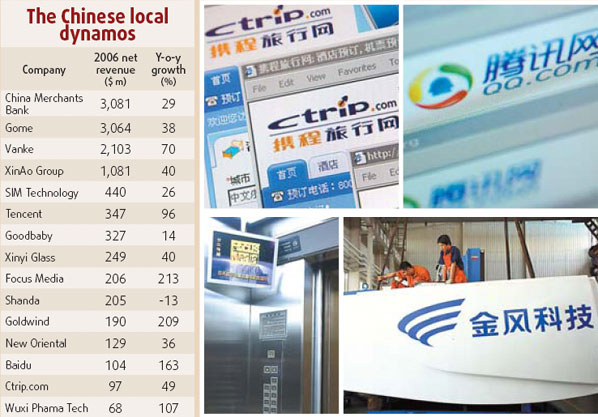
Updated: 2008-04-18 14:28 By redefining the rules of competition in local markets, companies from China and other emerging markets are putting the expansion plans of many global industry leaders at risk, a report said. Boston Consulting Group (BCG), a global management consulting firm, recently released a report entitled The BCG 50 Local Dynamos, which suggested multinational giants reconsider their strategies in developing markets, including China. The list comprises homegrown champions that are rapidly conquering their domestic markets through fierce competition and innovative business models that defy traditional strategies. These companies are from 10 emerging markets, including India, Brazil and Mexico. Of the 50, 15 - the largest number - are Chinese. "We chose companies mainly based on their having an innovative business model," David Michael, the report's coauthor and a Beijing-based BCG senior partner, said. "The high number of Chinese companies on the list weakens the idea that they are only good at mass producing cheap goods." Also, local dynamos have developed business models adapted to their home markets. While China's market is among the world's most competitive, many local companies are holding their own, preventing large foreign entrants from dominating, the report said. For example, local Internet startups Baidu.com and Tencent have the upper hand over Western rivals Google and Yahoo!. In the utility sector, XinAo Gas Holdings, founded by a former taxi-fleet manager, is now an incumbent liquid-petroleum-gas utility, serving homes and businesses in more than 60 Chinese cities. These dynamic local competitors are vivacious, private companies led by a new generation of ambitious executives. They are neither State-owned behemoths nor longstanding incumbent conglomerates, the report said. The report identified six key factors distinguishing these companies from their less-successful competitors. Most of the firms have played on several of these factors simultaneously and consistently over time to create and sustain new business models that thrive in rapidly developing environments. The six factors are: customizing to suit local needs; devising innovative business models to overcome local challenges; leveraging the latest technologies; benefiting from low-cost labor while overcoming shortages of skilled labor; scaling up fast; and sustaining long-term hyper-growth without imploding. Shanda's success story, for example, is one of meeting local demands and adopting a creative business model. The firm capitalized on Chinese consumers' enthusiasm for video games while accounting for their relatively low incomes and the high prices of patented software. Shanda created a piracy-proof gaming industry based on multiplayer, online role-playing games. This industry earned revenues of some $600 million in 2006 - a 70 percent increase over 2005. Because their service simultaneously connects thousands of users through online games, their products are virtually impossible to pirate. The country's entertainment-craving youth are more than willing to pay for these "live" experiences, and Chinese companies, such as Shanda, dominate this arena. Model adjustment "Global giants need to learn from this new breed of rivals if they want to win in emerging markets," Michael said. "They are increasingly finding that deep pockets, solid patent libraries and successful business models are not enough to face down the local dynamos on their home turf." According to the Economist Intelligence Unit's estimates, emerging markets will by 2010 account for 45 percent of the world's GDP and 60 percent of GDP growth. China is already the world's largest market for mobile handsets, motorcycles and refrigerators, and soon will become its No 2 market for automobiles. Despite the tantalizing potential such growth presents, multinational companies (MNCs) entering these markets risk misjudging what it takes to seize opportunities, the report said. There are numerous stories of firms failing in this realm. Some of the best known are Yahoo!'s and eBay's retreat from the Chinese market, and NEC's and Panasonic's withdrawal from China's handset sector. The report said too many MNCs base their emerging market strategies on outmoded assumptions. Emerging markets are now so dynamic and complex that they should not be regarded as "X year behind our home market". And business models from home should not be revered as the preferred paths to success. Many successful Western companies operating in emerging markets have recognized the vast differences between local market environments and their home bases. General Motors (GM), for example, learned luxury-car owners in China typically employ drivers and sit in the backseat. Today, GM's made-for-China Buicks offer climate and music controls in the backseats. GM holds the No 2 position in a crowded market. BCG also pointed out that conditions seen as impediments in developed markets can create advantages in rapidly developing ones. By creating models that overcome obstacles to realizing these opportunities, companies have created market openings for themselves while shutting the door to followers, it said. (For more biz stories, please visit Industries)
|
主站蜘蛛池模板: 亚洲线精品一区二区三八戒| 精品乱码一区二区三四五区| 国产亚洲精品第一综合另类| 四虎永久在线精品免费视频观看| 国产国语一级毛片| 亚洲男人精品青春的天堂| 国产午夜亚洲精品国产成人| 丰满的熟妇岳中文字幕| AV无码免费不卡在线观看 | 久青草精品视频在线观看| 99国产精品国产精品久久| 国产草草影院ccyycom| 给我免费观看片在线| 亚洲午夜天堂| 国产成人综合久久精品推最新| 国产一级黄色av影片| 婷婷狠狠综合五月天| 色偷偷亚洲女人天堂观看| 日韩精品无码免费专区网站| 日韩啪啪精品一区二区亚洲av | 国产又爽又黄的激情视频| 爽死你欧美大白屁股在线| 久久精品国产99麻豆蜜月| 97精品尹人久久大香线蕉| 亚洲人成网站在线播放动漫| 狠狠综合久久久久综| 欧美色欧美亚洲高清在线观看| 国产一区二区高潮视频| 一个色的导航| 国产精品美女久久久久久麻豆| 欧美精品一区二区精品久久| 白丝乳交内射一二三区| 久久人妻av一区二区软件| 国99久9在线 | 免费| 国产精品18久久久久久| 国产又爽又黄的激情视频| 日本高清免费不卡视频| 国产真实精品久久二三区| 99视频精品全部免费 在线| 国产亚洲精品黑人粗大精选| 欧美一区二区三区成人久久片|