Not the climate feedback we want to hear about
Updated: 2007-10-09 07:30
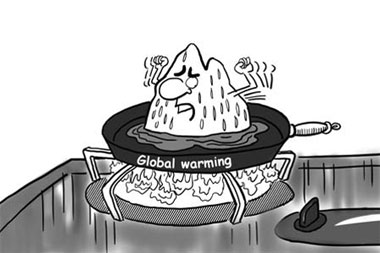
The Arctic ice cap melted this summer at a shocking pace, disappearing at a far higher rate than predicted by even the most pessimistic experts in global warming. But we should not be shocked, because scientists have long known that major features of Earth's interlinked climate system of air and water can change abruptly.
A big reason such change happens is feedback that creates a vicious circle. This type of feedback in our global climate could determine humankind's future prosperity and even survival.
The vast expanse of ice floating on the surface of the Arctic Ocean always recedes in the summer, reaching its lowest point sometime in September. Every winter it expands again, as the long Arctic night descends and temperatures plummet. Each summer over the past six years, global warming has trimmed this ice's total area a little more, and each winter the ice's recovery has been a little less robust.
These trends alarmed climate scientists, but most thought that sea ice would not disappear completely in the Arctic summer before 2040 at the earliest.
But this past summer sent scientists have been scrambling to redo their estimates. Week by week, the National Snow and Ice Data Center in Boulder, Colorado, reported the trend: From 2.23 million square miles of ice remaining on August 8 to 1.6 million square miles on September 16, an astonishing drop from the previous low of 2.05 million square miles, reached in 2005.
The loss of Arctic sea ice will not be the last abrupt change in Earth's climate, because of feedbacks. One of the climate's most important destabilizing feedbacks involves Arctic ice.
It works like this: Our release of carbon dioxide and other greenhouse gases around the planet causes some initial warming that melts some ice. Melting ice leaves behind open ocean water that has a much lower reflectivity (or albedo) than that of ice. Open ocean water absorbs about 80 percent more solar radiation than sea ice does. And so as the sun warms the ocean, even more ice melts, in a vicious circle.
This ice-albedo feedback is one of the main reasons warming is happening far faster in the high north, where there are vast stretches of sea ice, than anywhere else on Earth.
There are other destabilizing feedbacks in the carbon cycle that involve the oceans. Each year, the oceans absorb about half the carbon dioxide that humans emit into the atmosphere. But as oceans warm, they will absorb less carbon dioxide, partly because the gas dissolves less readily in warmer water, and partly because warming will reduce the mixing between deep and surface waters that provides nutrients to plankton that absorb carbon dioxide.
And when oceans take up less carbon dioxide, warming worsens.
Scientists have done a good job incorporating some feedbacks into their climate models, especially those, like the ice-albedo feedback, that operate directly on the temperature of air or water. But they have not incorporated as well feedbacks that operate on the atmosphere's concentrations of greenhouse gases or that affect the cycle of carbon among air, land, oceans and organisms. Yet these may be the most important feedbacks of all.
Global warming is melting large areas of permafrost in Alaska, Canada and Siberia. As it melts, the organic matter in the permafrost starts to rot, releasing carbon dioxide and methane (molecule for molecule, methane traps far more heat in the atmosphere than carbon dioxide).
Warming is also affecting wetlands and forests around the world. This summer's loss of Arctic sea ice indicates that at least one major destabilizing feedback is gaining force quickly. Scientists have also recently learned that the Southern Ocean, which encircles Antarctica, appears to be absorbing less carbon, while Greenland's ice sheet is melting at an accelerating rate.
When warming becomes its own cause, we might not be able to stop extremely harmful climate change no matter how much we cut our greenhouse gas emissions. We need a far more aggressive global response to climate change.
The New York Times Syndicate
(China Daily 10/09/2007 page11)
|
|