Home work
By Wang Xing (China Daily)Updated: 2007-06-25 09:29
Sandy Liang is the mother of a four-year-old girl living in Guangzhou. Like many others in the city, she gets up at seven in the morning and drives her daughter to her kindergarten before she gets to work. But that's where the similarity ends.
Unlike others, who sweat through hours of traffic jams from the school to work, Sandy enters her "private office" by eight, takes a quick shower, fixes herself a coffee, snuggles into a plush settee and starts working at home.
"Before I chose to work from home, I would usually have to spend two hours on
traffic every day," Liang says. "But now, I can freely arrange my own work
schedule and work for hours without disruption." 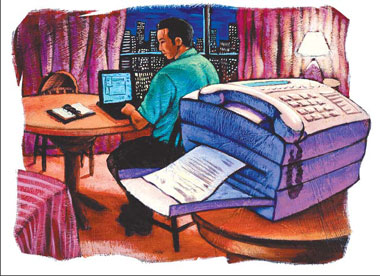
As the diversity leader of the human resources department of IBM's Greater China Group, Liang's job is to promote the development of IBM's female employees, create equal opportunities for all kinds of talent, and further IBM's flexible work programs.
Every day, Liang makes calls to IBM's departmental bosses and other employees across the Asia-Pacific region to liaise with them on her work and reports the progress to her boss, who is located in Beijing.
"I go back to office about once every month because I don't want to lose touch with my colleagues in Guangzhou, although my work is not directly related to them," Liang says.
In IBM's Chinese arm, Liang's experience is shared by many through the flexible work program, which includes working at home, working part-time, a mobile work program, leave of absence program and an individualized work schedule program.
Since it was first introduced in China in 2001, two-thirds of IBM's 9,000 employees in the country have joined the flexible work program, eliminating from their lives the strict restrictions of time and location that comes with conventional jobs.
Through these flexible programs, IBM wants to encourage its employees to find a schedule and atmosphere that best fit the nature of their work and personal needs, thus increasing their productivity and earning their loyalty.
"Flexible work programs enable us to pay more attention to individual needs of IBM employees and help us attract and retain more talents" Liang says.
Quiet revolution
Since the mid '90s, working from home has become an everyday part of modern employment practices in all major industrial countries. There's increasing evidence that a similar revolution is underway in China.
Horizon Research Consultancy Group, a Beijing-based research company, released a SOHO (small office-home office) report in 2004, saying the number of people who work from home in Beijing has reached 188,000. Others have reported that the number has crossed 1 million in the capital and 700,000 in Shanghai.
"Few figures are available from government or other researchers that could give us a comprehensive picture of just how many Chinese people are working from home," says Shen Min, an analyst from Horizon Research Consultancy Group, who is responsible for the SOHO report. "But as an emerging trend, it's gaining enough momentum to make it difficult to ignore its impact."
Most Chinese people actually got their first taste of working from home in 2003, when SARS struck, forcing office-goers to lock themselves up at home and connect with colleagues through the phone and Internet. The increasing mass application of new technologies such as VoIP and WiFi in recent years has only reinforced the status of remote working as a real alternative.
"Advances in information technology have made it possible to work remotely from a central office while staying in touch with colleagues, lowering costs and increasing efficiency," says Liu Bin, chief analyst of research house BDA China.
| 1 | 2 |  |
(For more biz stories, please visit Industry Updates)