Putting more emphasis on imports
Updated: 2011-11-22 09:38
By Diao Ying (China Daily)
|
|||||||||||


China changes its economic policy as world changes gear
BEIJING - For Chinese travelers abroad, shopping for gifts can be a headache. Souvenirs from New York, London or Cairo may look exotic at first, but a closer examination will find most of them are labeled "Made in China".
|
 |
|
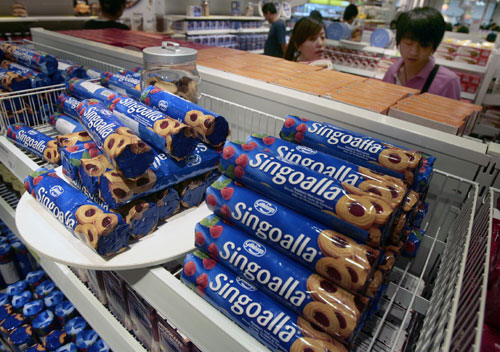
Swedish cookies on the shelves at a supermarket in Nanjing, capital of East China's Jiangsu province.[Photo/China Daily] |
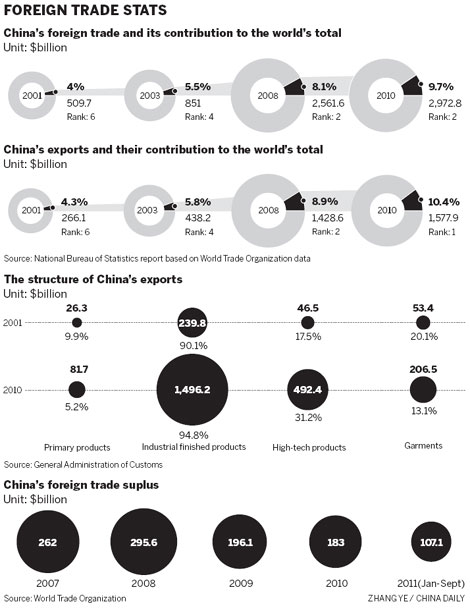
Joining the World Trade Organization has transformed China from a closed economy into the world's factory. Cheap products from China make daily necessities much more affordable for people worldwide. By buying products from China, people in the United States saved $600 billion over the past decade, and each household in the European Union could save 300 euros a year, Chinese Premier Wen Jiabao said recently. It also benefited China itself: The manufacturing sector in the southeast of the country flourished, providing jobs for millions of people.
Things are changing 10 years after China's entry into the WTO. The biggest world factory is on the way to become one of the largest world markets. The country now is the world's second largest importer. It imported $1 trillion of goods in 2009, compared with $243.6 billion in 2001. Imports will exceed $1.7 trillion in 2011, with total imports amounting to about $10 trillion over the next five years, according to Chen Deming, the commerce minister. China now is the largest export market for Japan, South Korea, Southeast Asia, Brazil and South Africa, the second largest export market for the European Union, and the third largest for the US.
The increase of imports has pulled down the trade surplus, which has been a main target of criticism in its trade relations. China's trade surplus amounted to as much as $295.6 billion in 2008, about 6.5 percent of gross domestic product (GDP). In the first three quarters of 2011, the surplus has dropped to $107.1 billion, or about 2.2 percent of GDP. "China will combine the expansion of imports with export stability and aim to balance international trade," Wen said in a recent speech. Wen said the government is improving policies to make it more convenient for enterprises to expand imports.
The change in trade policy is in accordance with the country's overall growth strategy. China has long relied on exports, investment and consumption as the three drivers of its economic growth. Exports are faced with more difficulties as a main growth engine. "Made in China" already takes more than one fifth of the world market share, and it is hardly getting any bigger. Cheap labor costs used to be the main advantage for manufacturing in China but now workers' wages are rising. The country is also facing fierce competition from Africa and other emerging economies. Further, the overall export market is shrinking as consumers in the developed world cut spending as the world economy weakens.
As a result, domestic consumption has become more and more important as an alternative policy. "For the past 30 years, China has been encouraging exports. Now is the time to make the import policy our national strategy," said Wei Jianguo, a former commerce vice-minister.
Demand for raw materials and resources in particular is going up. As the world's second largest energy consumer, China imports half of its energy resources. The imports of primary goods increased sixfold from 2001 to 2009. About one third of the imports were primary products last year, compared with 19 percent in 2001. By 2009, China had become the world's largest importer of soybeans, corn, coal and iron ore, according to Han Xiushen, a researcher with the Chinese Academy of International Trade and Economic Cooperation, a research institute under the Ministry of Commerce.
There is still more room to increase. The government could further lower import tariffs of consumer goods to boost imports. Import costs on consumer goods include tariffs, value added taxes and consumption taxes. Together they make some products much more expensive in the domestic market than overseas. The price of a Louis Vuitton handbag in a shopping mall in Beijing, for example, can be twice as much as it is in Paris, and an iPhone here costs much more than it does in the US. Chinese people often have to travel abroad to buy these products. That might change soon, too. Lowering the tariff of these products is only "a matter of time", a spokesman for the commerce ministry said recently.