Smart robots report for service
 |
|
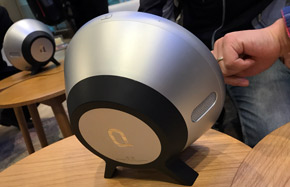
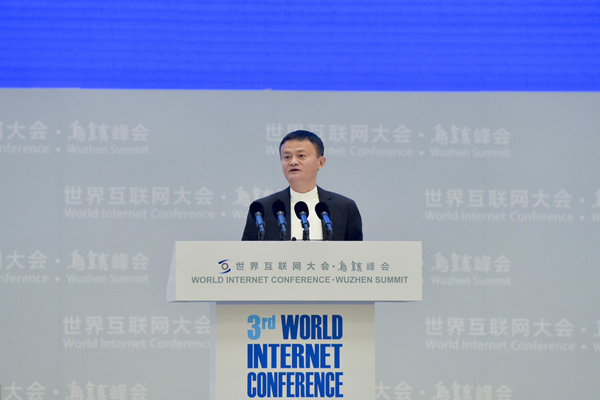
A visitor interacts with robots at the Third International Internet Forum in Wuzhen, Zhejiang province, on Nov 15, 2016. ZHU XINGXIN / CHINA DAILY |
After industrial robots, domestic machines for professional, personal use materialize as labor costs rise in China's aging society
Security officer AnBot, on patrol at the Shenzhen Bao'an International Airport, stands out from other security officers at the scene. They are tall-and cool. In contrast, AnBot is just 1.5 meters in height and portly, oval-shaped. But it's AnBot that attracts fliers' and others' attention. AnBot is no ordinary security officer. It is China's first "robot cop", pressed into service in August.
The smart machine can move on wheels at a maximum speed of 18 kilometers per hour. Equipped with four cameras, it can automatically map the best routes for itself to move, communicate with people, recognize and track faces. When its battery is about to die, it can find the nearest charging pile to recharge itself, which enables it to patrol nonstop for eight hours.
More importantly, in an emergency situation, human officers can remote-control the robot to disable or disarm a target. According to the Shenzhen Municipal Public Security Bureau, AnBot can patrol 24 hours a day and is of great help at the airport, which is short-staffed.
The smart machine, developed by China's top military academy, the National University of Defense Technology, is part of the country's broad efforts to develop service robots for both professional and personal use, amid the dual challenges of an aging society and rising labor costs.
"Though China became the biggest market for industrial robots as early as in 2013, its service robot industry is still at a very early stage," said Luo Jun, CEO of the Asian Manufacturing Association.
In 2014, 212,590 units of service robots were sold in China, accounting for less than 5 percent of the global market, according to the Shenzhen-based Forward Business Research Institute.
But that is changing rapidly, partly fueled by strong policy support from national and provincial governments, and rising demand from China's swelling middle class.
In April, the Ministry of Industry and Information Technology unveiled an ambitious plan to sell more than 30 billion yuan ($4.6 billion) worth of domestic service robots by 2020, to meet the demand from the healthcare, education, entertainment, medical and defense industries.
"If you ask me to describe the development of China's robotics industry in one word, I'd choose 'explosion'," said Zhao Jie, a professor of mechanical engineering at the Harbin Institute of Technology.
According to him, investments and talent are rushing into the industry, with the involvement of giants as well as startups. In line with the trend, the Harbin Institute of Technology's startup HIT Robot Group was launched in 2014, in partnership with the Heilongjiang provincial government.

The top-notch university has done years of cutting-edge research into robots. It is the maker of China's first space robots and lunar vehicle. One of its priorities now is to develop service robots for professional use, such as defense robots.
Some of its anti-terrorism robots, which can sniff out bombs, climb slopes, monitor environment and operate guns, have been exported to countries in the southern hemisphere already, an employee at HIT Robot said.
"Universities and enterprises are working closely on the research and development of robotics technology, which is pushing China's service robot industry forward," said Hao Yucheng, deputy director of the China Robot Industry Alliance.
According to him, the professional robot industry is investment-intensive, highly risky and generates slow returns. Any breakthrough demands long-term efforts. Shortsighted strategies will lead to failure, he said.
Zhejiang University, in association with Nanjiang Robotics, a startup that was set up in 2014, unveiled China's first four-legged robot Chitu that can jump and run at last fortnight's third World Internet Conference in Wuzhen, Zhejiang province.
The mid-sized, spider-like Chitu can walk upstairs step by step, just like human beings, and can carry a load of up to 50 kg.
"In future, Chitu can be used to carry goods in earthquake-stricken areas and outdoors where the roads are pretty bumpy," said Li Chao, a member of the research team who is from Zhejiang University.
A vacuum robot outsold TVs to emerge as the top-selling electronic appliance on Alibaba Group Holding's Tmall.com on Nov 11, China's annual Singles Day online shopping festival.
Online sales of DeeBot, the automated vacuum cleaner developed by Ecovacs Robotics Co Ltd, generated 200 million yuan ($29 mllion).
Such encouraging consumer response is pulling new players into the industry. Xiaomi Corp, which has evolved from a smartphone maker to a tech giant, unveiled an automated vacuum cleaner in September.
This "explosion" of service robots is spawning unlikely uses beyond households, in places like cemeteries. In central Henan province, a cemetery deployed a humanoid robot in October to escort female patrol guards on night duty, local media reported.
Winnie Tang, a founding member of Hong Kong Professionals and Senior Executives Association, an organization to promote communication between the Chinese mainland and Hong Kong, said in a column for South China Morning Post that there are three stages in the evolution of the service robots in China: tool, governor and companion.
"China is still at the "tool" stage, where robots are mainly used to do household chores. To progress, the country must enter the "governor" and "companion" stages, where the main objective is social interaction," she added.