|
|
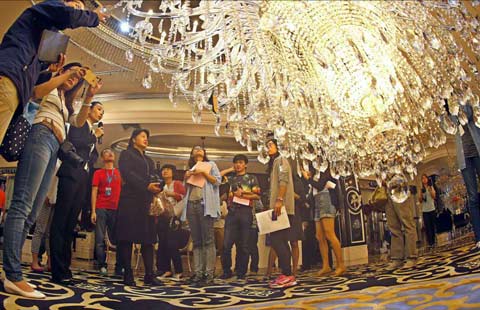
An exhibitor displays his company's battery recharging and power supply equipment at a digital prod-ucts expo in Beijing. A Qing / For China Daily |
Like many mobile phone users, I have only one cellphone, but keep three chargers handy. I put them in my home, my car and my office to ensure that my iPhone 6 Plus doesn't run out of power anytime, anywhere. If I go out for a meeting or an interview, a portable battery charger is a must-take item, more crucial than a notebook, a pen or a recorder.
Consumers, as well as phone and battery makers, electric-car producers, researchers, environmentalists, and policymakers, have been hoping for a faster, safer, cleaner, cheaper and more sustainable way of powering all the electronic equipment in our lives. Now, the advent of electric cars makes the need more urgent.
Any sign of a technology breakthrough in recharging technology or power supplies easily stirs market enthusiasm.
The recent market performance of Dongxu Optoelectronic Co Ltd, a Shenzhen-listed new materials producer, allows me to perceive the huge potential of the advanced battery market.
The company announced early last month that it has developed what it claims to be the world's first graphene-based lithium-ion battery, named G-KING. It enables a phone to be fully recharged in only 15 minutes, compared with the conventional six hours.
Backed by the graphene research center at Shanghai Jiaotong University, the company also launched a production line for its fast-charging battery in Taizhou, Jiangsu province.
Its share price has seen a sharp rise during the two weeks of July 11-22, growing 56 percent, or 14.17 yuan ($2.14) per share. It was 9.08 yuan per share on July 8, when it announced the launch of G-KING.
In just a little more than a month, the company's market value has grown 80 percent from 30 billion yuan on June 24 to 54 billion yuan on July 24, which has caught the attention of financial regulators. The Shenzhen Stock Exchange regulatory division ordered the company to suspend trading starting July 25 to check the reasons for sudden hike in its valuation - demanding evidence of its claimed technology, intellectual property rights and requiring verification by a third party.
After the clarification, the company resumed trading on July 27, with a high opening price of 14.64 yuan per share, closing at 13.43 yuan.
This case demonstrates the overheated demand for a better battery.
If the fast-charging problem could be solved, demand for plug-in hybrids and pure electric-powered cars would be dramatically spurred, regardless of whether the government provides an incentive subsidy.
The spread of electric cars is hindered by the lack of electric charging stations, the required hours needed to recharge, uncertainty about the battery's lifespan and the limited cruising range of about 250 kilometers.
In the new-energy vehicle arena, fast-charging has been achieved in electric fuel-cell cars, with the charging speed equaling that of conventional gas stations, at about 4-5 minutes per tank.
The fuel-cell powered Toyota Mirai car, priced at $58,000 in California, has been gaining popularity because a fuel-charging station network is being established. The sedan debuted early last year in Japan, before landing in the US and European markets. However, it is not available in China yet.
A blueprint was released in early August by the Ministry of Industry and Information Technology, giving the industry guidance on China's batteries. The ministry aims to support the research and application of new-energy vehicles driven by battery power and hopes to gather the best talent and technology.
China still faces a gap in battery R&D compared with Japan and South Korea, which are capable of producing batteries with 30-40 percent longer cruising range. China hopes to catch up by 2020, when the country plans to serve some 5 million e-cars by providing enough charging stations.
In April I wrote a piece about why I'm not buying an electric car. The immature charging network and battery quality best explain it. The biggest incentive that would lead me to consider an electric car would be 7-24 availability to run on the road in the capital city. The lucrative government subsidy also matters.
The technology and logistics are hard, but I see relentless efforts by both enterprises and the government to boost research and development and to commercialize a better battery. I hope the extra chargers I have will be useless someday because I'll be able to carry a portable charger that does the job in 15 minutes.


Copyright 1995 - . All rights reserved. The content (including but not limited to text, photo, multimedia information, etc) published in this site belongs to China Daily Information Co (CDIC). Without written authorization from CDIC, such content shall not be republished or used in any form. Note: Browsers with 1024*768 or higher resolution are suggested for this site.
License for publishing multimedia online 0108263 Registration Number: 130349