Self-driving cars must shift up a gear


 |
|
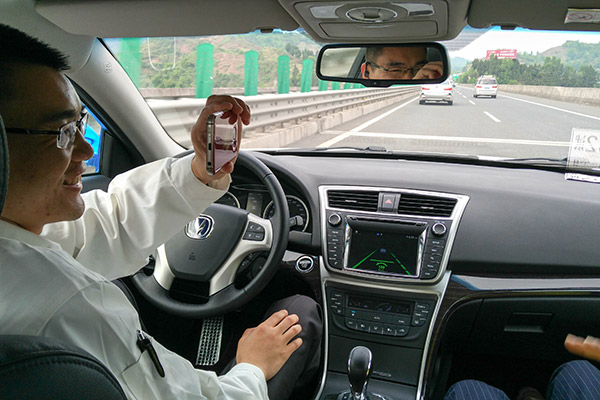
An autonomous car heads to Beijing from Chongqing in June last year. Equipped with multiple sensors, the car fully controls its own speed, braking and steering. [Photo/Xinhua] |
Commuters may dream of autonomous vehicles that relieve the hassle of driving, but the reality of urban centers means the technology still has a way to go
Jayson Au had been cruising hassle-free in his Tesla Model S. He had turned on Autopilot, the car's driver assist feature, and was feeling relaxed as he passed through Hong Kong's Cross-Harbour Tunnel to pick up his family after a trip to Macao.
Suddenly, he was snapped awake by the din of an alarm.
He had fallen sleep, and the alarm was going off because his hands had slipped from the steering wheel. He had no idea how long he had been asleep - possibly a couple of minutes.
"I felt lucky that Autopilot really did steer for me," said the Hong Kong real estate agent, recalling the incident later. "But I also think it was Autopilot that lowered my awareness and caused me to fall asleep."
Au bought the Model S after the Hong Kong Special Administration Region approved limited use of Tesla's Autopilot system on city roads last year.
He was not alone. More than 7,000 electric cars were registered with the city's transportation authority by the end of November. Seven years ago, it was fewer than 100. The rapid rise has been fueled, in part, by large tax breaks for drivers who go green with environmentally friendly vehicles.
Tesla made $1 billion from the Chinese market last year, about 15 percent of its global revenue, and continues to hold the No 1 spot in Hong Kong.
However, the response from drivers to the company's Autopilot function has been mixed.
Elon Musk, the CEO of Tesla, has said Autopilot is "50 percent safer than a human driver". Yet Hong Kong motorists believe it will take some time before the technology is able to handle the traffic in one of the most densely populated cities in the world, where streets are packed with other vehicles, and pedestrians can come out of nowhere.
 |
|
People experience Tesla's new product in 2015. The company has been developing autonomous cars in recent years. [Photo/Xinhua] |
Bend sinister
Hong Kong doesn't have black-and-white regulations for e-vehicles with autonomous driving functions. In the case of Tesla, only assisted steering, lane change and auto parking functions were cleared for use after an evaluation by the transportation authority. The Summon function, which navigates a car in or out of a parking space using remote control, is not allowed.
Most people disable Autopilot on urban streets. Drivers like Au have to wait until they are on highways or in tunnels before turning on the function - and even then Tesla cars require them to rest their hands on the steering wheel at all times.
"If your hands are off the steering wheel for too long, the Autopilot function will be suspended temporarily. It's like the system is punishing you," Au said.
Although Tesla has named its system Autopilot, the company states the system is only partially autonomous - there to assist drivers, not take over.
That was the explanation the company gave last year when a driver who had activated Autopilot died on a highway in Florida, the United States, after his car hit a truck. An investigation found the driver, Joshua Brown, 40, had been watching a Harry Potter movie at the time of the crash.
It was the first known fatality involving Tesla's Autopilot. In response, the automaker issued a statement that the accident was only the first after 209 million kilometers of Autopilot driving, compared with the US average of one fatality for every 151 million km for all types of vehicles.
After months of using Autopilot, Au does not trust the system entirely to drive hands-free, but he does believe it is useful.
"If you're always in the car, especially if you're driving for a long distance, you get tired easily," he said. "Driving through the Cross-Harbour Tunnel usually takes about a minute. During that time, I can relax my feet a little."
Au lives in a village in Sai Kung, about a 40-minute drive from Hong Kong Island, and the nature of his work as a realtor requires him to drive a lot.
"I usually turn on the Autopilot function when I'm in the tunnel, because you don't have to change lane and there are hardly any bends," he said. "But when I reach the end of the tunnel, when two lanes turn into more lanes, I'd suggest turning off Autopilot because the car can't seem to find the right lane and it sways about. I take over steering until it's in the lane I want."
China Daily recently took a spin with Au in his Model S. As he drove along the 3-km section of the Island Eastern Corridor expressway from Causeway Bay to North Point, he turned on Autopilot.
"Actually, I don't always use Autopilot here because there are quite a few bends. But let's try," he said, adding that his car does not usually steer well if there are too many bends, and sometimes he feels it gets too close to vehicles in the next lane.
On that day, however, the autonomous steering was doing OK. Au gave a signal to change to the right lane, and after about 5 seconds the car found a gap and steered over. The car was traveling at 70 km/h, and Autopilot was autonomously adjusting the distance from the car in front. Au could set the distance at a length of one, two or three cars.
"There's one major defect of the system right now," he said. "It doesn't recognize traffic lights. For example, say I'm at a crossroads and the traffic light is red - if there is no car in front, the car will just go ahead. That's a big no-no."
Still, he said he believes Autopilot is safer than human drivers, and that the technology will eventually mature and be able to take on the bustling streets of Hong Kong.
To err is human
As carmakers and tech companies vie to make better autonomous technology, there already are self-driving trucks and self-driving ride-hailing services.
On the Chinese mainland, internet giant Baidu is working with BMW to develop and test such technology, with testing grounds in Shanghai as well as cities in Anhui and Zhejiang provinces.
Testing self-driving technology under actual road conditions on the mainland is against the law, so companies like Baidu and LeEco have headed to California in the US for road tests.
At this stage, autonomous vehicles are still better suited to the open road than busy urban streets, according to Liu Ming, associate professor at the Robotics Institute at Hong Kong University of Science and Technology, who said none of the models currently on the market are advanced enough to replicate the lightning-quick reflexes and decision-making ability needed for urban driving.
"Technically, it's easier to drive on the highway in driverless mode than to drive at a comparatively low speed in an environment where there are pedestrians, motorbikes and bicycles in front of the car. For this kind of situation, at the moment, it's not easy for (autopilot technology) to deal with," he said.
That milestone requires the evolution of "perception technology", which allows autonomous vehicles to be aware of what is going on around them, he explained. Cameras, radar and lasers act as sensors to detect nearby objects, but judgment about what to do is handled by artificial intelligence.
But Liu said further advancements are needed, as perception technology for self-driving cars has not matured enough to be effective in complex driving environments.
"When a human driver sees the car in front randomly weaving left to right, probably he or she will guess that the driver ahead is drunk or exhausted. The following driver will likely exercise extreme caution," he said. "That extra caution can't be triggered just from direct recognition that there is a car nearby. That judgment comes more from experience, or from other higher levels of understanding in this context."
He predicted it will take four or five years for that kind of technology to mature in autonomous cars. It will entail gathering even more transportation data to improve the judgment of autopilot systems, making it closer to a human's decision-making ability.
On top of all that, the proportion of e-vehicles on the roads will have to be a lot higher before autonomous driving achieves a safe level. Liu cited the example of Hong Kong's complex subway network, the Mass Transit Railway.
Within that network, each train is supplied with data on what is happening with other trains and on the platforms, and other information to ensure the system is safe and efficient.
"If you have all the cars driving on the roads with shared knowledge about what other cars want to do, it'll be much safer," Liu added.
Au believes that driverless cars are the future. But, he said, "I also believe that in such a populous city, the autopilot technology has to be very solid."
Life in the automatic lane
Level 0
An automated system issues warnings, but has no vehicle control.
Level 1: hands-on
Driver and automated system share control of the vehicle, such as cruise control (driver controls steering, automated system controls speed) and assisted parking (automated steering, manual speed). The driver must be ready to retake full control at any time.
Level 2: hands-off
An automated system takes full control of accelerating, braking and steering. The driver must monitor and be prepared to intervene at any time. Hands-off should not be taken literally.
Level 3: eyes-off
The driver can safely turn their attention from driving; for example, they can text or watch a movie. The automated system will handle situations that call for an immediate response, although the driver should be prepared to intervene in a particular time, specified by the manufacturer, when prompted by the vehicle.
Level 4: mind-off
Same as Level 3, but no driver attention is ever required - they can safely go to sleep or leave the driver's seat. Self-driving is supported only in limited areas (geofenced) or under special circumstances, like traffic jams. Otherwise, the vehicle must be able to safely abort the trip, such as by parking, if the driver does not retake control.
Level 5: wheel optional
No human intervention is required at any time, like a robotic taxi.
Source: Sae International