

New energy vehicles await fuel injection
Updated: 2013-08-05 07:35 Comments()
  Print
Print  Mail
Mail  Large Medium Small
Craving for luxury
|
 |
|
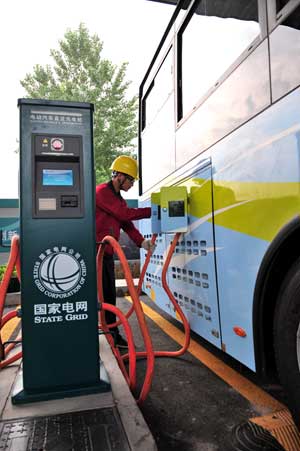
A worker charges an electric bus in Zibo, Shandong province. The city operates 20 of the vehicles. YUAN DELIANG / XINHUA |
Some industry experts said Chinese auto manufacturers have failed to develop their products in accordance with demand trends as outlined by market investigations.
For example, in large cities such as Beijing, Shanghai and Guangzhou, consumers are starting to buy their second or even third car, and most of them are embracing luxury brands such as BMW.
"The Chinese urban middle class has not yet satisfied its craving for luxury brands. It's hard for them to bypass this stage and head toward a green lifestyle, unless they drive electric cars produced by BMW," said Pang of Beijing EV Future Information Technology. "Although some white-collar workers who already have a car want to buy an electric vehicle, demand is not high enough to support mass production."
Pang argued that cities at prefecture-level or lower, where everyday activities take place within a radius of 50 kilometers and there is more space for parking, could be prime markets for electric vehicles.
Although motorists in smaller cities are anxious to buy cars, their budgets are limited and they have to minimize their running costs. Therefore, electric vehicles priced at less than 60,000 yuan would be an attractive option.
High-end users are also a potential market, similar to US motorists who own electric cars made by Tesla Motors Inc.
"For rich people who have plenty of time to do what they want, buying an electric car is like putting on a tag that says, 'I'm cool. I'm an environmentalist and a person with high social status,'" said Pang.
So far, no Chinese manufacturer has developed a new energy vehicle that targets high-end users. Only about a dozen electric vehicle models are available in the Chinese market, and some of them have not been on the road long enough to provide an accurate assessment of their capabilities.
Lack of charging facilities
| Gearing up for a move from the farmyard?
In 2012, Pang Yicheng, CEO of the industry information provider Beijing EV Future Information Technology Co, visited Shifeng Group, a manufacturer of agricultural trucks, tractors and diesel engines, based in Gaotang county, Shandong province. Pang was amazed by the size of the assembly lines for low-speed electric vehicles, which have a range of 100 km at an average speed of 50 to 60 km per hour. The company has an annual production capacity of 200,000 of these vehicles. "A top Shifeng executive told me, 'If large State-owned companies like SAIC Motor don't develop low-speed electric vehicles, they can still deliver a good performance. But if we don't, our company will die for sure,'" recalled Pang. However, China's development plan for fuel-efficient and new energy vehicles and the specifications for electric passenger cars means the central government does not count low-speed electric autos as new energy vehicles. Shifeng received strong support from the local government. In Shandong, the company's low-speed electric vehicles are allowed on roads that have speed limits of 60 to 80 km an hour. Purchasers can also apply for a temporary license plate that allows them to drive within the province. With a market price of about 30,000 yuan ($4,895), the vehicles have become increasingly popular among farmers. The electricity bill - less than 20 yuan a month - is also attractive to those who want to keep running costs low. "If we hope to see electric vehicles spreading quickly across China, we should take low-speed electric cars into consideration," said Zhang Junyi, principal at Roland Berger Strategy Consultants. "If this issue is handled well by the government, it will accelerate China's urbanization process and reinforce the trend toward electric transport. But we could see problems and even serious traffic accidents if low-speed electric vehicles are left in a gray area that lacks technical standards and government administration." |
The State Grid Corp of China built just 156 charging stations and battery-switching stations nationwide in 2011, plus 6,252 "charging poles", wall-mounted or freestanding electricity points, specifically designed for use by new energy vehicles.
In recent years, Shanghai Municipal Electric Power Co has built about 20 charging stations and erected 1,800 charging poles in the city, but the facilities are rarely used. Recognizing this fact, the company decided to change its strategy and so, to avoid wasting resources, it only erects charging poles in response to requests from drivers, according to Xu.
It's a chicken-and-egg scenario; if charging facilities are not readily available nationwide, the extensive use of electric vehicles will be impossible, said Roland Berger's Zhang, who urged grid companies and automakers to improve cooperation in this field.
Auto industry professionals also emphasized that the distribution of public charging facilities has a huge influence on the use of electric vehicles.
"If you buy an electric vehicle with a range of more than 100 km and live in a big city such as Beijing, you have to consider whether there is a charging station near the place you intend to visit," said Wang. "We hope that the upcoming central government policy will make it compulsory for newly built shopping malls and five-star hotels to have charging poles installed on their parking lots."
To encourage better infrastructure development, Pang suggested the government break up the power supply cartel operated by State-owned companies such as State Grid and China Southern Power Grid Co. That would allow a greater number of private companies to participate in the construction and operation of charging facilities.
The central government should also change the way it distributes subsidies. Instead of giving the money to auto manufacturers through local governments, the cash should be paid directly to the consumer, said Pang. This would prevent local authorities from only supporting local companies and would open up the market to fair competition.
"If the local government wants to stand firm in the promotion of new energy vehicles, it should invite open tenders for the supply of plug-in hybrids and electric cars, or even have a trial period for different models to see which is the most suitable for the city," said BYD's Wang.
Contact the writer at jiangxueqing@chinadaily.com.cn
Chen Hong and Zhang Yuchen also contributed to this story.
 IDEO
IDEO

|
|
|

|
 HOTO
HOTO

|

|

|

|
 EWS BY BRAND