Oded Shenkar
Updated: 2012-02-10 09:35
By Chen Weihua (China Daily)
|
|||||||||


|
Management expert Oded Shenkar says the most profitable innovations could be those containing a strong dose of imitation. [Provided to China Daily] |

Management professor and China specialist Oded Shenkar bids to change the public mindset
Innovation is undoubtedly the buzzword of our time. Everyone, from policymakers to business leaders and students, believes that only innovation can bring progress and profits. They despise the word imitation and relate it to losers who live off the crumbs by keen innovators.
But Oded Shenkar, the Ford Motor Co chair in global business management and professor at the Fisher College of Business of Ohio State University, believes such widespread public perception has been wrong for too long.
"Imitation is not only as critical as innovation to business survival and prosperity, but also vital to the effective exercise of innovation itself," Shenkar says.
He says imitation is the copying, replication, or repetition of an innovation or a pioneering entry. It can be a product, a process, a practice or a business model. That, of course, excludes piracy, counterfeits and other illegal forms of imitation.
Legendary companies, such as IBM, General Electric, Apple Inc, McDonald's and Coca-Cola, have all been engaging in imitations, but no one seems to acknowledge that fact.
"That is the major challenge. Companies take offense at the idea that they are imitators. These are companies which have been imitating but they just don't want to call it imitation because there is a stigma associated with this word," Shenkar says.
He says the unwillingness to use the word is a serious problem and obstacle. "If you are not willing to admit what you are engaging in is imitation, you are less likely to do it right," he says.
In his book Copycats: How Smart Companies Use Imitation to Gain a Strategic Edge, Shenkar writes that 34 of 48 innovations were imitated by the time they were studied, and the rate of brand imitation now exceeds 80 percent. The average time to widespread imitation declined from 23.1 years between 1877 and 1930 to 12 to 18 months by 1985. QQ, a Chinese copy of GM's minicar, hit the road within a year.
Contrary to public misperception that imitators are losers, a study covering 1948-2001 finds that innovators captured only 2.2 percent of the present value of their innovations; the rest, Shenkar assumes, went to imitators. He also cites another example that generics made up only 2 percent of the US prescription drug market in 1982, but 63 percent by 2007. Prozac, a blockbuster drug by Eli Lilly, lost some 80 percent of the market share in only two months.
"Indeed, negative stereotyping notwithstanding, many imitators do so well that it is the innovator that is left in the dust," he says.
To Shenkar, the success of many imitators comes as no surprise. With the innovators and pioneers paving the way and paying for it, the imitator enjoys a free ride. It saves not only on research and development, but also on marketing because customers have already been primed to use the novel product or service. Meanwhile, the imitator avoids dead ends, whether a losing bet on a dominant design, such as Sony's Betamax format, or an innovative prescription drug that proves not to work.
"With almost 90 percent of the drugs under development failing in the trial phase after a billion-dollar investment, the potential savings are enormous. Even though the innovator is granted a monopoly period during which it can try to recoup its investment, a fast follower enjoys a monopoly of its own," he says.
Shenkar extols the many attributes of imitation. "Because imitators do not incur the investment made by pioneer incumbent, imitators can tweak the original to fit shifting consumer tastes. Or they can leapfrog into the next technological generation, such as Samsung's leapfrog into the digital age because most productivity gains come not from the original innovation but from subsequent improvements, imitators are often better positioned to offer the customer something that is not only potentially better but also considerably cheaper, a critical factor in an era of thin margins . Because imitators often work from more than one model, they are constantly reminded that there is more than one way to go forward, a precursor to further imitation as well as to focused innovation.
"It should not come as a surprise that the most profitable innovations often are those containing a strong dose of imitation," he says.
Shenkar says that imitation is, or at least should be, part of any overarching strategy. He is surprised to find that quite a few capable imitators are also known as innovators, such as Wal-Mart, Apple, Procter & Gamble and GE.
Shenkar calls these firms "imovators", a word he has coined. "Imovators understand that imitation is not contradictory to, but rather supportive of, innovation. Imovators make a conscious decision about when to innovate and when to seek parity. Imovators build on the capability platforms shared by innovators and imitators. Imovators also know how to develop and leverage the distinct qualities associated with imitation," he says.
He has written in length about the challenges facing both imovators and imitators as well as the capabilities, processes and strategies required for them.
Shenkar, who taught at universities in China and wrote books on China, calls China the biggest imitator in the world. He believes some Chinese firms are creative imitators while some are pirates and some engage in blind imitation.
"China is in this phase of imitation. It needs to come out of this phase. The Chinese government is trying very hard to encourage innovation. But my message is that imitation is not less important than innovation. It is actually a mistake to forgo and neglect imitation capability at the same time these companies are trying to develop innovation capabilities. Both activities are very important," he says.
Statistics from the United Nations' World Intellectual Property Organization show that China's research and development investment jumped to 12.8 percent of the world's total in 2009, from 2.2 percent in 1993, trailing now only the United States.
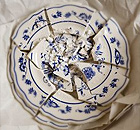
"China may have a better opportunity to become a genuine innovator. If one looks at history, there were way more innovations out of China than out of Japan," he says, citing China's invention of porcelain, which occurred hundreds of years before the Germans and British began making it.
"But again the message is that you want to become an innovator, you also want a good ability to be an imitator because as successful as China may be, there will always be many innovations coming out of different parts of the world. Therefore, if Chinese companies will forgo their ability to imitate, they may be at a disadvantage," Shenkar says.
That said, Shenkar admits that he is not sure that he will succeed in convincing the public not to be shy about imitation. "It is not an easy challenge because people have associated imitation as a bad thing. It's very difficult to change this mindset. I am determined to try and I hope we will be successful eventually," he says.