Economic growth target can be achieved as stabilizing signs have emerged, Kim says
China is on the right track to push for economic reforms and tackle environmental pollution, and the World Bank will fully support the nation by providing solutions, World Bank President Jim Yong Kim said on Sunday.
 |
|
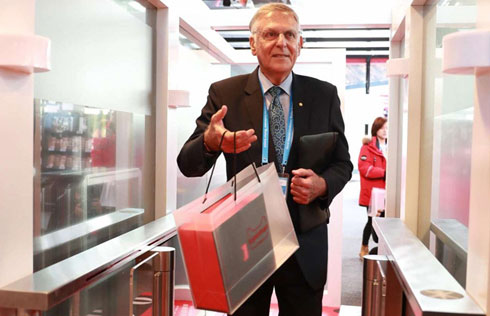
World Bank President Jim Yong Kim (right) learns about the design of a green building in Shanghai on Sunday. He began a four-day trip to China to promote low-carbon development. Wu Zhiyi / China DAILY |
"It's encouraging that, despite growth having slowed, the Chinese government sticks to the reforms ... and has a strong commitment to tackling the pollution problem," Kim told China Daily in Shanghai, the first stop of his four-day China visit starting on Sunday, and also the city where the World Bank has low-carbon emission projects.
"The Chinese government is doing the right thing," Kim said.
"China has a vision of the future that we want to have quality growth that is more driven by consumption and services, and one that is cleaner and more livable."
He also said China is likely to achieve its growth target of 7.5 percent this year amid signs of a stabilizing economy.
In the past few months, China has vowed to transform its economy by advancing reforms and addressing air pollution after thick and hazardous smog engulfed much of industrial north China, including Beijing.
This year, the nation has launched a series of measures to reduce carbon emissions and develop the renewable energy industry.
Last week, China announced measures to tackle air pollution, with plans to close old polluting steel mills, cement factories and aluminum smelters, slash coal consumption and boost the use of nuclear power and natural gas, marking the nation's strong commitment to halt air pollution.
"Climate change is a real and present danger which can set back years of development progress, hitting the poor hardest. China is a vital partner in tackling this challenge," Kim said.
"I am here, at least in part, to pledge the full support in helping tackle the pollution issue," he added.
The World Bank is working with China on a broad climate change agenda, including promoting clean energy, reducing traffic jams and air pollution, and improving flood risk management.
This is the second time Kim has visited China as the head of the World Bank and the visit is mainly focused on carbon emission reductions and China's urbanization push. He will meet with Premier Li Keqiang, a strong advocate of urbanization, and witness the signing of a memorandum on climate change with the Chinese government.
Last year, China and the World Bank signed an agreement on launching an urbanization report, which covered issues including environmental protection and is expected to be launched in December, Kim said.
China vows to push forward urbanization, and an estimated 300 million people may move to urban areas over the next 20 years.
Pan Jiahua, director of the Institute of Urban and Environment Studies of the Chinese Academy of Social Sciences, said urbanization is more than the expansion of city size and should feature highly efficient, green and low-carbon development.
Lu Dadao, an academic at the Chinese Academy of Sciences, said green urbanization is not an option, but "imperative" in China.
China's annual economic growth slowed to 7.5 percent in the second quarter, down from 7.7 percent during the January-March period.
Despite the slowdown, the government has been persistent in advancing reforms including financial and fiscal reforms and social programs, saying it is high time to implement the transformation.
"Achieving sustainable and clean growth is a big part of the goal. It links directly to a fundamental challenge in our fight against poverty — climate change," Kim said.
But it's not easy to strike a balance between growth and environment, he said.
China is the "largest contributor" to global greenhouse gas emissions by volume, accounting for almost 30 percent of global emissions, he said.
To tackle environmental problems, China is committed to reducing its carbon emissions per unit of GDP by 40 to 45 percent by 2020 from 2005 levels and is aiming to increase renewable energy to 15 percent of its total energy consumption by 2020 from 8 percent in 2011.
Forum: What can China learn from other countries in terms of air pollution?


Copyright 1995 - . All rights reserved. The content (including but not limited to text, photo, multimedia information, etc) published in this site belongs to China Daily Information Co (CDIC). Without written authorization from CDIC, such content shall not be republished or used in any form. Note: Browsers with 1024*768 or higher resolution are suggested for this site.
License for publishing multimedia online 0108263 Registration Number: 130349