|
 |
|
Heavy smog covers Nanjing, the capital of Jiangsu province, on the morning of June 10. [Photo/China Daily] |
He Kebin, a professor of environmental science and engineering at Tsinghua University who took part in the formulation of the PM2.5 standard, said the current monitoring sites were selected after strict scientific assessment.
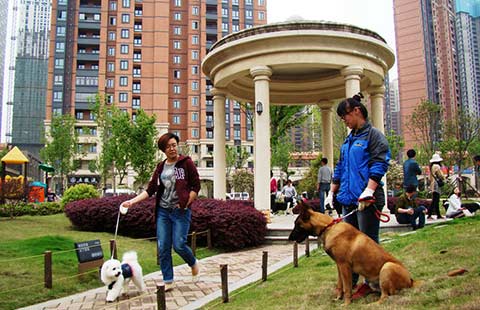
"The concentration of PM10, or particulate matter less than 10 micrometers in diameter, in schools and parks is no lower than in other urban areas," said He, pointing out that as the air circulates, pollutants from major traffic arteries and other sources tend to saturate a given area and thus affect the overall air quality. So monitoring sites in parks and school areas may indeed offer an accurate reflection of the general situation.
According to China's air-quality monitoring standard, released in 2007, monitoring stations should be sited to avoid direct interference from vehicle exhaust and other sources. For example, if a street has a traffic flow of more than 40,000 vehicles per day, the minimum distance between a PM10 testing site and the street should be 150 meters.
And there are strict regulations in force concerning the height at which monitoring stations are erected. If the station is ground-based, the pumps must be raised by 3 to 15 meters, while on stations erected on the roof of a building the pumps must not be set lower than 1.5 meters. That's to ensure a steady flow of air circulating around the station. "If the air is like stagnant water and there's no exchange with the surrounding areas, there is no point in conducting the examination," said Wei Qiang, a Beijing Municipal Environmental Monitoring Center employee who has been working with the monitoring devices for 13 years.
"In other countries, monitoring sites set up close to the street are not used to evaluate the city's air quality," said He from Tsinghua University, who explained that sites close to roads are usually used to evaluate the effects of traffic pollution sources on air quality and that the distance between a monitoring site and a road or other sources varies according to the site's function.
"Usually in the United States, the monitors are close to where people live, but are sited away from sources such as busy streets and factories," said Robert A. Harley, professor of environmental engineering at the University of California at Berkeley. "In my opinion, it's OK to site in parks and schools, as long as the sites include city centers, rather than just quiet locations far away in the countryside."
The major sources of PM2.5 are motor vehicles and other combustion sources, such as coal-fired plants, and secondary aerosols that comprise particles and, sometimes, liquid droplets combined with the gas. These are formed by photochemical reaction and are usually referred to as smog particles. The contribution from vehicles will obviously be highest near busy roads, according to Richard L. Corsi, a professor at the Department of Civil, Architectural & Environmental Engineering at the University of Texas at Austin.
Corsi said there are plenty of coal-burning sources in the suburbs of Beijing and that generally the highest concentrations of particulates will be found downwind of the urban core. "Given this, I believe it's important to collect samples from a wide range of locations," he said. "In the US, many schools are close to busy roads and so it's not a bad idea to collect samples near those schools."
Collecting samples at nature reserves, far removed from autos or other combustion sources, can probably provide good data on background concentrations, primarily reflective of smog particles if the reserves are situated downwind of the main urban area. This would allow a direct comparison with samples collected close to roads, according to Corsi.
"As an outside observer, I am actually impressed with China's moves toward improved environmental quality and suspect that over the next decade these standards will become more stringent," said Corsi. "China is basically going through the steps that the US went through starting in the early 1970s, but is doing so at a more rapid rate than we did. My hope is that government officials and scientists in China have benefited from the research done in the United States, and that this helps China as it moves forward."


Copyright 1995 - . All rights reserved. The content (including but not limited to text, photo, multimedia information, etc) published in this site belongs to China Daily Information Co (CDIC). Without written authorization from CDIC, such content shall not be republished or used in any form. Note: Browsers with 1024*768 or higher resolution are suggested for this site.
License for publishing multimedia online 0108263 Registration Number: 130349